



Use Wozber and land your dream job
Create Resume
No registration required
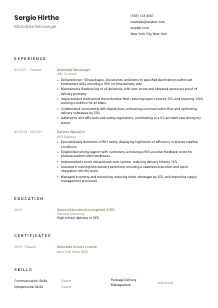
Zipping through traffic, but your resume feels stuck in neutral? Ride alongside this Motorbike Messenger resume example, created with Wozber free resume builder. Learn how to throttle your delivery skills to match job expectations, steering your career down success-filled express lanes!
Motorbike messenger hiring moves quickly because the work leaves little room for missed handoffs, vague route knowledge, or poor road judgment. A resume for this role needs to show that you can handle daily delivery volume, stay accurate under time pressure, and keep both the bike and the paperwork in order while working through busy city streets.
Resume tailoring makes that operational picture easier to read right away, especially when dispatch-heavy employers screen for specific terms such as proof of delivery, route efficiency, and license status. Wozber's free resume builder helps you shape an ATS-compliant resume around those details so hiring teams can quickly see whether your background matches the pace, safety standards, and communication demands of the job.
For motorbike messenger roles, the contact section needs to do one practical job well: confirm that you are reachable, professionally presented, and, when relevant, already based where the deliveries happen. Keep it clean and specific so nothing slows down the first review.
Use your full name in a larger, easy-to-read font at the top of the page. For a job built around speed and clear handoffs, the resume should open the same way. Skip nicknames unless they are the name you use professionally with dispatchers, clients, and employers.
Place "Motorbike Messenger" directly below your name when that matches the role you are pursuing. This helps recruiters and ATS tools connect your resume to the position immediately. If your most recent title was something close, such as "Delivery Specialist," you can still align the headline to the target role when your experience clearly supports it.
Include a working phone number and a professional email address, then check them carefully. In a role where timing matters, an employer should be able to reach you without friction. If you respond quickly to calls or texts for shift coordination, make sure the number listed is the one you actually monitor.
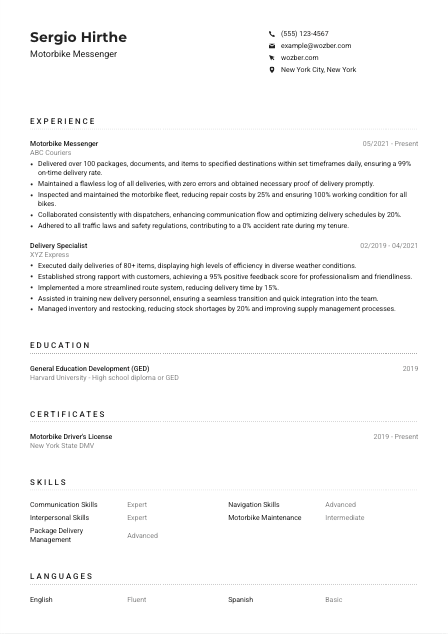
If the posting requires local availability, list your city and state clearly. In the example, "New York City, New York" answers a stated requirement right away. Use this approach when location affects route familiarity, start times, or eligibility for the role.
Include a website or profile only if it adds something useful, such as professional background, delivery work history, or endorsements. For most motorbike messenger applicants, this section works best when it stays lean. A polished link can help, but only if the information supports the same reliability and professionalism shown in the resume.
This section should confirm the basics without distraction. When your name, title, contact information, and location are clear, the employer can move straight to the parts that prove you can deliver safely and on time.




Experience carries the most weight in motorbike messenger hiring because it shows whether you have already worked under delivery deadlines, road constraints, and customer-facing pressure. Focus less on general busyness and more on what you delivered, how consistently you did it, and how well you managed accuracy, safety, and coordination.
Start by marking the operational requirements in the job ad: timely deliveries, navigation in high-traffic areas, delivery logs, proof of delivery, bike upkeep, dispatcher communication, and traffic-law compliance. Then shape your experience bullets around the parts you have actually done. That makes your work history read like a direct answer to the employer's day-to-day needs.
List your jobs in reverse chronological order and make sure delivery-focused titles are easy to spot. Roles such as "Motorbike Messenger" or related courier and delivery positions should carry the most detail. If an earlier job was not messenger work, keep it shorter unless it involved route management, customer interaction, or time-sensitive transport.
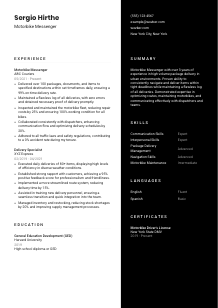
Each bullet should show a real task and a measurable result. Strong examples in this field include packages delivered per day, on-time rate, proof-of-delivery accuracy, route improvements, customer feedback, or accident-free performance. The sample resume does this well with lines like "99% on-time delivery rate" and "zero errors" in delivery logs, both of which are highly relevant to messenger work.
Metrics matter when they reflect how the work is actually judged. Delivery volume, turnaround time, repair cost reduction, route efficiency, and safety records all belong here. For instance, saying you reduced repair costs by 25% or improved scheduling efficiency by 20% tells the employer that you contributed beyond simply completing runs.
Keep the section centered on courier performance, road reliability, client interaction, and coordination with dispatch. Remove older accomplishments that do not support those themes. A hiring manager looking for a messenger wants to see urban delivery execution, not a long list of unrelated tasks.
By the end of this section, the reader should understand your delivery pace, your consistency, and how you operate on the road. The clearest resumes show that you can move items quickly, document each handoff properly, and stay dependable in real traffic conditions.
Education usually plays a supporting role in motorbike messenger hiring, but it still needs to be handled accurately. Most postings ask for a high school diploma or GED, so your task is to confirm that requirement clearly and keep the section straightforward.
If the job asks for a high school diploma or GED, list that exact qualification in your education section. This is especially useful for ATS matching and for fast screening. In the example, the candidate includes a GED, which directly answers the stated requirement.
Present the credential, field if relevant, school or institution, and graduation year or date. A clean structure keeps this section easy to scan. Motorbike messenger roles are not won on academic detail, so the format should be direct and readable.
When your credential genuinely aligns with the posting language, use wording that closely reflects it. If you have a GED, say GED. If you have a high school diploma, say that. Precision helps both ATS systems and human reviewers confirm that the requirement is met without extra interpretation.
Additional coursework can help if it relates to customer service, vehicle safety, basic maintenance, logistics, or local navigation. Keep it selective. One relevant line is more useful than a crowded list of unrelated classes.
If you are early in your career and need more substance, a brief mention of activities that reflect stamina, reliability, or teamwork can help. Keep the connection practical. For experienced messengers, work history and license credentials will matter far more than school-era details.
This section only needs to settle the qualification question and support the rest of your resume. Once that is clear, your delivery record, safety habits, and route performance should take over.
For a motorbike messenger, certificates are not decorative. They show legal eligibility to ride, current qualifications, and, in some cases, added safety preparation. Put the required credential first, then add any training that strengthens your ability to work efficiently on the road.
Your motorbike driver's license belongs at the top of this section because it is essential for the role. If local permits or endorsements apply in your area, include those too. The example lists a New York State motorbike driver's license, which directly supports the job requirement.
After the required license, include certifications that make practical sense for delivery work, such as defensive riding, road safety, first aid, or vehicle maintenance basics. These help show that you can operate responsibly in traffic and handle day-to-day issues that affect delivery continuity.
List the issue date and, when relevant, the expiration date or "Present" status. Employers need to know whether the credential is active. An outdated license or unclear status creates avoidable doubt for a role that depends on immediate road readiness.
Recent training can strengthen your profile, especially if you are targeting dense urban delivery work. Refresher courses in safety, local compliance, or advanced riding suggest that you take the operational side of the job seriously and stay current with expectations.
A hiring team should be able to glance here and know that you are properly licensed and prepared to ride. When the essentials are current and relevant, the rest of your resume carries more credibility.
The skills section should reflect how the work actually gets done. For motorbike messengers, that means balancing road awareness, delivery accuracy, communication with dispatch, and basic bike care. Keep the list tied to the job, not padded with vague strengths.
Start with the posting and extract the skills that define performance in the role. Here, that includes communication, interpersonal ability, navigation in heavy traffic, delivery handling, and motorbike maintenance. Wording that matches the employer's language helps with ATS optimization as long as the skills reflect real experience.
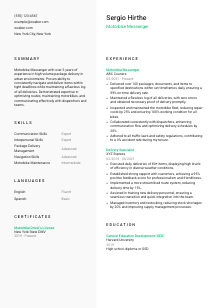
Lead with the abilities that affect daily execution, such as route navigation, on-time delivery management, dispatcher communication, proof-of-delivery handling, and traffic-law awareness. In the example, communication skills, package delivery management, navigation, and motorbike maintenance form a practical mix that aligns well with the role.
Organize your skills so they are easy to scan. You might separate them into delivery operations, communication, and technical or maintenance skills. That structure helps a recruiter quickly understand whether you can handle the road, the handoff, and the coordination side of the work.
Every skill listed here should support something you could reasonably be asked to do on shift. If the section reflects real messenger tasks, it will strengthen both ATS matching and the hiring manager's confidence in your day-to-day capability.
Language matters in messenger work because instructions, address confirmations, handoff questions, and dispatcher updates all depend on being understood quickly. List languages in a way that makes your working communication level immediately clear.
If the job requires professional English, list English prominently with an honest proficiency level such as "Fluent" or "Native." This tells the employer you can handle client interactions, delivery confirmations, and dispatcher communication without confusion.
Additional languages can be useful when your routes involve varied neighborhoods, customer-facing exchanges, or delivery coordination across different communities. The sample includes basic Spanish, which may be helpful in some markets, though it is an added asset rather than a universal requirement.
Choose standard levels such as "Fluent," "Intermediate," or "Basic." Avoid inflated claims. In a role where a missed word can lead to a missed delivery, accuracy matters more than impressiveness.
Language skills are most persuasive when they support actual work situations, such as confirming drop-off details, speaking with reception staff, or clarifying a rerouted stop. Keep the focus on communication that improves service and reduces friction on the route.
If you regularly use another language on deliveries and your level improves, revise the section. Even modest gains can matter when they help with customer interaction or smoother handoffs in a busy urban setting.
This section should quickly show whether you can handle the language demands of the route and the client interaction that comes with it. Clear proficiency levels do that better than broad claims.
The summary sits at the top of the resume, so it should immediately establish your delivery background, working environment, and strongest operational strengths. For motorbike messenger roles, that usually means experience level, urban delivery pace, route efficiency, communication, and record-keeping accuracy.
Before writing, identify the few requirements that define success in the role. Here, those include timely deliveries, navigation in high-traffic areas, communication with dispatch and clients, delivery logging, and safe riding. Your summary should bring those themes together in a compact opening snapshot.
Start with your title and years of experience, then anchor it in the kind of delivery environment you know best. The sample summary does this effectively with "over 3 years of experience in high-volume package delivery in urban environments," which gives both tenure and operating context in one line.
Follow the opening with two or three specifics that map to the role, such as route optimization, on-time performance, proof-of-delivery accuracy, customer communication, or motorbike upkeep. Choose the strengths that are most supported by your work history rather than trying to cover everything.
Aim for three to five lines with clear language and no filler. This is not the place for broad personal traits or generic enthusiasm. A concise summary that mentions delivery volume, deadlines, urban navigation, and coordination reads much stronger for this profession.
A focused summary gives the employer a fast read on the kind of messenger you are and the conditions you can handle. When it matches the role closely, the rest of the resume lands with more context and credibility.
A well-tailored motorbike messenger resume should now show the essentials clearly: delivery pace, route judgment, proof-of-delivery accuracy, safe riding habits, and reliable coordination with dispatch and customers.
Use Wozber's free resume builder, ATS-friendly resume template, and ATS resume scanner to sharpen wording, align your background with the posting, and keep the final document easy to process in an ATS-friendly resume format. The result should make one thing clear fast: you are ready to handle the route.




