



Use Wozber and land your dream job
Create Resume
No registration required
Nurturing toddler talents, but your resume feels more like coloring outside the lines? Crayon in the details with this Preschool Assistant Teacher resume example, created with Wozber free resume builder. Learn how to blend your classroom charisma with job criteria, setting your career journey as bright as a finger-painted masterpiece!
Preschool Assistant Teacher hiring often turns on a very practical question: can you support a calm, safe, engaging classroom day after day? Schools look for candidates who can help deliver age-appropriate activities, redirect behavior with patience, and keep children secure during transitions, playtime, and parent handoff. Your resume should make that classroom reliability visible, not bury it under broad statements about loving children.
A tailored resume also helps hiring teams quickly separate general childcare experience from true preschool classroom support. When you mirror the language of lesson planning, child development, parent communication, and safety supervision, Wozber's free resume builder can help shape an ATS-compliant resume that surfaces the right terms and structure. That makes it easier for a school to recognize where you have already contributed to learning routines, child progress, and a well-run classroom.
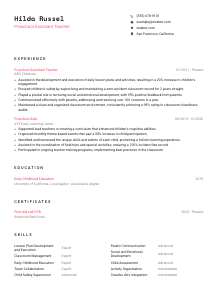
This section is simple, but it still affects how smoothly your application moves. For preschool roles, hiring teams want clear contact information, a matching job title, and location details that remove avoidable questions before they even reach your classroom experience.
Use your full name in a clean, readable font and give it enough space to stand out. In school hiring, clarity matters. A polished header suggests the same care you bring to attendance sheets, parent notes, and classroom organization.
Write "Preschool Assistant Teacher" directly below your name if that is the role you are pursuing. This helps the employer immediately connect your application to the opening and signals that your background is centered on early childhood classroom support rather than general tutoring, nannying, or daycare work.
Add a phone number you answer regularly and a professional email address based on your name. Accuracy matters here. If a center wants to schedule an interview quickly, missing a digit or using an outdated email can cost you the opportunity before your experience is even reviewed.
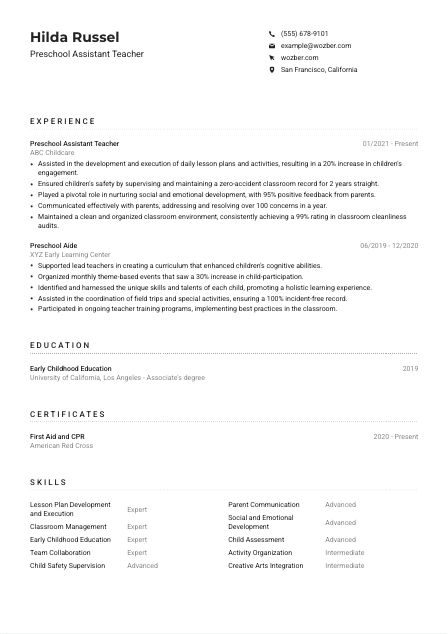
If an employer asks for candidates in a specific area or those willing to relocate, show that clearly in your header. In the example, listing San Francisco, California directly supports the posting's location requirement and removes a common screening concern. You do not need to include a full street address. City and state are usually enough.
A LinkedIn profile or portfolio link can reinforce your experience if it is current and consistent with your resume. For a Preschool Assistant Teacher, that might mean matching job titles, dates, certifications, and education. If the profile is sparse or outdated, leave it off rather than create conflicting information.
Your header should answer the practical basics fast: who you are, what role you want, how to reach you, and whether location is aligned. That allows the reader to move straight into the classroom experience that matters most.




This is where schools decide whether you can step into the rhythm of a preschool day and be useful from week one. Hiring teams look for concrete work with lesson support, supervision, classroom routines, child development, and parent communication, not just time spent around children.
Before rewriting your bullets, identify the recurring needs in the posting. Here, the priorities are assisting with lesson plans, supervising children indoors and outdoors, supporting social, emotional, and cognitive development, communicating with parents, and maintaining a safe, organized classroom. Those should guide which accomplishments you feature and how you phrase them.
Start with your most recent preschool or early childhood role and work backward. That format helps employers see your current classroom scope first, including the age group you supported, the setting, and how recently you handled daily routines, transitions, and behavior support.
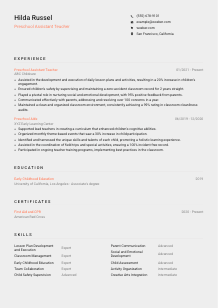
Each bullet should show a clear contribution to the classroom. Focus on actions such as supporting daily activity plans, helping children participate, reinforcing developmental goals, coordinating routines, or communicating with families. The example does this well by showing direct classroom work instead of vague claims, including support with lesson plans and parent communication.
Metrics make your experience easier to trust when they fit the work naturally. In early childhood settings, that can include engagement rates, parent satisfaction, incident-free supervision, participation in activities, or classroom audit scores. The sample resume uses figures like a 20% increase in engagement, more than 100 parent concerns resolved, and a zero-accident record to give hiring teams a clearer picture of day-to-day impact.
Prioritize experience that connects directly to preschool operations. If you have other roles, keep only the parts that show transferable strengths such as child supervision, family communication, activity coordination, or classroom support. A hiring manager should not have to search through unrelated duties to find proof that you can support a lead teacher and keep children safe and engaged.
Your experience section should leave no doubt that you can support instruction, manage daily routines, and contribute to a safe learning environment. When the bullets are specific, schools can picture you in the room with children, teachers, and parents.
For preschool hiring, education is usually checked quickly but taken seriously. Schools want to see whether your training aligns with child development, classroom practice, and the age group they serve, especially when the posting names a required degree or related field.
If the posting asks for an Associate's degree in Early Childhood Education or a related field, place that information clearly in your education entry. The example does this directly with an Associate's degree in Early Childhood Education, which immediately answers a core requirement.
List your degree, field of study, school, and graduation year in a clean order. Hiring teams are usually scanning for qualification match, not a detailed academic narrative, so keep this section easy to read and easy to verify.
When your education closely matches the role, make sure the field is impossible to miss. Early Childhood Education, Child Development, or a closely related program adds stronger context than a degree title alone because it points to training in developmentally appropriate practice and classroom support.
This is especially useful if you are earlier in your career or your experience is still growing. Include coursework tied to child development, curriculum planning, behavior guidance, inclusive learning, or health and safety if it helps explain your preparation for preschool work.
If you have academic honors, child development club involvement, practicum work, or volunteer experiences connected to early learning, include them when they add substance. Keep the focus on details that reinforce your readiness for a preschool classroom rather than general campus involvement.
Your education section should confirm that your training supports the work described in the posting. For preschool roles, that means making child development and early education credentials easy to spot in seconds.
Certifications matter in preschool settings because they connect directly to child safety and classroom responsibility. A current First Aid and CPR credential tells employers you are prepared to respond in situations where fast, calm action matters.
When a job description specifically asks for First Aid and CPR certification, list it clearly and use the wording that reflects the required population coverage when applicable. In this case, Infant, Child, and Adult CPR and First Aid are directly relevant to preschool supervision and care.
Only include certifications that strengthen your application for early childhood work. Safety training, child development credentials, or classroom-related professional development belong here. Unrelated certificates can distract from the qualifications schools are trying to confirm.
Dates matter for certifications that expire or require renewal. The sample resume includes "2020 - Present," which quickly suggests that the credential is active. That is useful for hiring teams that need to confirm compliance before a candidate enters the classroom.
If you complete workshops in behavior guidance, inclusive education, mandated reporting, or age-specific classroom practices, update this section. Preschool settings often value candidates who keep current with safety standards and developmentally appropriate teaching methods.
This section should reassure an employer that you are prepared for the safety and care expectations of the role. Current, relevant credentials strengthen your case quickly, especially in child-focused environments.
A preschool skills section should reflect how the day actually runs. Hiring teams look for classroom support skills they can connect to lesson delivery, child supervision, developmental support, and communication with families and staff.
Start with the capabilities the employer actually named, then add closely related strengths you can back up with experience. In this posting, that includes lesson plan implementation, communication with children and parents, child supervision, classroom organization, and support for social, emotional, and cognitive development.
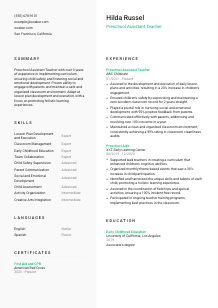
Choose skill phrases that sound like the work itself. "Classroom Management," "Child Safety Supervision," "Parent Communication," and "Lesson Plan Development and Execution" are stronger than broad labels like "people skills" or "team player." The sample resume uses this kind of direct phrasing well.
Organize your skills into a logical mix of classroom instruction, child development, safety, and collaboration. That makes it easier for a director or lead teacher to spot where you can contribute, whether they are focused on behavior support, activity execution, or family communication.
Your skills section should read like a practical match for preschool operations. When the language is specific and supported elsewhere in the resume, it strengthens both ATS alignment and human review.
Language ability matters in preschool settings because communication happens constantly and in different forms. You may be speaking with children at their developmental level, updating parents at pickup, or coordinating with teachers during a busy classroom transition.
If the role requires you to function effectively in an English-speaking environment, list English clearly and include your proficiency level. This addresses a stated requirement and reassures the employer that you can handle classroom instructions, parent updates, and team communication without friction.
Additional languages can be a real advantage in early childhood settings, especially in diverse communities. The sample resume lists Spanish as fluent, which could help with parent conversations and a more inclusive classroom environment. That said, extra languages are a bonus unless the posting specifically requires them.
Use clear labels such as Native, Fluent, Intermediate, or Basic so employers know what level of communication to expect. Honest language ratings are especially important in school settings where misunderstandings can affect children, families, and staff coordination.
List languages that help you communicate with families, support multilingual children, or contribute to a welcoming classroom culture. Relevance matters more than volume. Two accurately stated languages are more useful than a long list with unclear proficiency.
For preschool roles, language skills are most valuable when they improve connection and communication. Frame them as part of your ability to support children and families, not just as a personal extra. That makes the section feel grounded in the job.
Language skills can strengthen your application when they clearly support classroom interaction and parent engagement. Keep the section honest, relevant, and tied to the communication demands of preschool work.
The summary sets the tone for the rest of the resume. For a Preschool Assistant Teacher, it should quickly show your classroom experience, your comfort with child safety and development, and the kind of support you provide to lead teachers, children, and families.
Review the posting and identify the few themes that matter most. Here, those are preschool experience, lesson plan support, child safety, developmental guidance, and parent communication. Your summary should reflect those priorities in plain, specific language rather than general enthusiasm.
Start with a direct introduction such as "Preschool Assistant Teacher with over 3 years of experience" if that is accurate for you. The sample resume uses this approach effectively, immediately establishing both role identity and experience level.
Include strengths that matter in the classroom, such as implementing curriculum, maintaining a safe environment, supporting social and emotional growth, or helping run organized routines. Choose points that are also supported by your experience bullets so the summary feels credible and consistent.
Aim for 3 to 5 sentences. That is enough space to present your background, your core classroom strengths, and one clear area of contribution without repeating the whole resume. A hiring manager should finish the summary with a clear sense of the age-group setting you support and the value you bring to the classroom.
Your summary should quickly answer the question, "What kind of Preschool Assistant Teacher is this candidate?" When it is specific and role-aligned, it gives the rest of the resume a stronger frame.
A Preschool Assistant Teacher resume works best when it shows how you support learning, protect children, communicate with families, and keep the classroom organized. Once those points are clear across your experience, skills, certifications, and summary, your application becomes much easier to trust.
Use Wozber's free resume builder to organize your content in an ATS-friendly resume format, strengthen job-specific wording, and improve ATS optimization with more accurate preschool terminology. The finished resume should make it easy for a school to see that you can step into the classroom and contribute right away.




