



Use Wozber and land your dream job
Create Resume
No registration required
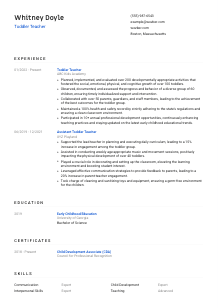
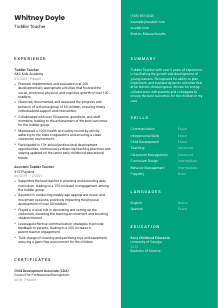
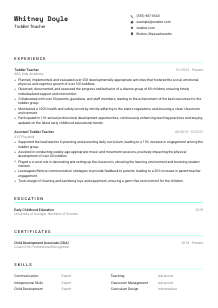
Guiding giggles, but your resume feels like napping? Check out this Toddler Teacher resume example, created with Wozber free resume builder. It shows how to present your playtime prowess to match job standards, ensuring your career journey is as animated as the stories you read aloud!
Toddler teaching is practical, observant work. Schools look for educators who can build a calm routine, guide early social and language development, respond to behavior in age-appropriate ways, and keep the classroom safe while thirty small details compete for attention. Your resume should make that daily judgment visible, not just list that you enjoy working with children.
When your resume is tailored to the posting, the hiring team can quickly see whether your background matches the age group, classroom setting, and developmental responsibilities they need covered first. Wozber's free resume builder helps shape that into an ATS-compliant resume by aligning your wording with the posting's language, so your experience reads clearly as toddler-focused teaching rather than general childcare.
For a Toddler Teacher, the top of the resume should feel straightforward and dependable. Hiring teams want to know who you are, how to reach you, and whether you meet any immediate practical requirements before they move into your classroom experience.
Place your full name prominently at the top in a clean, readable font. In school hiring, resumes are often reviewed alongside certifications, references, and interview notes, so your name should be easy to spot at a glance.
Write "Toddler Teacher" under your name if that is the role you are pursuing. This immediately frames your background around toddler classrooms, developmental activities, parent communication, and early learning support instead of leaving the reader to guess whether your experience is broader daycare work or K-12 teaching.
List a phone number you answer reliably and a professional email address, ideally a simple variation of your name. Schools move quickly when setting up interviews, working interviews, or reference checks, so accuracy here matters more than style.
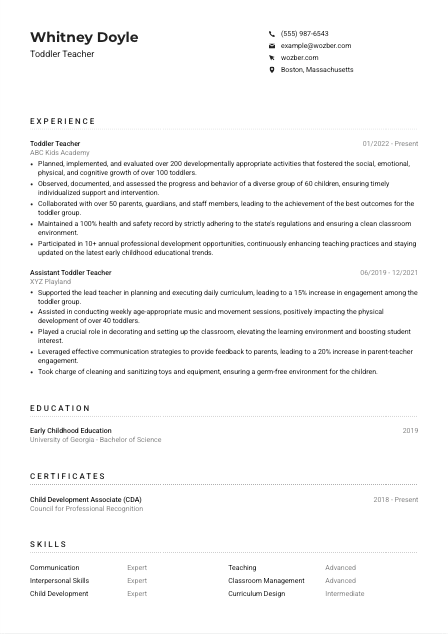
If the posting specifies a city or state, include your location so employers can confirm that practical requirement immediately. In this example, listing Boston, Massachusetts directly addresses the employer's stated need and removes questions about relocation timing.
Include LinkedIn or a professional profile only if it supports your application with consistent experience, credentials, or recommendations. For early childhood roles, that profile should reinforce classroom work, certifications, and education, not distract with unrelated content.
Your personal details should quickly confirm identity, contact access, and any location-based requirement. Keep it simple, accurate, and aligned with the realities of school hiring.




This section carries the most weight because toddler teaching is learned in real classrooms. Employers want to see how you plan activities, manage transitions, observe development, communicate with families, and maintain a safe environment with consistency day after day.
Read the job description closely and mark the recurring classroom themes. Here, the employer emphasizes developmentally appropriate activities, observation and assessment, individualized support, collaboration with parents and staff, health and safety, and professional development. Those should shape which achievements you highlight and how you phrase them.
Start with your most recent position and list job title, school or center name, and dates worked. That format lets the reader quickly follow your growth from support roles into lead responsibility, which is especially useful when you have progressed from assistant teacher work into full toddler classroom ownership.
Focus each bullet on what you planned, led, documented, improved, or maintained. The sample resume does this well with details like planning more than 200 developmentally appropriate activities and supporting over 100 toddlers. Numbers like class reach, parent participation, training frequency, or safety results help hiring teams understand your scale and consistency.
Use metrics that fit the profession naturally. That can include number of children supported, family engagement gains, activity volume, incident-free safety records, assessment frequency, or participation in staff training. A line such as improving parent-teacher engagement by 20% works because it ties communication skills to a concrete classroom outcome.
Prioritize duties and achievements tied to toddler development, classroom management, sanitation procedures, lesson planning, behavior support, and collaboration. Details like maintaining a clean room, documenting child progress, or assisting with movement sessions matter here because they connect directly to the responsibilities in the posting. Unrelated hobbies or general filler do not.
Your experience section should show that you have already handled the real pace of a toddler classroom. When your bullets reflect the employer's language and are presented in Wozber's ATS-friendly resume format, your teaching record reads as practical, relevant, and ready for the room.
Formal education matters in toddler teaching because it signals preparation in child development, learning environments, observation, and age-appropriate practice. Even with strong experience, schools often screen for degree alignment early in the review process.
If the posting asks for a bachelor's degree in Early Childhood Education or a related field, make sure that information is easy to find. List the degree, field, school, and graduation year clearly so there is no ambiguity about meeting the educational baseline.
Use a simple format: degree, field of study, school, and date. Hiring teams reviewing multiple education candidates do not need extra design here. They need to confirm quickly that your academic background supports toddler development and classroom teaching.
When your degree directly matches the role, give the field proper visibility. In the example, "Bachelor of Science in Early Childhood Education" does that immediately, which is exactly what a school wants to see when the posting names that discipline.
Relevant coursework can help if you are early in your career or changing into early childhood education from a related field. Courses in child development, classroom management, literacy foundations, or family engagement can add useful context. If you already have solid toddler teaching experience, the degree itself usually carries the section.
List honors, practicums, internships, or campus activities only if they reinforce your preparation for early childhood settings. Student teaching in infant-toddler classrooms, child development lab work, or education-focused volunteer roles add more value than generic academic extras.
Your education section should confirm that your classroom instincts rest on formal training in early childhood practice. Present it clearly so the employer can move from academic qualification to teaching performance without hesitation.
Certifications carry real weight in toddler teaching because they speak to compliance, child safety, and professional standards. In many centers and schools, they are not extras. They are part of how a candidate is screened for classroom readiness.
Start with any certificate or licensure the employer specifically asks for. This posting mentions relevant state licensure or a credential such as the Child Development Associate, so that item should be listed prominently if you hold it.
Choose credentials that directly support toddler instruction and supervision. CDA is highly relevant because it reflects early childhood knowledge, while Pediatric First Aid/CPR/AED strengthens your profile by showing preparedness for the health and safety demands of a toddler room.
Add issue or validity dates when they help show that your credentials are active and current. For safety-based certifications especially, recency matters because employers need confidence that your training reflects current practice and compliance expectations.
If you regularly complete workshops, renewal training, or specialized learning in behavior guidance, inclusive practice, developmental screening, or classroom health procedures, include the most relevant items. Ongoing learning fits this profession because early childhood standards, developmental guidance, and best practices continue to evolve.
Your certifications section should show that you meet required standards and take classroom responsibility seriously. With Wozber's ATS optimization tools, these credentials are easier to align with the posting and easier for the employer to spot.
A skills section works best when it sounds like the real job. For toddler teachers, that means showing a mix of developmental knowledge, classroom execution, safety awareness, and family communication rather than a generic list of personality traits.
Pull skill terms directly from the posting where they accurately describe your background. Here, that includes child development, age-appropriate transitions, communication, interpersonal skills, classroom safety, and collaboration. Matching this language helps your resume read as relevant in both ATS screening and human review.
Include hard and soft skills that reflect how toddler classrooms actually run. Curriculum planning, classroom management, behavior support, observation, and documentation sit alongside parent communication and team collaboration. That balance matters because the role combines caregiving, instruction, and family partnership every day.
Choose skills you can support through your experience bullets or credentials. The sample list works best where it includes child development, teaching, classroom management, curriculum design, and behavior management. A less relevant item can stay only if it genuinely supports your teaching style or classroom activities, but most of the section should stay tightly tied to the role.
Your skills should read like the operating toolkit of a capable toddler teacher. Use Wozber's ATS resume scanner to check that your wording reflects the posting naturally and that the section supports, rather than repeats, the rest of your resume.
Language proficiency matters in early childhood settings because teachers spend the day giving directions, narrating routines, speaking with families, documenting observations, and coordinating with coworkers. Clear communication is part of classroom quality, not a side detail.
If the posting states that strong English is required, show your proficiency directly. Labeling English as "Native" or "Fluent" makes that qualification easy to confirm, especially when communication with parents and staff is part of the role.
Additional languages can strengthen your application in communities where families speak more than one language. Spanish, for example, can be valuable in parent communication and classroom rapport, but it should be presented as an added asset rather than a substitute for the required English proficiency.
Keep ratings simple and recognizable, such as Native, Fluent, Intermediate, or Basic. Clear labels help employers understand whether your language ability supports family meetings, daily conversation, or only limited interaction.
In early education, another language is most useful when it improves connection with children, caregivers, or colleagues. If you include extra languages, think about whether they reflect the families you serve or the kind of school community you want to work in.
Only list languages you can use confidently at the level stated. In school settings, overclaiming can create problems quickly when parent conferences, written updates, or classroom communication require real fluency.
Your language section should confirm that you can communicate clearly in the classroom and, where relevant, with a broader family community. Keep it accurate and useful.
The summary sits at the top of the resume, so it should quickly establish your teaching level, age-group experience, and strongest value to a toddler classroom. Generic passion statements are common in early education resumes and rarely help on their own.
Build the summary around the parts of the job that matter most: toddler classroom experience, child development knowledge, age-appropriate activity planning, observation, parent communication, and safe learning environments. This gives the section substance immediately.
Lead with a direct line that names your role and experience level. The sample summary opens well with "Toddler Teacher with over 5 years of experience," which quickly tells the reader your specialization and classroom depth.
Follow that opener with strengths that match the posting. Planning developmentally appropriate activities, supporting holistic child progress, and collaborating well with parents and colleagues are all relevant because they connect your approach to the day-to-day work of the position.
Aim for 3 to 5 lines with no filler. Your summary should read like a concise professional introduction, not a mission statement. A hiring manager should finish it with a clear picture of your age-group focus, classroom capability, and the kind of environment you know how to support.
Your summary should immediately position you as a teacher who understands toddler development, classroom routines, and family partnership. Wozber's free resume builder helps shape that opening into a clean, ATS-friendly introduction that matches the role from the first lines.
A Toddler Teacher resume should leave no doubt that you can guide development, manage a safe classroom, communicate well with families, and work smoothly with other educators. Every section should support that picture with clear role titles, relevant training, and experience bullets grounded in classroom outcomes.
Use Wozber to organize your content, refine role-specific wording, and strengthen ATS optimization so your resume is easier to read by both systems and school leaders. The final version should make one thing clear right away: you are ready to step into a toddler classroom and do the work well.