



Use Wozber and land your dream job
Create Resume
No registration required
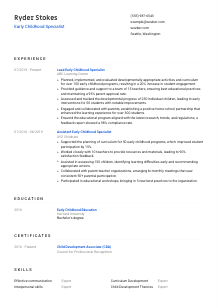
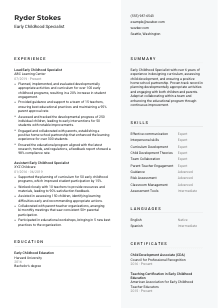
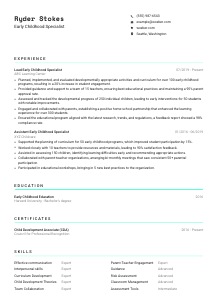
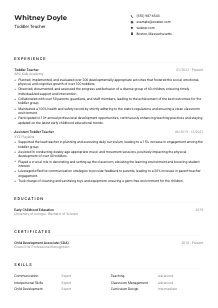
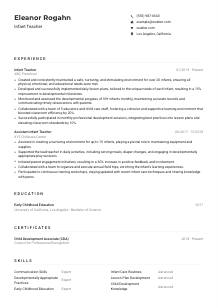
Nurturing young minds, but your resume doesn't grow as joyfully? Check out this Early Childhood Specialist resume example, created with Wozber free resume builder. It shows how to showcase your nurturing expertise to meet job benchmarks, ensuring your career blossoms alongside those little ones!
Early childhood roles are built on daily judgment. You are planning learning experiences that match developmental stages, watching for delays or behavioral shifts, supporting teachers, and building trust with families at the same time. A resume for an Early Childhood Specialist needs to make that practical range visible, especially your work with curriculum, developmental observation, classroom support, and safe learning environments.
Hiring teams often need to quickly distinguish between candidates who have simply worked around young children and those who can guide program quality, document child progress, and communicate well with parents and staff. Wozber's free resume builder helps you shape that experience into an ATS-compliant resume using the language employers already use, so your background reads clearly as specialist-level early childhood work.
This section is brief, but it still carries useful information for an early childhood employer. Schools and childcare organizations need accurate contact details, a clear professional title, and in some cases confirmation that location or relocation will not slow down hiring.
Use your full name in the most prominent text on the page. Keep it easy to read and professional. In education hiring, clarity matters more than styling, and your header should feel as organized as the classroom practice you are describing elsewhere in the resume.
Place "Early Childhood Specialist" directly under your name when that is the role you are applying for. Matching the posting title helps frame the rest of the resume around curriculum planning, child development support, teacher guidance, and parent partnership rather than broader childcare work.
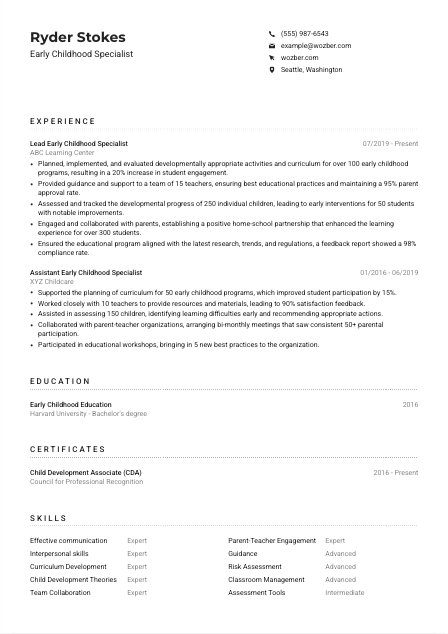
If the posting requires you to be in a specific city or open to relocation, reflect that clearly in your location line. Here, listing Seattle, Washington, as shown in the example, immediately answers a stated requirement. For other applications, use the same approach only when location affects eligibility or availability.
If you include LinkedIn or a professional website, make sure it supports your resume with consistent titles, education, certifications, and experience. For early childhood professionals, that profile can also reinforce workshop participation, program leadership, or community engagement if those details are current and presented professionally.
Your personal details should confirm who you are, how to reach you, and whether you meet any practical requirements tied to the role. Keep this section clean, accurate, and aligned with the posting.




For an Early Childhood Specialist, experience is where hiring teams look for proof that you can translate child development knowledge into daily practice. They want to see curriculum decisions, developmental assessment, collaboration with teachers, parent communication, and the scale of the children or programs you supported.
Read the job description for repeated responsibilities, then build your bullets around them. In this role, the clearest themes are developmentally appropriate curriculum, teacher support, child progress tracking, family partnership, and staying current with best practices or regulations. Those themes should be easy to spot across your recent positions.
Do not stop at "worked with children" or "assisted in classroom activities." Show what you planned, guided, assessed, or improved. The sample resume does this well by describing curriculum planning, staff support, developmental tracking, and family collaboration. Write bullets that show your judgment in practice, such as adapting activities for developmental readiness, coaching teachers on classroom strategies, or coordinating referrals when concerns emerged.
Metrics make early childhood work more concrete when they reflect real scope and outcomes. Useful numbers include program count, number of children served, teacher team size, parent participation, engagement gains, compliance rates, or intervention volume. The example's 95% parent approval rate and 250 child assessments are strong because they show both scale and quality of work.
Prioritize experience that connects directly to early learning environments, developmental support, and collaboration with families and educators. If your background includes less relevant roles, reduce them to basic facts or leave them out. The strongest bullets should keep bringing the reader back to curriculum quality, child outcomes, staff support, and program improvement.
A hiring manager should be able to trace your progression from classroom support to broader educational responsibility. When your bullets show developmental insight, program contribution, and measurable results, your experience reads like specialist work instead of general childcare experience.
In this field, your degree is more than a requirement on paper. It tells employers that your classroom decisions are grounded in child development, learning theory, and age-appropriate practice. Present that foundation clearly, then add detail only when it strengthens your case.
If the role requires a bachelor's degree in Early Childhood Education or a related field, make that easy to find. Use the exact degree and field wording from your records. In the example, "Bachelor's degree in Early Childhood Education" directly matches the posting and removes ambiguity.
Most experienced candidates can keep the section concise. If you are earlier in your career, you can briefly mention coursework, projects, or practica tied to child development theories, curriculum design, inclusive instruction, or observation and assessment. That extra context helps connect your education to the actual work of the role.
Course lists are most useful when your degree title is broad, such as Education or Psychology, and you need to make your early childhood focus clearer. In that case, mention a few directly relevant areas like child development, play-based learning, behavior support, or family engagement rather than a long academic inventory.
Honors, leadership, or notable fieldwork can help if they reinforce your early childhood track. Keep them brief and relevant. For example, student teaching in a preschool setting or recognition for work in developmental assessment is more useful here than unrelated campus activities.
Your education section should quickly show that your practice with young children rests on formal preparation, not only on experience. Clear degree information and a few targeted details are usually enough.
Certifications matter in early childhood education because they show current professional standards, regulated training, and commitment to the field beyond basic degree requirements. When a posting mentions specific credentials, treat them as important resume real estate.
If the employer mentions certifications such as CDA or teaching certification in early childhood education, move those to the top of the section. In this case, both appear in the example resume and directly support the role's stated requirements. For other jobs, give priority to whichever credential the employer highlights.
Choose credentials that strengthen your case as someone who can support young children's learning and maintain program standards. Beyond CDA or state teaching credentials, that may include training in child assessment, special education support, behavior guidance, health and safety, or mandated reporting if those are current and relevant to the role.
Add the issuing organization and, when relevant, the active date range. That helps employers understand whether the certification is current and recognized. The example's issuer lines work well because they show both the credential and the body behind it.
Early childhood programs evolve with new research, licensing expectations, and instructional practice. Recent coursework, renewal activity, or additional training can show that your methods are current. That matters for roles involving teacher guidance, developmental intervention, and program quality improvement.
Well-chosen credentials add practical credibility to your resume. They show that your knowledge of child development and early education is supported by current training, recognized standards, and ongoing learning.
A useful skills section for this profession should sound like the real work, not a generic list of pleasant traits. Focus on the abilities that shape classroom quality, developmental support, family communication, and collaboration with staff.
Start with the terms the employer uses. Here, that includes strong knowledge of child development theories, effective communication, interpersonal skills, and the ability to plan and evaluate developmentally appropriate activities. Those phrases tell you what language should appear in your skills list and throughout your experience bullets.
Early childhood roles require both instructional and interpersonal capability. Alongside communication and collaboration, include profession-specific skills such as curriculum development, child observation, developmental assessment, classroom management, behavior support, lesson adaptation, family engagement, and program compliance if those reflect your actual work. The sample skills section is strongest where it names concrete areas like Curriculum Development and Parent-Teacher Engagement.
Do not overload this section with every strength you can think of. Choose skills you can support elsewhere on the resume with examples, outcomes, or certifications. A shorter list grounded in real practice is far more persuasive than a long list of vague qualities.
When the skills section reflects curriculum work, developmental knowledge, staff collaboration, and family communication, it reinforces the rest of the resume instead of repeating generic claims.
Language ability matters in early childhood settings because the work depends on clear communication with children, families, teachers, and support staff. List languages in a way that reflects actual proficiency and practical use, especially when the posting names one explicitly.
If the role calls for high proficiency in English, make that visible first. This posting does, so English should appear prominently with an accurate level such as Native or Fluent. That immediately confirms you can handle parent communication, staff coordination, documentation, and day-to-day classroom interaction.
List your primary language and level in a straightforward way. If English is not your first language but you use it professionally at a high level in educational settings, state that honestly and confidently. The important point is that the employer can quickly see you meet the communication demands of the role.
Additional languages can be valuable in preschool and childcare environments, particularly when programs serve multilingual families. In the example, Spanish adds useful context because it may support communication with caregivers and strengthen family partnership work. Include extra languages when they are real assets, not filler.
Be specific about whether you are Native, Fluent, Advanced, Intermediate, or Basic. Overstating proficiency creates problems quickly in a role that depends on trust, parent communication, and clear developmental discussions.
If a second language has helped you build relationships with families, translate educational information, or support a more inclusive classroom environment, that benefit can be reinforced elsewhere in your experience section. The language section itself should stay concise, but it should still reflect real value.
For an Early Childhood Specialist, language proficiency is not a decorative extra. It helps employers picture how you will communicate with families, document progress, and work effectively across the school or center community.
Your summary should quickly establish the level and focus of your early childhood experience. In a few lines, it needs to show that you understand child development, can support educational quality, and have worked effectively with both families and staff.
Before writing, identify the two or three themes the employer cares about most. Here, those include developmentally appropriate curriculum, child progress assessment, staff support, and parent collaboration. Your summary should echo those priorities in natural language, not copy the job description word for word.
Start with your title and years of relevant experience. The sample summary does this effectively with "Early Childhood Specialist with over 6 years of experience." That first line immediately tells the reader you belong in the field and have enough hands-on background to operate beyond entry level.
Use the next sentence to highlight what you are known for in practice. Good options include curriculum design, developmental assessment, coaching educators, strengthening home-school partnership, or improving engagement and program quality. If you mention achievements, keep them believable and tied to the way early childhood work is measured.
Aim for three to five lines with no wasted words. Avoid broad claims about being passionate or dedicated unless the rest of the sentence names concrete work, such as guiding teachers, tracking developmental milestones, or implementing research-informed learning activities.
When this section clearly presents your experience level, early childhood focus, and strongest contributions, the hiring team can read the rest of the resume through the right lens from the start.
Once each section points back to curriculum planning, child development knowledge, family partnership, staff support, and measurable program contribution, your resume starts reading like a clear match for Early Childhood Specialist roles.
Use Wozber's free resume builder, ATS resume scanner, and ATS-friendly resume format to align your wording with the posting and present your background in a structure employers can review quickly. The final result should make it easy to see your readiness to support children, families, and early learning teams from day one.