




Use Wozber and land your dream job
Create Resume
No registration required
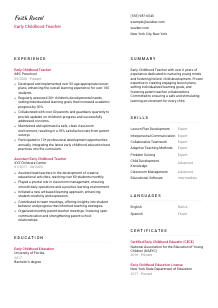
Shaping young minds, but your resume isn't making the grade? Check out this Early Childhood Teacher resume example, created with Wozber free resume builder. Learn how to blend your nurturing nature with job specifics, so your career path blossoms as beautifully as the kids you inspire!
Early childhood teaching is built on daily judgment. You are planning learning that matches developmental stages, reading behavior and progress in real time, and keeping a classroom safe, calm, and engaging for very young children. A resume for this field needs to make that practice visible through concrete teaching scope, family communication, and child-centered results.
When that experience is tailored to the opening, the hiring team can quickly separate preschool classroom experience from broader education work, and an ATS can match the right terms around lesson planning, child development, and parent collaboration. Wozber's free resume builder helps organize that language into an ATS-friendly resume format so your application reads clearly as early childhood teaching, not general caregiving or generic teaching support.
Schools and early learning centers usually start with the basics. If your contact details are incomplete, unprofessional, or mismatched to the role, the rest of your teaching experience gets harder to trust. This section should present you as an educator who is easy to contact and already aligned with the position.
Use your full name at the top in a clean, readable format. It should be the easiest element to spot on the page, since directors and hiring coordinators may review many applications at once.
Place "Early Childhood Teacher" directly under your name when that is the role you are applying for. Matching the posted title helps position your classroom experience immediately, especially when employers are sorting applicants across assistant, lead, and general education roles.
Include a reliable phone number and a professional email address. In education hiring, parent communication and staff coordination are part of the job, so even small details like a polished email address reinforce professionalism.
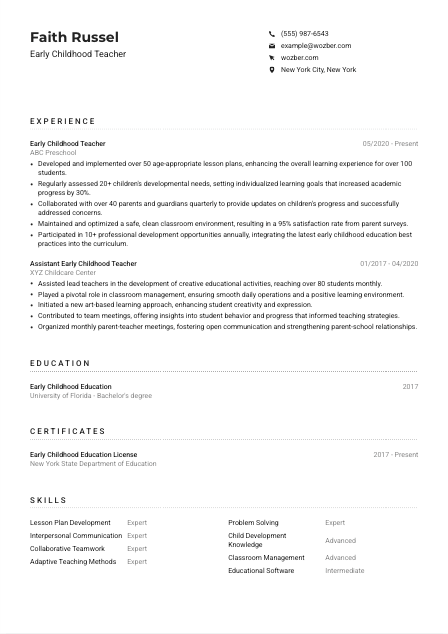
If the posting specifies a city or local availability, add your city and state. Here, New York City, New York matters because the employer asked for candidates based there, so that detail removes a possible screening question early.
A LinkedIn profile or personal teaching website can support your application if it reflects your classroom work, teaching philosophy, certifications, or professional development. Keep it current and consistent with the resume you submit.
This section does not need flair. It needs accuracy, professionalism, and the small signals that show you are ready to step into an early childhood classroom without extra friction.




For early childhood teachers, experience is where hiring teams look for the difference between general childcare exposure and real classroom practice. They want to see how you plan instruction, observe development, manage routines, work with families, and contribute to a healthy learning environment.
Read the posting closely and mark the responsibilities that define the role. In this case, those include age-appropriate lesson planning, developmental assessment, individualized goals, parent communication, classroom safety, and professional development. Those ideas should shape the order and wording of your bullets.
Start with your most recent position and include job title, school or center name, and dates. A straightforward chronology helps employers quickly confirm that you meet experience requirements such as 2+ years in a preschool or early childhood setting.
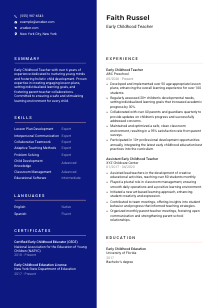
Focus each bullet on work that matters in early childhood education: designing activities, supporting developmental growth, guiding behavior, partnering with families, or improving the classroom environment. The example resume does this well by showing 50+ lesson plans, individualized goals for 20+ children, and regular parent collaboration rather than relying on vague claims about being passionate.
Metrics are useful when they match the work. You might quantify number of students served, lesson plans created, parent meetings held, satisfaction scores, developmental gains, or frequency of assessments. In the sample, parent survey satisfaction and measurable student progress make the teaching impact easier to understand.
Prioritize work that proves you can run or support an early childhood classroom. If you have experience outside preschool education, include it only if it adds something relevant, such as behavior support, family engagement, or child-focused program delivery. The main story should stay centered on young learners and classroom practice.
The strongest experience sections make your daily practice easy to picture. By the end of this section, a hiring team should be able to see your age group, classroom responsibilities, and the results of your work with children and families.
Education matters in early childhood hiring because it shows your formal grounding in child development, curriculum design, and age-appropriate teaching practice. When the degree requirement is explicit, this section should confirm it quickly and without clutter.
Look for the degree named in the posting and make sure your resume reflects it clearly. Here, a Bachelor's degree in Early Childhood Education or a related field is a stated requirement, so that credential should be easy to find.
List your degree, field of study, school, and graduation year. Hiring teams do not need extra decoration here. They need to confirm that your academic background supports the classroom responsibilities in the role.
If your degree is directly tied to early childhood education, spell that out exactly. "Bachelor's degree, Early Childhood Education" connects immediately to developmental theory, classroom methods, and early learning standards. The sample resume handles this directly and effectively.
Relevant coursework can help if you are earlier in your career or if your degree title is broader. Classes in child development, literacy foundations, behavior guidance, inclusive education, or curriculum planning can help clarify your preparation for preschool teaching.
Honors, teaching practica, or education-related student organizations can add value when they reinforce your preparation for working with young children. Keep these details if they support your candidacy, not just to fill space.
This section should confirm that your training matches the developmental and instructional demands of early childhood teaching. Clear degree details help the employer move on to the more nuanced question of how you teach.
Licensure and certifications carry real weight in education hiring. They show legal eligibility, professional commitment, and in many cases ongoing engagement with current classroom practice and child development standards.
Review the posting for any mandatory license or certification and place that credential first. In this job, a state-approved teaching certification or license in Early Childhood Education is essential, so it should lead this section.
List certificates that directly support your ability to teach young children, manage a classroom, or meet state standards. The sample's New York Early Childhood Education license is the strongest example because it addresses a non-negotiable requirement.
For active licenses and time-bound credentials, include the issue date or active date range. This helps employers confirm that your certification is current and usable for the position.
Beyond required licensure, include certifications or recognized training that strengthen your work with curriculum, child behavior, inclusion, assessment, or family engagement. Keep the list focused on what improves your classroom practice and employability.
A hiring team should be able to glance at this section and know you meet the formal standards for the classroom. After that, additional certifications can show how you keep your teaching practice current.
Early childhood teaching relies on a mix of instructional skill, developmental knowledge, and steady communication with children, families, and coworkers. Your skills section should reflect that blend in the language schools actually use when they describe the role.
Look for the abilities named directly in the job description. Here, that includes interpersonal communication, knowledge of child development theories and practices, lesson planning, and maintaining a safe and stimulating classroom. Those terms give you the right foundation for tailoring.
List the skills most relevant to your classroom work, such as lesson plan development, classroom management, developmental assessment, parent communication, and adaptive teaching methods. The sample resume pairs these well by combining instructional skills with relationship-based strengths like collaborative teamwork.
Do not overcrowd the section with every tool or trait you have used. Choose the skills that best match the age group, teaching environment, and responsibilities of the role. A concise list that mixes technical teaching abilities with role-critical soft skills is easier for both hiring teams and ATS screening to read.
This section should sound like the day-to-day language of an early childhood classroom. If the list points clearly to teaching practice, child development, and family communication, it is doing its job.
Language ability can matter a great deal in early childhood settings, where communication happens with children, families, and multidisciplinary staff. This section is especially useful when the employer names a required language or when additional fluency supports family engagement in a diverse community.
If the role specifies language proficiency, list it clearly. This job requires proficiency in English, so your resume should make that qualification easy to confirm.
Lead with the language the employer asked for and note your proficiency level plainly, such as Native or Fluent. In this example, "English: Native" immediately addresses a stated condition of employment.
Additional languages can strengthen your application when they help with family communication or classroom inclusivity. The sample's Spanish fluency is a good example of an added asset in many early learning communities, though it is not a universal requirement.
Be accurate about what you can do in each language. If you can conduct parent conversations, support students, or handle written communication, note the level that reflects that realistically.
For early childhood teachers, language ability matters most when it improves understanding, trust, and communication. Present it in that practical context rather than as a generic extra.
List languages in a way that helps an employer picture stronger communication with children and families. That is the value they add on an early childhood resume.
The summary sits at the top of the resume, so it needs to establish your teaching profile quickly. For early childhood educators, that usually means years of experience, classroom focus, and a few strengths that reflect how you support children's development and partner with families.
Start by identifying the themes at the center of the job. Here, the role emphasizes whole-child instruction, developmental assessment, individualized goals, parent collaboration, and classroom safety. Those are the ideas your summary should echo if they reflect your background.
Lead with a direct introduction such as "Early Childhood Teacher with 6+ years of experience" or a version that matches your background. This gives the reader immediate context and places you within the right level of classroom practice.
Choose strengths that connect to the employer's priorities, such as creating age-appropriate lesson plans, tracking developmental progress, or building strong parent partnerships. The sample summary works because it names these areas specifically instead of relying on broad statements about loving children or being hardworking.
Aim for 3 to 5 lines with specific language. A concise summary is enough to frame your teaching style and scope before the reader moves into your experience, where the proof belongs.
A useful summary gives the employer an immediate sense of the classroom you can lead and the developmental work you know how to do. Keep it brief, specific, and grounded in early childhood teaching.
A well-tailored Early Childhood Teacher resume should now show the essentials clearly: relevant classroom experience, knowledge of child development, parent communication, required education, and any active teaching license. That combination helps a school or center understand how you will teach, support, and care for young children from day one.
Use Wozber to refine the language, strengthen ATS optimization, and organize everything in an ATS-compliant resume that reflects the role accurately. When your resume presents your classroom practice with this level of clarity, the hiring team can quickly see that you are prepared for the work.




