



Use Wozber and land your dream job
Create Resume
No registration required
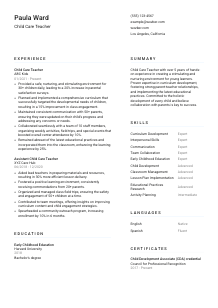
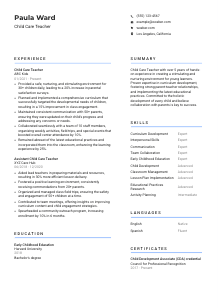
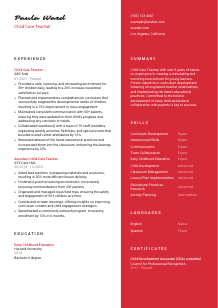
Nurturing wee ones, but your resume doesn't play nice? Tinker with this Child Care Teacher resume example, created with Wozber free resume builder. Learn how to weave your early education magic to meet job expectations, paving the path for many "a-ha!" moments in your professional journey!
Child care hiring moves quickly when a resume makes the classroom visible. Centers want to see how you support children's development day to day, keep routines safe and calm, and turn lesson plans into age-appropriate learning rather than simply listing that you
When those details are tailored to the posting, your background reads less like general caregiving and more like licensed classroom experience. Wozber's free resume builder helps shape that into an ATS-compliant resume by aligning your wording with the job description, so employers can quickly see your work with curriculum, parent communication, and child development.
This section handles the practical checks first. For a Child Care Teacher, that means making it easy to confirm who you are, how to reach you, and whether you meet straightforward filters such as job title and location before anyone gets to your classroom experience.
Use your full name in a clean, readable format at the top of the page. Keep it slightly larger than the rest of the text so it is easy to spot, especially when a director or recruiter is reviewing several applications for teaching staff.
Place
Include a current phone number and a professional email address that you check regularly. Child care hiring often involves quick follow-up for interviews, classroom observations, or licensing questions, so accuracy matters here more than style.
If the job requires local availability, include your city and state. In the example,
A LinkedIn profile is useful if it reflects your teaching history, credentials, and education accurately. Personal websites are optional, but if you have one, it should support your professional profile with classroom philosophy, certifications, or early learning work rather than unrelated content.
Your header should remove basic uncertainty right away. A hiring team should be able to confirm your target role, contact details, and any sample-specific logistics without hunting for them.




For Child Care Teachers, experience is where hiring teams look for proof that you can manage children safely, teach intentionally, and communicate well with families. Generic caregiving statements are easy to skip. Specific classroom actions, age-appropriate planning, and measurable outcomes hold attention.
Start by pulling out the duties that define the job, then make sure your bullets reflect that same work in your own words. For this role, that includes maintaining a safe and nurturing environment, planning curriculum, communicating with parents, and collaborating with staff on activities or events.
List your most recent child care or early education role first, followed by earlier positions. That order helps employers see whether you already have experience in a licensed facility, how your responsibilities have grown, and whether you have moved from support work into leading classroom activities.
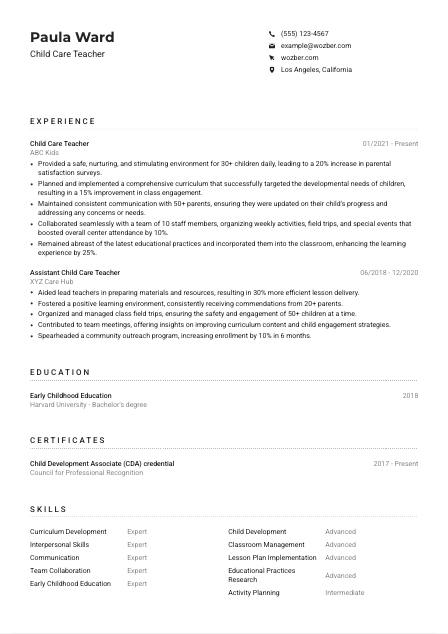
Each position should show what you were trusted to do and what changed because of your work. Strong Child Care Teacher bullets mention classroom size, lesson planning, developmental goals, parent updates, behavior support, or team coordination. The example does this well by tying daily care and curriculum work to outcomes such as better engagement and stronger parent satisfaction.
Numbers make classroom impact easier to picture. Use metrics that fit the field, such as number of children served, parent communication volume, activity frequency, attendance changes, engagement gains, or satisfaction improvements. A bullet like
Prioritize experience that supports the target job. If a bullet does not show supervision, developmental support, lesson implementation, family communication, compliance, or teamwork in an education setting, rewrite it or remove it. Field trips, special events, and curriculum contributions are worth keeping when they reflect the responsibilities named in the posting.
By the end of your experience section, a center should be able to picture you managing a classroom, supporting development, and working smoothly with families and staff. That is the level of clarity that gets interviews.
Education matters in this field because it connects your classroom practice to child development theory, instructional planning, and age-appropriate learning. When a posting asks for a bachelor's degree in Early Childhood Education or a related field, make that qualification easy to find in seconds.
List the degree that best aligns with the posting exactly and prominently. Here, a bachelor's degree in Early Childhood Education is a direct match, so that wording should appear clearly rather than being buried under less relevant academic details.
Include degree, school, field of study, and graduation year or date. This section does not need extra decoration. Clean formatting helps a hiring manager confirm qualifications quickly, especially when reviewing education requirements alongside licensing and facility experience.
If your degree is in Early Childhood Education, Child Development, or a closely related area, make the field easy to scan. That subject tells employers you have formal grounding in developmental milestones, classroom planning, and learning approaches used with young children.
Relevant coursework can help if you are earlier in your career or if your degree title is broad. Courses tied to child development, classroom management, literacy foundations, or early learning assessment can give more context, but only include them when they add information your experience section cannot yet show.
Honors, leadership roles, or education-focused projects can support your candidacy when they connect to teaching practice. For example, a student practicum in an early learning setting or leadership in an education organization adds more value than unrelated campus activities.
Your education section should confirm that your teaching approach rests on formal preparation in early learning. If the degree requirement is central to the posting, make that match immediate.
In child care hiring, certifications are often more than a bonus. They can determine whether you meet licensing or classroom eligibility requirements. Present them so an employer can immediately tell that your credentials are current, relevant, and connected to the role.
Put any credential named in the posting near the top of this section. For this example, a valid state teaching certification or a Child Development Associate credential is central, so the CDA should appear clearly and with its issuing body.
Choose certifications that support your work with young children, classroom safety, development, or instruction. A shorter list of relevant credentials carries more weight than a long list of unrelated certificates that do not help explain your readiness for a licensed child care setting.
Add issue dates, expiration dates, or a current status when applicable. Child care employers often need to confirm that a credential is valid now, not simply earned at some point in the past. The example handles this well by showing the CDA as active.
This field changes through updated child development research, classroom practice, and state requirements. Ongoing certifications in areas such as behavior guidance, inclusive education, or early literacy can strengthen your resume when they reflect the kind of teaching the center provides.
Your certifications should answer a practical question fast: can you step into the classroom with the qualifications this employer requires. Keep that answer obvious.
A Child Care Teacher skills section should sound like real classroom work, not a generic list of strengths. The most useful skills combine instruction, developmental support, family communication, and the teamwork needed to keep a child care program running smoothly.
Start with the language used in the posting. For this role, that includes creating age-appropriate lesson plans, strong communication, interpersonal skills, and collaboration. These phrases help your resume stay closely aligned with the employer's priorities and improve ATS optimization without forcing keywords unnaturally.
Balance instructional strengths with the interpersonal and operational skills the job actually requires. Curriculum development, classroom management, child development knowledge, parent communication, and team collaboration belong together because Child Care Teachers are evaluated on both learning outcomes and daily care routines.
Place the most relevant skills first instead of listing everything you can do. If the posting emphasizes lesson planning and developmental support, those should appear before broader traits. An ATS-friendly resume format helps these terms stay readable for both screening systems and center leadership reviewing your application.
Your skills list should sound like someone ready to run an early learning classroom, work with families, and contribute to the center team from day one.
Language ability can matter a great deal in child care because communication happens with both children and adults throughout the day. When a posting names fluency requirements, list them clearly. Any additional language can also support stronger relationships with families in multilingual communities.
If the job explicitly requires English fluency, include English and your proficiency level clearly. That is a core qualification here because instructions, parent updates, classroom communication, and documentation all depend on strong day-to-day communication.
Additional languages can strengthen your resume when they help you connect with children, caregivers, and the surrounding community. In the example, Spanish is a useful addition because it suggests wider communication range in a diverse child care setting.
Terms such as Native, Fluent, Conversational, or Basic are easier to understand than vague descriptions. Choose labels you can comfortably support in real parent conversations, classroom interaction, or staff communication.
Even when a posting mentions only English, another language can still be relevant if it reflects the families the program works with. In child care, that can improve trust, smoother handoffs, and clearer discussion of a child's progress or concerns.
List languages in a way that connects to the work. For a Child Care Teacher, language skills support inclusion, parent relationships, and a classroom environment where children and families feel understood.
Handled well, this section shows more than fluency. It shows how you communicate with children, families, and colleagues in the real flow of a child care setting.
The summary sits at the top of the resume, so it should immediately place you in the right lane. For this role, that means highlighting years of licensed child care experience, your approach to curriculum and child development, and the way you work with parents and staff.
Read the posting closely and identify the two or three priorities that define the job. Here, those include early childhood education background, classroom experience in a licensed facility, lesson planning, and parent communication. Your summary should reflect those priorities first, not generic enthusiasm for working with children.
Start with your title, years of experience, and area of practice. A line such as
Use one or two concrete strengths or results that support the role. The example summary works because it mentions curriculum development, parent-teacher relationships, and hands-on experience in creating a nurturing learning environment. If you have measurable results such as engagement gains or parent satisfaction improvements, allude to that impact briefly.
Aim for three to five lines that are easy to scan. Avoid broad mission statements and save detail for the experience section. A good summary should quickly tell an employer that you understand child development, can manage a classroom, and communicate well with families and coworkers.
After reading these opening lines, a hiring manager should already understand your teaching background, classroom strengths, and relevance to the child care setting they need to staff.
A Child Care Teacher resume works best when it shows the real rhythm of the job: keeping children safe, planning developmentally appropriate learning, communicating consistently with parents, and collaborating with staff to keep the classroom running well.
Use Wozber's free resume builder to organize that experience into an ATS-friendly resume template, then refine it with the ATS resume scanner so the language, qualifications, and priorities in your application match the role you want.
When the resume is tailored well, employers can quickly see whether you are ready to step into their classroom and support children with confidence.