



Use Wozber and land your dream job
Create Resume
No registration required
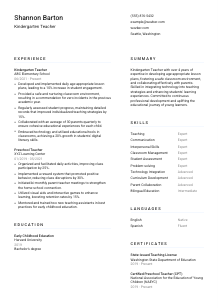
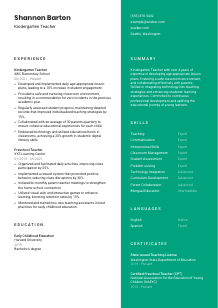
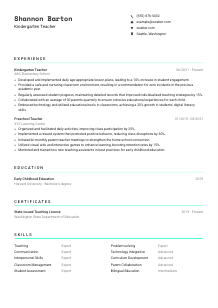
Nurturing minds, but your resume feels like a time-out? Check out this Kindergarten Teacher resume example, created with Wozber free resume builder. Learn how to blend your nurturing spirit with the job criteria, ensuring your career stays as colorful and joyful as a finger-painted masterpiece!

Kindergarten classrooms run on far more than warmth and patience. Schools need teachers who can turn early learning goals into age-appropriate lessons, guide behavior with consistency, keep children safe, and track developmental progress closely enough to adjust instruction child by child. Your resume needs to show that daily teaching reality, not just a general love of working with children.
When that experience is tailored well, the first scan of your resume quickly shows whether you meet core filters such as early childhood credentials, classroom experience, parent communication, and instructional technology use. Wozber's free resume builder helps organize those details in an ATS-friendly resume format so both hiring teams and applicant tracking systems can see, early on, that you can lead a kindergarten classroom with confidence.
School administrators usually see your contact details before they read a single bullet point. For a Kindergarten Teacher, this section should confirm practical basics fast: who you are, what role you are targeting, and whether you match any location or communication requirements attached to the opening.
Use your full name in a clear, slightly larger font so it stands out immediately at the top of the page. In teaching, your name is attached to classroom trust, parent communication, and professional references, so present it cleanly and consistently across your resume, email, and any teaching profile.
Place "Kindergarten Teacher" directly under your name if that is the role you are pursuing. This helps the school see your target right away and supports ATS alignment with the posting. If your recent role was Preschool Teacher, you can still target Kindergarten Teacher here when the rest of the resume shows relevant early childhood instruction.
Include a reliable phone number and a professional email address you check often. Hiring for school roles often moves through quick calls to schedule interviews, reference checks, or classroom observations, so accuracy matters. Use an email that looks professional, ideally based on your name rather than a nickname.
If the school specifies that candidates must already be in a certain area or able to relocate, list your city and state clearly. In the provided example, "Seattle, Washington" addresses a stated location requirement directly. Treat this as tailoring to the opening rather than a rule for every kindergarten resume.
Include a LinkedIn profile, teaching portfolio, or personal website only if it strengthens your application. For educators, that might mean a portfolio with classroom philosophy, sample learning materials, family communication examples, or professional development highlights. Make sure anything linked reflects the same role focus and professionalism as the resume itself.
This section should remove basic questions before they arise. When your details are accurate, role-specific, and aligned with the posting, the reader can move straight to your classroom experience and qualifications.




This is the section school leaders read most closely. They are looking for proof that you can plan instruction, manage a room full of young children, communicate with families, and document student growth in a way that supports both learning and accountability.
Start by pulling the biggest needs from the job description, then shape your bullets around those areas. For kindergarten roles, that usually means lesson planning, classroom environment, progress monitoring, parent partnership, and technology use. The sample resume does this well by tying experience directly to daily teaching work such as age-appropriate lesson plans and student assessment.
Show your most recent classroom experience first, with school name, job title, and dates. This format helps hiring teams quickly see your current level, whether you have worked with preschool or kindergarten-aged children, and how your responsibilities have grown. If you have both preschool and kindergarten experience, keep both visible because that progression is highly relevant in early childhood hiring.
Avoid generic statements like "responsible for teaching students." Instead, describe what you implemented and what changed as a result. Strong bullets mention outcomes such as improved engagement, better behavior, stronger family participation, or more effective individualized instruction. In the example, "improved individualized teaching strategies by 15%" gives much more hiring value than a plain note about recordkeeping.
Metrics help when they reflect how schools actually track performance. Useful examples include student engagement, behavior incidents, parent meeting participation, classroom observation results, literacy or readiness gains, and the number of students or families you supported. The sample's references to 30 parents per quarter and a 20% increase in digital literacy work because they are tied to real classroom outcomes.
Every bullet should strengthen your case for leading a kindergarten classroom. Prioritize experience with social-emotional development, hands-on learning, routines, differentiated instruction, and collaboration with assistants or families. Leave out unrelated work unless it adds clear value, such as childcare, tutoring, or youth program leadership that supports your early education background.
A hiring team should be able to picture how you teach from this section alone. When your bullets connect instruction, care, assessment, and family communication, your experience reads like real kindergarten readiness, not a list of broad responsibilities.
For kindergarten positions, education is usually a qualifying section, not a formality. Schools often need to confirm that your degree aligns with early childhood education requirements before they move further into your application.
If the posting asks for a Bachelor's degree in Early Childhood Education or a related field, make that easy to find. List the degree, field of study, school, and graduation year clearly. In the sample, a Bachelor's degree in Early Childhood Education directly supports the role requirement.
This section does not need extra decoration. A simple structure with institution, degree, field, and date is usually enough, especially once you have classroom experience. Hiring teams are often checking for degree level and subject match first, so make those details visible without forcing them to search.
When your degree is closely related but not an exact wording match, use the field name that accurately reflects your preparation for teaching young children. Programs tied to early childhood development, elementary education, or child study can still be relevant when the rest of your resume reinforces kindergarten-level instructional experience.
Relevant coursework can strengthen this section if you are early in your career or your program title is broad. Include subjects that connect directly to kindergarten teaching, such as child development, literacy instruction, classroom management, inclusive education, or educational technology. Keep it selective and practical.
Honors, education-related projects, student teaching, or leadership in early childhood organizations can add value when they reinforce your classroom preparation. This is especially useful for newer teachers who need to show depth beyond the degree itself. Focus on distinctions that connect to teaching young learners rather than general campus activities.
This section should answer the school's first academic question without effort. When your degree and field are easy to verify, the reader can move on to the teaching record that shows how you use that training in practice.
In early childhood hiring, certifications often determine whether an application moves forward at all. Schools need to know that you hold the required teaching license and that any additional credentials support current classroom practice.
Lead with your state-issued teaching certification or early childhood license when the posting requires it. This is an eligibility checkpoint, so do not bury it under optional training. The example places the state teaching license prominently, which is exactly right for a role that names licensure in the requirements.
After the required license, include certifications that connect to early learning instruction, child development, classroom management, special education support, literacy, or educational technology. A shorter, relevant list is more useful than a long catalog of unrelated workshops.
Show issue dates or active date ranges when the credential is current, renewable, or tied to compliance. Schools often need up-to-date certification records during hiring and onboarding, so current status matters. The sample's "2019 - Present" format works well for active teaching credentials.
Professional development matters in kindergarten because teaching methods, classroom tools, and developmental support approaches continue to evolve. If you regularly complete training in areas like early literacy, behavior support, trauma-informed practice, or technology integration, list the most relevant items to show ongoing growth.
Your certifications should quickly confirm that you are eligible to teach and committed to staying current in early childhood practice. That combination matters to schools that need both compliance and classroom quality.
Kindergarten teaching blends instructional skill with relationship-driven work. The best skills sections show that you can manage both sides of the job: guiding learning for young children while working closely with families, colleagues, and classroom systems.
Read the requirements and responsibilities closely, then note the capabilities they imply. For a kindergarten opening, that often includes lesson planning, classroom management, student assessment, parent communication, and technology use. This gives you a role-specific list instead of a generic set of education buzzwords.
Lead with skills that directly support kindergarten teaching, such as curriculum development, classroom management, social-emotional support, student assessment, family collaboration, and instructional technology. The sample's mix of "Classroom Management," "Student Assessment," and "Technology Integration" is a good model because those skills map directly to the job description.
Do not overload this section with every soft skill you have ever used. Choose the capabilities that you can support with examples elsewhere in the resume. If you list "Parent Collaboration" or "Problem-solving," your experience bullets should show family meetings, behavior strategies, differentiated instruction, or similar classroom situations that make those skills credible.
A focused skills section helps the school connect your experience to everyday kindergarten demands. Keep it grounded in instruction, classroom care, communication, and the tools you actually use with young learners.
Language ability can matter a great deal in elementary settings, especially when schools serve diverse families. For a Kindergarten Teacher, list languages in a way that supports communication requirements without overstating your proficiency.
If the posting specifies fluent English, list English at the top with an accurate proficiency level such as "Native" or "Fluent." This immediately confirms a stated requirement and reassures the school that you can handle classroom instruction, family communication, and documentation in English.
Additional languages can strengthen your application when they help with family outreach, student connection, or inclusive classroom communication. The sample includes Spanish, which may be especially useful in some school communities, though that will depend on the population served rather than being a universal requirement.
Use straightforward labels such as "Native," "Fluent," "Intermediate," or "Basic." Schools may rely on this information for parent communication expectations or bilingual support needs, so accuracy matters. Do not claim fluency unless you can genuinely teach, converse with families, or handle professional communication at that level.
If you know the school serves multilingual families, language skills can carry real weight. Mention them when they are relevant, but keep the emphasis proportional. The core hiring decision for kindergarten will still center on teaching ability, child development knowledge, and classroom effectiveness.
Language skills are most persuasive when they are framed as useful in the school setting. They can support clearer parent conferences, smoother transitions for students, and stronger trust with families. Present them as an added capability that strengthens your classroom reach.
This section works best when it confirms required communication ability and highlights any added value you bring to the school community. Keep it honest, relevant, and easy to scan.
A kindergarten resume summary should sound like someone ready to run a classroom, not someone describing teaching in broad terms. In a few lines, it needs to connect your experience level with the parts of early childhood teaching that matter most for the role you want.
Read the posting and identify the few priorities that appear most central. For kindergarten roles, that often means age-appropriate instruction, a safe classroom environment, student progress tracking, family communication, and comfort with classroom technology. Build your summary around two or three of those themes rather than trying to cover everything.
Lead with a direct statement such as "Kindergarten Teacher with 4+ years of experience" or, if relevant, a combination of preschool and kindergarten experience. This gives immediate context and helps the reader place you quickly. The sample summary does this effectively by opening with both title and years of experience.
Use the middle of the summary to name the teaching strengths most relevant to the opening. Good examples include developing engaging lesson plans, supporting social-emotional growth, maintaining a structured classroom, collaborating with parents, or using educational technology to support learning. Choose strengths that are backed up in your experience section.
Stay within 3 to 5 lines and avoid vague phrases about being passionate or dedicated unless they are paired with real teaching substance. The sample works because it combines practical strengths like lesson planning, classroom environment, and technology integration in a compact format. Aim for the same balance of brevity and specificity.
Your summary should make one thing obvious within seconds: you understand early childhood classrooms and can contribute from day one. When it is tailored well, the rest of the resume feels like proof of that opening claim.
You now have a resume structure that speaks to how kindergarten hiring actually works: credentials first, classroom experience with outcomes, practical skills, and a summary that sounds like a real educator. Wozber's AI resume builder and ATS resume scanner can help you tighten the language, map job requirements to the right sections, and keep the final version clear in an ATS-friendly resume template.
Before you apply, check that the document makes three things easy to see: you meet the teaching requirements, you can run a safe and engaging early childhood classroom, and you communicate well with families. That is the combination schools want to recognize quickly.




