



Use Wozber and land your dream job
Create Resume
No registration required
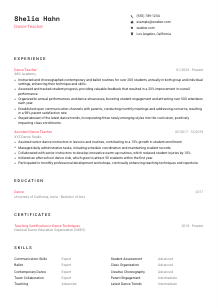
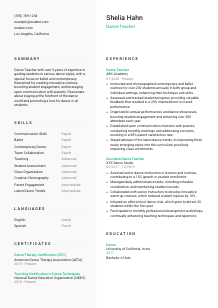
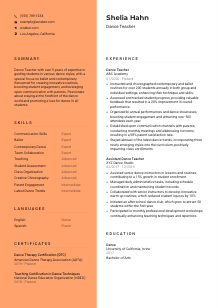
Stepping to the rhythm, but your resume feels offbeat? Check out this Dance Teacher resume example, created with Wozber free resume builder. It shows how to match your teaching skills and artistic flair with job demands, ensuring your career journey is as graceful as your grand jeté!
Dance teaching resumes are read through the lens of instruction, not performance alone. Schools and studios want to see how you train technique, adapt for different age groups, guide student progress, and help classes move toward recitals or showcases without losing structure or consistency in the studio.
A targeted resume makes that teaching range visible quickly, especially when hiring teams are sorting through adjacent profiles like performers, choreographers, and instructors. Wozber's free resume builder helps you shape an ATS-compliant resume around the language of the posting so your ballet, contemporary, assessment, and parent communication work are easy to pick out from the start.
For a Dance Teacher, the header needs to do one thing well: confirm that you are easy to contact and already aligned with the practical requirements of the role. Keep it clean, professional, and tailored to the setting where you will be teaching students and communicating with parents.
Use your full name in the largest text on the page so it is immediately identifiable in a studio manager's or school administrator's review. Skip decorative styling. Dance hiring often moves between printed resumes, emailed PDFs, and ATS parsing, so clarity matters more than flair.
Match your headline to the role you want. If the posting is for a "Dance Teacher," use that title directly rather than a broader label like "Performer" or "Choreographer." That distinction matters because teaching roles are screened for classroom instruction, student development, and curriculum contribution, not just stage experience.
Include a working phone number and a professional email address. If you have a website, portfolio, or reel that supports your teaching work, use it to show class clips, recital choreography, or teaching philosophy, not only performance footage. The contact section should reinforce that you are prepared for both studio communication and family communication.
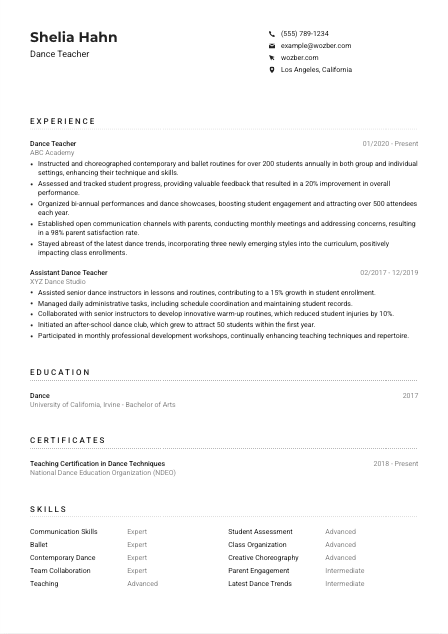
If the job specifies a city or region, include your city and state exactly. In the example, "Los Angeles, California" immediately addresses the location requirement and removes questions about relocation or local availability for rehearsals, recitals, and parent meetings.
Do not add age, marital status, headshots, or other details that do not help an employer understand your teaching qualifications. Use the space for information that supports scheduling, certification checks, or portfolio review instead.
Your personal details should confirm three basics right away: who you are, how to reach you, and whether you meet practical requirements such as location and professional presentation. That lets the rest of the resume stay focused on teaching quality.




This section carries the most weight for Dance Teacher hiring. Employers look for signs that you can run classes, build technique over time, work with different age groups, manage recital preparation, and communicate progress in a way parents and program leaders can trust.
Start with positions where you taught classes, coached individuals, or supported structured instruction. A recent Dance Teacher role should appear before less relevant performance work. In the example, the lead role immediately shows direct teaching in ballet and contemporary, which aligns well with the posted emphasis on those styles.
Go beyond job titles. State who you taught, how classes were delivered, and what your responsibilities included. Useful details include group and private instruction, age ranges, recital prep, choreography, technique correction, or curriculum support. That gives employers a clearer picture of whether you can step into their class schedule and student mix.
Quantify outcomes where you can. Good metrics for this field include student count, recital attendance, retention, performance improvement, enrollment growth, injury reduction, or parent satisfaction. The sample resume does this well with points like teaching more than 200 students annually, improving performance by 20%, and attracting over 500 attendees to showcases.
Trim accomplishments that do not strengthen your case for a teaching post. Administrative support can stay if it shows scheduling, student records, or program coordination, but the core of the section should stay on instruction, assessment, choreography, and student development. Every bullet should help explain how you operate in a dance education environment.
Mirror the language of the job description where it matches your actual background. Terms like "instructed," "choreographed," "assessed," "tracked progress," "provided feedback," and "organized performances" make your experience easier to connect to the role. This also helps ATS matching without forcing awkward keyword repetition.
By the end of this section, a reader should be able to see your teaching range, your classroom results, and your ability to support performances and student growth across the year. That is the core of Dance Teacher credibility.
Formal training matters in dance education because it shows technical grounding, discipline knowledge, and preparation for teaching beyond instinct or performance experience. Even when employers accept equivalent professional experience, your education section should still make your dance training easy to understand.
When a posting asks for a bachelor's degree in Dance or equivalent experience, make that qualification unmistakable. If you have the degree, list it clearly. In the example, "Bachelor of Arts" in "Dance" from the University of California, Irvine directly addresses the educational requirement.
Use a straightforward structure: degree, field, school, and graduation year. That is enough for most Dance Teacher resumes. Hiring teams want to confirm the credential quickly so they can return to your teaching history and style expertise.
If your degree is directly tied to dance, do not bury the field name. A clear entry such as "Bachelor of Arts in Dance" is stronger than listing only the degree title. This matters when the employer is comparing applicants with broader arts backgrounds against candidates with formal dance training.
Extra educational detail can help early-career candidates or applicants with highly relevant training. Consider adding teaching-focused coursework, choreography projects, pedagogy study, or notable performance training if it supports the role. Keep it brief and relevant to instruction, student technique, or curriculum contribution.
If you have several years of teaching behind you, your experience section will do more of the persuading. Still, dance employers often want to see your technical foundation, so do not minimize education to the point that it looks accidental or incomplete.
This section should confirm that your teaching practice rests on real dance training. Whether that comes from a degree, equivalent experience, or both, make the foundation easy to find and easy to trust.
Certifications carry extra value in dance teaching because they speak to safety, pedagogy, and ongoing professional development. When a role asks for state-specific teaching certification or membership in a recognized dance education association, this section becomes more than a nice addition.
Read the job ad carefully and surface certifications that directly match it. If the role asks for a teaching credential, state certification, or association membership, place that near the top of the section. In the example, certification tied to dance teaching and membership-linked recognition supports the employer's stated requirement.
Choose credentials that strengthen your case as an instructor. Teaching certifications, pedagogy programs, injury prevention training, child development coursework, or recognized association credentials usually matter more than unrelated workshop attendance. Quality and relevance beat a long list.
List the year earned and, if applicable, the active period. This helps employers understand whether the credential is current, especially for teaching certifications or memberships that may need renewal. The sample format of "2018 - Present" communicates that the credential remains active.
Dance education changes with new approaches to conditioning, inclusion, injury prevention, and class design. Update this section when you complete meaningful training that improves how you teach, assess, or support students. That ongoing development is especially useful when schools want instructors who stay current beyond their initial training.
The right certifications show that your teaching practice is current, recognized, and built for real student instruction. They also help close the gap between artistic ability and classroom trust.
A Dance Teacher skills section works best when it balances technical dance ability with instruction, communication, and class management. Employers are not only looking for style proficiency. They also need to know how you run a room, correct technique, and keep students and parents informed.
Start with the competencies named or implied in the posting. Here, that includes ballet or contemporary expertise, teaching across age groups, interpersonal communication, parent communication, assessment, choreography, and professional development. These are stronger anchors than broad claims like "creative" or "passionate."
Place your most job-relevant skills first. For this kind of role, style proficiency such as "Ballet" and "Contemporary Dance" should sit alongside classroom skills like "Student Assessment," "Creative Choreography," and "Communication Skills." The sample resume does this well by mixing technical and instructional strengths instead of separating them too sharply.
Avoid turning the section into a catchall inventory. Focus on the abilities you would use week to week in class planning, rehearsal preparation, student feedback, and recital delivery. A concise list makes it easier for hiring teams and ATS tools to connect your background to the opening.
This section should make it obvious that you can teach the required styles, manage the learning environment, and communicate well with the people around the student. That blend is what makes a Dance Teacher effective.
Language ability matters in dance teaching because instruction is physical, verbal, and relational at the same time. You are cueing movement, correcting technique, explaining musicality, and often speaking with parents about progress, expectations, and upcoming performances.
If the role requires fluency in a specific language, list it plainly with your proficiency level. In this posting, English is required, so it should appear first. That tells the employer you can teach classes, give feedback, and handle parent communication in the language their program uses daily.
Extra languages can be valuable when they help you connect with students and families in your community. For example, Spanish may be useful in some Los Angeles studios or schools, but it is an advantage rather than a universal requirement. Include additional languages when they are real working strengths.
Keep levels easy to interpret. Terms such as "Native," "Fluent," "Intermediate," and "Basic" are enough. This matters because employers need to know whether you can simply greet families, handle full parent conversations, or teach comfortably in that language.
Language skills are especially helpful in roles that involve parent updates, recital coordination, and student support across mixed-age groups. If you can communicate clearly with both children and adults in more than one language, that can improve trust and reduce friction around schedules, expectations, and feedback.
If you take language classes or gain real teaching experience in another language, revise the section to reflect your current level. Keep it honest. Instructors are often hired into community-facing environments where practical communication matters more than a long language list.
List the languages you can genuinely use in teaching and parent communication. Done well, this section shows that you can reach students clearly and support families with confidence.
The summary should quickly establish your teaching identity, the styles you work in, and the kind of student outcomes you help produce. For Dance Teacher roles, that usually means blending technique instruction, choreography, progress tracking, and performance preparation into a short, focused opening.
Start by identifying the role's most important themes. In this case, those include multi-style instruction, emphasis on ballet and contemporary, work across age groups, student assessment, and parent communication. Use those points to decide what belongs in your opening lines.
Lead with a direct statement such as "Dance Teacher with 5+ years of experience" if that reflects your background. This immediately places you in the correct hiring category and gives context for the rest of the summary. Keep it factual and specific.
Choose strengths that matter in day-to-day teaching. Good options include choreography for student showcases, measurable improvement in technique, curriculum design, strong parent communication, or experience teaching both group and private lessons. The example summary works because it points to student engagement, innovative routines, and communication rather than relying only on enthusiasm.
Aim for three to five lines. That is enough room to state your experience, style focus, and a few teaching strengths without repeating the experience section. A concise summary helps the employer quickly understand whether to keep reading for the details.
Your summary should make one thing clear right away: you are ready to teach, not simply perform. When it is aligned with the posting, the rest of the resume has a much easier job proving it.
Once each section is aligned with the job, your resume should show a clear teaching profile: relevant dance styles, student outcomes, recital or showcase involvement, communication with parents, and any required credentials or location details.
Use Wozber's free resume builder to organize that experience into an ATS-friendly resume template, strengthen phrasing with role-specific terminology, and improve ATS optimization without flattening your real teaching voice.
The finished resume should make it easy to judge whether you can lead classes, develop technique, and contribute to a dependable dance program from day one.




