



Use Wozber and land your dream job
Create Resume
No registration required
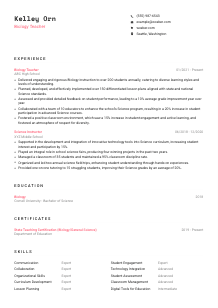
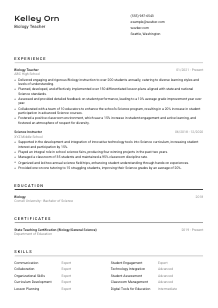
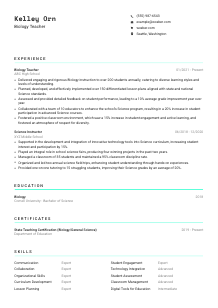
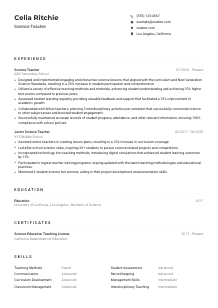
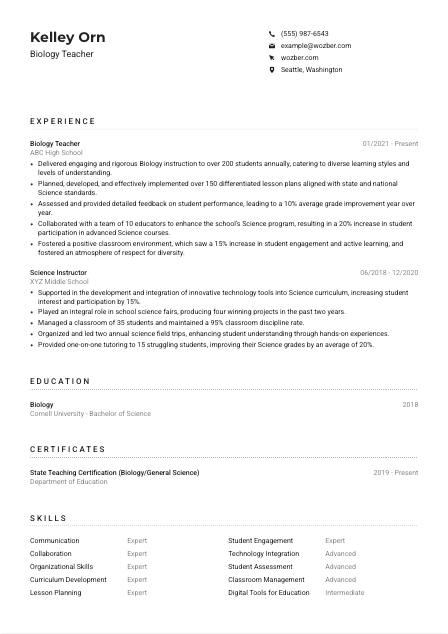
Unraveling the mysteries of life, but your resume could use some evolution? Check out this Biology Teacher resume example, created with Wozber free resume builder. It shows how to adapt your scientific insights to meet academic expectations, propelling your teaching journey to species-swapping heights!
Biology teaching gets evaluated in the classroom long before a principal reads every line of your resume. Schools want someone who can turn complex topics like genetics, cell processes, and ecosystems into lessons students can actually follow, while keeping instruction aligned with standards, assessments, and classroom realities. Your resume should make that teaching range visible, from lesson design and lab-based learning to student growth and classroom culture.
When a resume is tailored well, it quickly separates secondary Biology teachers from broader science generalists by showing subject depth, standards-based planning, and measurable student outcomes. Wozber's free resume builder helps organize that information into an ATS-friendly resume format, so coursework, certification, classroom results, and technology integration are easy to scan and easy to connect to the teaching work a school needs covered.
School hiring teams move through contact details quickly, but they still notice whether this section answers practical questions upfront. For a Biology Teacher, your header should confirm who you are, what role you teach, and whether location or credentials line up with the posting.
Use your full name as the most visible text at the top of the page. Keep the formatting clean and professional so the document opens with the same clarity you would bring to a lesson plan or parent communication.
If you are applying for a Biology Teacher opening, label yourself "Biology Teacher" rather than a broader title like "Educator" or "Science Professional." That direct match helps hiring teams and ATS filters identify your subject area immediately.
List a reliable phone number and a professional email address. Double-check both. A missed digit or typo can cost you an interview, especially during fast school hiring cycles before the term begins.
If a school specifies a city or relocation requirement, include your current city and state. In the example, listing "Seattle, Washington" directly supports a posting that requires candidates to be based there or willing to move, which removes an early point of uncertainty.
Include a website, portfolio, or professional profile only if it supports your candidacy. For teachers, that might mean a page with curriculum projects, classroom resources, science fair leadership, or a concise teaching philosophy. Skip links that are outdated or unrelated to classroom practice.
This section should answer the basic logistics in seconds and reinforce that you are applying as a Biology teacher, not as a generic educator.




Schools hire Biology teachers for what happens between the standards document and the student desk. Your experience section should show what you taught, how you taught it, and what changed for students because of your instruction.
Before writing bullets, identify the work the school cares about most. Here, that includes differentiated Biology instruction, standards-aligned lesson planning, assessment, recordkeeping, collaboration, and classroom environment. Use those priorities to decide which accomplishments deserve space.
List each position in reverse chronological order with the school name, your title, and dates of employment. That format makes it easy to track your secondary teaching history, progression from broader science instruction into Biology-specific work, and the amount of classroom experience you bring.
Each bullet should connect a classroom responsibility to a result. Strong Biology Teacher bullets often cover lesson design, lab instruction, standards alignment, student assessment, intervention, and collaboration with science departments. The example does this well by pairing work like developing differentiated lesson plans with clear scope and results.
Quantify what you can with student counts, lesson volume, grade improvement, participation rates, or program growth. "Taught over 200 students annually," "developed 150+ lesson plans," or "improved average grades by 10%" reads much stronger than a generic claim about supporting student success.
Keep the focus on teaching experience that supports a secondary Biology opening. If you include adjacent science roles, frame them in ways that show transferable value, such as curriculum support, technology integration, tutoring, field-based learning, or classroom management. The sample's middle school science work earns its place because it supports Biology teaching through instruction, engagement, and hands-on learning.
Your experience section should show a teacher who can plan rigorous Biology instruction, manage a classroom well, and improve student learning in measurable ways.
For Biology teachers, education does two jobs on a resume. It confirms subject knowledge in the life sciences and shows formal preparation for classroom instruction, curriculum, and student learning.
A bachelor's degree in Biology or a related field should be easy to find because it directly supports your ability to teach the content. If your degree is in a neighboring area such as biochemistry, environmental science, or general science, keep the field explicit so schools can connect it to the role.
List degree, field of study, school, and graduation year. That is enough for most teaching resumes. Clear formatting helps administrators quickly confirm that your academic background matches subject-area hiring requirements.
If you hold a Master of Arts in Teaching, a Master of Education, or another degree tied to instruction, place it where it is easy to spot. In the example, the teaching master's strengthens the application because the posting prefers advanced preparation or certification beyond the biology degree itself.
Coursework, research, honors, or campus activities can help early-career teachers, especially if they connect to biology content, instructional practice, or youth education. Examples include microbiology research, undergraduate lab assistant work, peer tutoring, or science outreach.
Academic honors can support your profile, but keep them relevant and brief. Include them when they reinforce subject mastery, teaching preparation, or consistent performance, not as filler.
This section should make it easy to see that you are qualified to teach Biology and prepared to handle the instructional side of the job.
Teaching roles often have a hard credential screen before your classroom achievements are discussed. If the posting calls for state certification, your resume needs to show that status clearly and early enough that no one has to hunt for it.
Pull the certification language from the posting and mirror it accurately when it reflects your actual credential. For this opening, a state teaching certification in Biology or General Science is a key requirement, so that certification should appear exactly and prominently.
If you hold several credentials, start with the one that qualifies you to teach the subject and age group in question. A Biology or General Science teaching license matters more here than unrelated training certificates.
Add the issuing body and validity dates when relevant. For school employers, this is practical information, not decoration. The example's certification entry works because it shows the credential is active and tied to a Department of Education.
Professional development and added endorsements can strengthen your profile over time, especially in areas like science instruction, educational technology, special education support, or advanced placement coursework. List them when they have real hiring value for the role you are targeting.
A clearly listed teaching license removes one of the biggest barriers in school hiring and lets the reader focus on your classroom track record.
A Biology Teacher skills section should read like the toolkit of someone who can run an effective science classroom, not like a generic list pulled from any education resume. Prioritize skills tied to instruction, student learning, and subject delivery.
Start with the posting, then translate it into real classroom capabilities. In this case, that means differentiated instruction, lesson planning, assessment, technology integration, collaboration, communication, and organization. These are not abstract traits. They show up in daily teaching practice.
Include both instructional and operational strengths. A strong list might pair curriculum development and student assessment with classroom management, student engagement, and digital tools for science learning. The sample does this effectively by combining soft skills with concrete teaching functions.
Do not overload this section with every competency you have ever used. Choose the skills most relevant to a secondary Biology classroom and to the posting's priorities. A shorter list with clear relevance is easier for an ATS to parse and easier for a department head to trust.
Your skills section should reinforce that you can teach Biology well, manage the classroom responsibly, and work within a modern school environment.
Language ability matters in teaching because instruction, feedback, family communication, and collaboration all depend on it. Even when only one language is required, list it clearly so there is no ambiguity about your classroom communication level.
If the role requires English fluency, list English at the top with an accurate proficiency level such as "Native" or "Fluent." That directly addresses a stated requirement and supports your ability to teach, document progress, and communicate with colleagues and families.
After the required language, include any additional languages that could support your work with students or families. In many school settings, an extra language can be useful for relationship-building and accessibility, even when it is not a formal requirement.
Use clear levels such as Native, Fluent, Advanced, or Intermediate. Overstating language ability can create problems in real classroom or parent-facing situations, so accuracy matters.
Additional language ability can strengthen your profile when it supports a diverse student community, multilingual households, or cross-cultural communication. In the example, Spanish adds value because it suggests broader communication range beyond the required English fluency.
A language section does not need explanation or storytelling. List the language and your level, and let it support the rest of your teaching profile.
Clear language information helps schools understand how you will communicate in the classroom and across the wider school community.
The summary is where you frame your teaching profile in a few lines. For Biology teachers, it should combine subject knowledge, classroom experience, and the kind of student outcomes or instructional strengths that matter for the role.
Start with your title and years of relevant experience, such as secondary Biology teaching or broader science instruction. This gives the reader immediate context and helps distinguish you from candidates coming from research-only or non-classroom backgrounds.
Mention two or three core strengths that match the school's needs. Here, useful choices include standards-aligned lesson planning, differentiated instruction, technology integration, assessment, and building a positive classroom environment.
A summary becomes more convincing when it points to outcomes. That might be stronger student performance, improved engagement, science program contributions, or success with diverse learners. The example summary works because it ties experience to engagement, program improvement, and classroom practice.
Aim for 3 to 5 lines with specific language. Avoid broad statements about passion unless they are backed by classroom substance. A principal should be able to read the summary quickly and understand what kind of Biology teacher you are.
A focused summary gives schools a fast, accurate picture of your Biology teaching background before they move into the details of your experience.
A Biology Teacher resume works best when it connects subject expertise, classroom practice, and student outcomes in language that matches the school's opening. If your degree, certification, standards-based teaching, assessment work, and collaboration are all easy to find, hiring teams can quickly see whether you are ready for the classroom they need to fill.
Use Wozber's free resume builder to shape that information into an ATS-compliant resume, then refine it with targeted wording, clean structure, and role-specific details. The finished resume should make one thing clear without effort: you can teach Biology well, manage the classroom responsibly, and contribute to the science program from day one.




