



Use Wozber and land your dream job
Create Resume
No registration required
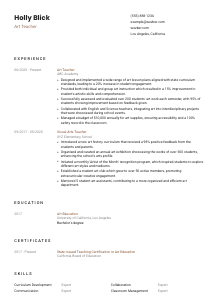
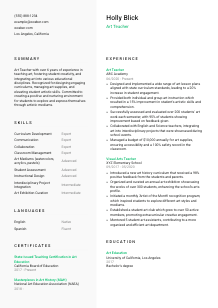
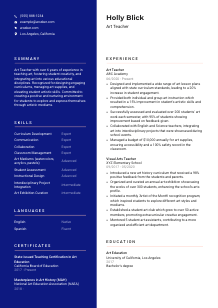
Painting the perfect picture, but your resume lacks artistic flair? Check out this Art Teacher resume example, created with Wozber free resume builder. Learn how to blend your creative instincts with job guidelines, ensuring your career canvas is as vibrant as your students' masterpieces!
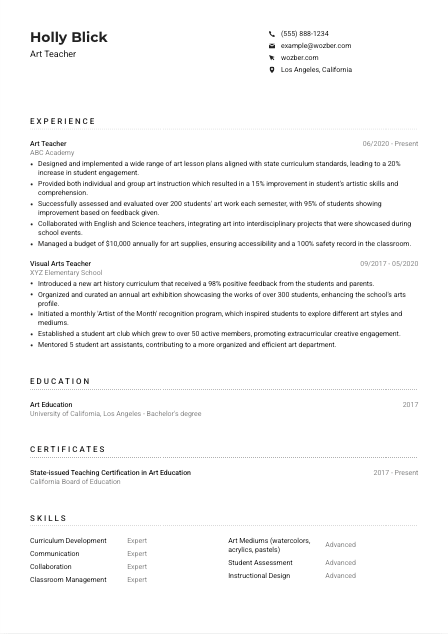
Art teaching resumes are strongest when they show what happens in the classroom, not just a love of creativity. Schools want to see how you turn studio knowledge into structured learning through lesson planning, age-appropriate instruction, student feedback, and a safe, well-run art room. Your resume should make that teaching practice visible from the first lines.
A tailored resume also helps a school quickly separate general arts experience from K-12 teaching experience. Using Wozber's free resume builder and an ATS-friendly resume format, you can mirror the language of the posting, surface teaching certification, curriculum alignment, and classroom results, and make it easier for a hiring team to recognize that you can lead instruction, assess student work, and contribute to school-wide learning.
School hiring teams start with practical questions. Can this person be reached easily, are they applying for the right teaching role, and do they meet any location requirement named in the posting? Your personal details should answer those points cleanly and without clutter.
Place your full name at the top in a clear, readable format. Keep the styling simple and professional so the page reads like an educator's resume, not a design portfolio. If you also maintain an artist identity, use the same version of your name that appears on your certification and school employment records.
Add "Art Teacher" directly under your name when that is the role you are pursuing. This keeps your positioning clear, especially if your background includes titles like "Visual Arts Teacher" or "Arts Instructor." In the sample resume, the headline uses the exact target title while the experience section still reflects related roles naturally.
List a current phone number and a professional email address that would look appropriate in a school setting. Double-check both. A missed digit or outdated inbox can stop an application before anyone reads about your lesson planning, classroom management, or student outcomes.
If the posting calls for someone based in Los Angeles or willing to relocate, show that clearly in your personal details. The example resume includes Los Angeles, California, which removes uncertainty on a sample that specifically asks for local availability. For other art teaching roles, only include location details that support the employer's stated requirement.
Include a portfolio site, teaching website, or LinkedIn profile only if it strengthens your application. For an Art Teacher, that link might show student exhibition work, classroom projects, curriculum samples, or your teaching philosophy. Make sure it matches the tone and facts of your resume, especially around grade levels taught and instructional work.
This section should quickly confirm that you are reachable, professionally presented, and aligned with the opening's basics. Once that is clear, the rest of the resume can focus on what matters most in art education: how you teach, assess, and support student growth.




For Art Teacher roles, experience is where schools look for proof that you can run instruction from planning to assessment. Hiring teams are scanning for lesson design, classroom delivery, feedback habits, collaboration with other staff, and the practical management of materials, safety, and student engagement.
Read the posting and identify the recurring teaching expectations before you rewrite your bullets. Here, the priorities include standards-aligned lesson plans, individual and group instruction, regular evaluation of student work, interdisciplinary collaboration, and art supply management. Those should shape what rises to the top of your experience section.
Start with your most recent teaching position and keep the structure consistent: school name, title, and dates. This gives a clear view of your K-12 teaching timeline, which matters when a school asks for at least 2 years of experience. If you have both classroom and community arts experience, keep school-based roles first and make the educational scope obvious.
Each bullet should show how you taught, what you implemented, and what changed for students or the school. Instead of saying you were responsible for lesson planning, say you designed art lessons aligned with state standards that increased participation, improved technique, or supported cross-subject projects. The sample does this well by tying lesson planning and instruction to gains in engagement and student skill development.
Quantify outcomes where the numbers are meaningful in education. That might include student engagement, number of students assessed, exhibition participation, supply budgets, club growth, or improvement rates after feedback cycles. In the example, evaluating more than 200 student works per semester and managing a $10,000 supply budget gives the hiring team a clear sense of scope and responsibility.
Prioritize experience that reflects teaching art to students, building curriculum, guiding creative exploration, and maintaining a safe classroom environment. Trim generic statements that do not show instructional value. If you mention events or extracurriculars, connect them back to student learning, school culture, or arts visibility, such as curating an exhibition or leading an art club.
After reading your experience section, a principal or department lead should understand how you teach, how you measure progress, and how you contribute beyond a single lesson. The best bullets show an art educator who can manage both creative instruction and the daily realities of a K-12 classroom.
Education matters more in teaching resumes than it does in many other fields because it directly supports eligibility for the role. For an Art Teacher opening, this section should quickly show that your academic background supports both art instruction and classroom practice.
When a posting asks for a Bachelor's degree in Art Education or a related field, make that easy to spot. If your degree is directly in Art Education, use that wording prominently. In the sample resume, "Bachelor's degree" and "Art Education" align cleanly with the stated requirement.
Use a simple structure with degree, field of study, school name, and graduation year. Teaching resumes usually benefit from clarity here more than detail. A school administrator should be able to confirm your academic qualification in a quick scan.
If your actual credentials match the employer's wording, reflect that language naturally for ATS optimization and easy review. For example, "Bachelor's degree in Art Education" is stronger than a vague reference to arts studies when your degree truly fits. Use exact phrasing only when it is accurate to your record.
If you are newer to teaching, you can strengthen this section with student teaching placements, curriculum-focused coursework, child development study, or capstone projects tied to visual arts education. These details help when your classroom experience is still growing and can show preparation for lesson planning and assessment.
Academic honors, scholarships, or leadership in arts education organizations are worth listing if they reinforce your teaching profile. Choose items that support the role, such as distinction in art education, exhibition leadership, or involvement in education-focused arts groups, rather than unrelated campus activities.
This section should confirm that your training supports the classroom work described elsewhere on the resume. When your degree is presented clearly and matches the level of the role, the hiring team can move on to the bigger question: how effectively you teach.
Certification is not a minor add-on for school roles. It is often a threshold requirement. For an Art Teacher resume, list required teaching credentials first, then use additional certifications to show continued growth in art instruction, pedagogy, or subject depth.
If the job asks for a state-issued teaching certification in Art Education, place that credential first and name it clearly. Do not make a school search for it. The sample resume gets this right by listing the state-issued art education certification before any supplemental credential.
After the required license, include certificates that add relevant value to your classroom profile. Good examples include art history study, specialized studio methods, classroom technology for visual arts, or professional development tied to K-12 instruction. Avoid filling this section with unrelated short courses that do not strengthen your candidacy.
Add issue dates, renewal periods, or active status when those details help confirm that a credential is current. This matters especially for state licenses and any training tied to compliance, instructional methods, or ongoing professional standing.
Schools appreciate teachers who keep refining both subject knowledge and instructional practice. If you have recent training in new mediums, inclusive teaching approaches, portfolio assessment, or arts integration, this section is a good place to show that your development did not stop after initial certification.
Your certificates section should first remove any doubt about eligibility, then add depth to your profile as an art educator. Keep it focused on credentials that strengthen classroom credibility and current teaching practice.
The skills section should read like the toolkit of a working art educator. Schools are looking for a blend of instructional ability, classroom management, subject knowledge, and collaboration, not a generic list of soft skills pulled from any resume template.
Start with the skills the employer actually names, then add closely related strengths you use in the classroom. In this case, that includes curriculum development, student assessment, communication, classroom management, and proficiency across art mediums and techniques. Only include skills you can support elsewhere in the resume.
Order your list around the job's priorities. For an Art Teacher, core teaching skills such as curriculum development, instruction, assessment, and collaboration should usually appear before secondary items. The sample resume does this effectively by leading with curriculum development, communication, collaboration, and classroom management before listing medium-specific strengths.
A school needs to know both that you can teach and that you have enough studio range to guide students across materials and techniques. Pair instructional skills with medium knowledge where relevant, such as watercolor, acrylics, pastels, ceramics, drawing, or mixed media. Keep the list focused enough that each item supports the role.
When this section is tailored well, it reinforces the experience section rather than repeating it. The list should sound like the profile of someone who can plan lessons, manage a classroom, teach technique, and work well with students and staff.
Language ability matters in teaching because communication runs through every part of the job, from instruction and critique to parent conversations and staff collaboration. On an Art Teacher resume, list languages in a way that supports the communication demands of the school environment.
If the posting explicitly asks for high-level English communication, list English clearly and give an honest proficiency level. This is especially important in teaching roles, where communication affects lesson delivery, classroom management, written feedback, and collaboration with families and colleagues.
After English, list any additional languages that are useful for the student population or parent communication in your target area. In the sample, Spanish is a practical addition for a Los Angeles-based school setting, but that kind of local relevance will vary by district and student community.
Extra language skills can strengthen your resume when they help with cultural connection, family outreach, or a diverse classroom environment. Keep the section selective. A shorter, accurate list is more useful than a long list of languages you rarely use in professional settings.
Use clear labels such as "Native," "Fluent," "Intermediate," or "Basic." Schools may rely on these skills in real interactions with students or caregivers, so accuracy matters. Overstating proficiency can create problems quickly in parent conferences or classroom support situations.
Not every Art Teacher opening needs multiple languages, but many schools value them because art classes often involve discussion, critique, encouragement, and family-facing events like exhibitions. If another language helps you connect with students and school communities more effectively, it is worth including.
This section should support your profile as an educator who can communicate clearly in the classroom and, where relevant, across a broader school community. Keep it truthful, relevant, and tied to how you actually teach and interact.
Your summary is the quickest way to frame your teaching profile before the reader reaches the details. For Art Teacher roles, it should establish experience level, instructional strengths, and the kind of student and classroom impact you deliver.
Before writing, note the themes that drive the posting. Here, those include K-12 art instruction, standards-aligned lesson planning, student assessment, collaboration, and a positive learning environment. Your summary should echo the most important parts that genuinely reflect your background, not try to cover everything.
Start with a direct line that names your profession and years of experience, such as "Art Teacher with 6+ years of K-12 experience." This immediately places you at the right level and helps distinguish you from studio artists, museum educators, or general classroom teachers with limited art instruction background.
Follow with the teaching strengths that matter most for the role, such as curriculum design, interdisciplinary collaboration, student skill development, or classroom culture. The example summary works because it combines years of experience with concrete strengths like designing engaging curriculum and improving student artistic growth.
Aim for a short paragraph of 3 to 5 lines. Skip broad claims about passion or creativity unless they are anchored in teaching practice. A concise summary that mentions K-12 art instruction, lesson planning, student development, and classroom environment will do more work than a longer paragraph full of general enthusiasm.
A well-written summary should make the reader expect a resume full of clear teaching experience, thoughtful curriculum work, and measurable student impact. When it is tailored to the opening, it positions you as an art educator who can step into the classroom and contribute immediately.
Your Art Teacher resume should now present a clear teaching profile: relevant education, active certification, classroom experience, instructional skills, and student-centered results. That combination tells a school you can do more than teach technique. It shows you can plan lessons, manage the room, assess work thoughtfully, and support creative growth across grade levels.
Use Wozber's free resume builder to tighten structure, align wording with the posting, and strengthen ATS optimization with an ATS-compliant resume that reflects your real classroom experience. When the resume is tailored well, a hiring team can quickly see that you are ready to teach art, guide students, and contribute to the wider life of the school.




