



Use Wozber and land your dream job
Create Resume
No registration required
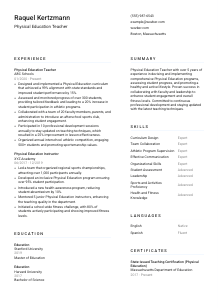
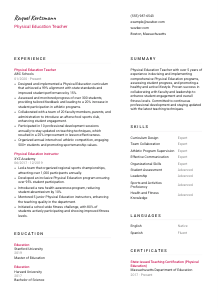
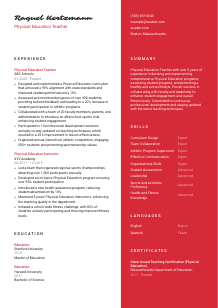
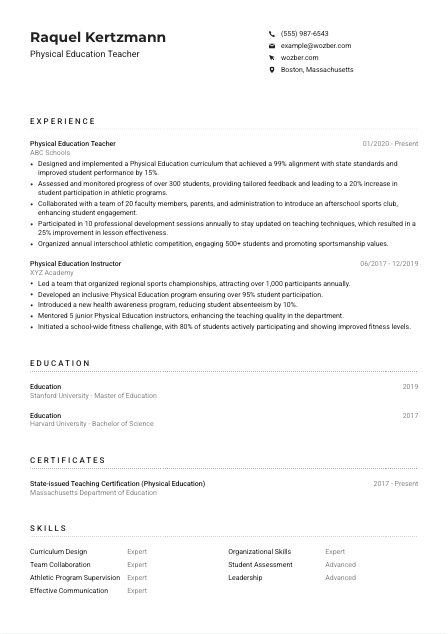
Shaping bodies and minds, but your resume feels out of bounds? Check out this Physical Education Teacher resume example, created with the Wozber free resume builder. Learn how to highlight your energetic instruction and fitness expertise to hit the target for school districts seeking health-savvy mentors!
Physical Education teaching is visible work. Schools can quickly tell whether a candidate has actually run classes safely, kept students engaged across different ability levels, and translated fitness goals into structured lessons that meet state standards. Your resume needs to show that balance of instruction, classroom management, assessment, and student development, not just a general interest in sports or wellness.
A tailored resume changes how your experience is read in both screening systems and by school leaders. When the language mirrors priorities such as curriculum design, student progress monitoring, and extracurricular supervision, Wozber's free resume builder helps you shape an ATS-compliant resume that surfaces the teaching work behind your results. That makes it easier for a hiring team to see you as someone who can step into a K-12 PE program and run it well.
School hiring starts with practical checks. Before anyone reads your lesson-planning experience, they need to see that your contact details are professional, your target role is clear, and any location requirement in the posting is addressed without confusion.
Use your full name in a larger, clean font so it is immediately visible. School administrators often review many applications at once, and your header should make it easy to identify you without distracting design choices.
Place "Physical Education Teacher" directly under your name when that is the target role. This helps frame the rest of the resume around instruction, health, student activity, and school athletics rather than broader education or coaching work.
If the posting calls for Boston, Massachusetts, show Boston in your personal details if you are already there. If you plan to relocate, state that clearly. This is a sample-specific requirement, but when location is named in a posting, removing doubt helps your application move forward.
Add a LinkedIn profile or professional site only if it supports your candidacy. For a Physical Education Teacher, that might include teaching credentials, school experience, athletic program leadership, or professional development activity that matches the resume.
Your personal details should answer the immediate practical questions: who you are, what role you want, how to reach you, and whether any location requirement is covered. That lets the school focus on your teaching background instead of missing basics.




This section carries the most weight because schools want proof that you can manage active classes, teach skill progression, measure student growth, and contribute to the broader life of the school. Strong bullets show what you taught, how you taught it, and what changed for students as a result.
Pull out the responsibilities that define the job, then match them to your own history. For Physical Education roles, that usually includes lesson planning, curriculum delivery, student assessment, collaboration with school staff and parents, and supervision of sports or afterschool programs. In the example, those themes are reflected clearly through curriculum alignment, progress monitoring, and athletic event leadership.
List positions in reverse chronological order with the school name, your job title, and employment dates. If your title was "Physical Education Instructor" rather than "Teacher," keep the official title but make sure the bullets show classroom teaching, student assessment, and school-based responsibilities that align with the target role.
Replace generic statements like "taught PE classes" with specifics about curriculum, instruction, inclusion, assessment, or program building. The sample resume does this well by showing outcomes such as improved student performance, higher participation, and new extracurricular offerings. Those details tell a hiring team how you operated in the gym, on the field, and within the school community.
Metrics make your work easier to understand when they reflect real education results. Good examples include number of students taught, participation rates, curriculum alignment, attendance impact, event turnout, or improvement in fitness benchmarks. A bullet like assessing more than 300 students or increasing participation by 20% gives concrete scale to your teaching.
Prioritize experience that supports K-12 Physical Education hiring. Coaching, event organization, health promotion, mentoring newer instructors, and inclusive activity planning all belong when they connect to student development and school programming. Leave out unrelated work unless it directly strengthens your case as an educator.
By the end of this section, a principal or department lead should be able to picture you planning lessons, managing student movement safely, tracking progress, and contributing beyond class time. That is the level of clarity your experience section should deliver.
For teaching jobs, education is not background filler. It confirms that you meet baseline academic requirements and can support instruction with formal preparation in education, health, movement, or a related field.
If the posting asks for a bachelor's degree in Education or a related field, make sure that credential is easy to spot. If you also hold a master's degree, include it prominently because it can strengthen your profile for schools that value advanced training, even when it is listed as preferred rather than required.
For each degree, list the institution, degree name, field of study, and graduation year or date format used across the rest of your resume. Clear formatting matters because education credentials are often checked quickly alongside certification status.
Write out credentials clearly, such as "Bachelor of Science in Education" or "Master of Education." In the example, both degrees align closely with the role, which helps reinforce the candidate's preparation for school-based instruction and curriculum work.
Most experienced Physical Education Teachers do not need to list classes. Consider it only if you are early in your career or if specific coursework strengthens your application, such as motor development, adaptive physical education, health instruction, or curriculum design.
Honors, teaching-related projects, or leadership in education programs can help if they reinforce your readiness for the classroom. This matters most for newer educators who may need added proof of preparation before their work experience carries the story.
Your education section should quickly confirm that you meet the academic bar for the role and, when applicable, show added depth through graduate study or relevant training. It should support your teaching credibility without taking attention away from classroom results.
For a Physical Education Teacher, certification is often a gatekeeping requirement, not an optional bonus. Schools usually need to confirm that you are authorized to teach in the subject area before moving your application deeper into review.
When a job asks for a state-issued teaching certification in Physical Education, place that credential clearly in this section. If you hold the exact state license named by the employer, list it exactly. In the sample, the Massachusetts certification directly supports the posting's requirement.
Include certifications that strengthen your candidacy for PE instruction, student safety, or school athletics. Teaching licensure comes first. Additional items such as CPR, first aid, coaching credentials, or adaptive PE training can follow when they are current and relevant.
Add issue dates, renewal dates, or active status where appropriate. For education roles, an up-to-date credential tells the school there should be no uncertainty around eligibility or compliance.
Professional development in teaching methods, health education, student wellness, or athletic supervision can strengthen future applications. Keep this section current so it reflects the standards and responsibilities attached to the roles you are pursuing now.
A clearly listed teaching certification reduces friction in school hiring. It shows that you meet a core requirement and are prepared to teach Physical Education within the standards and regulations of the role.
The best skills sections for PE teachers read like the toolset behind effective classes and well-run programs. Schools are looking for a mix of instructional ability, student management, assessment, communication, and fitness knowledge, not a generic list of soft skills.
Read the job description closely and extract the capabilities it emphasizes. In this case, that includes curriculum design, communication, organization, leadership, knowledge of physical fitness and health, and the ability to teach a range of sports and activities. Those are better anchors than broad claims with no connection to school practice.
Choose skills that reflect what happens in the role: lesson planning, student assessment, activity instruction, behavior management in active settings, extracurricular supervision, and collaboration with faculty and families. The sample resume's mix of curriculum design, athletic program supervision, health knowledge, and communication is a solid example of role alignment.
Put the most job-relevant capabilities first so the section reads with purpose. If the school emphasizes standards-aligned curriculum and student progress monitoring, those should appear before more general strengths. A tight, prioritized skills list is more persuasive than an oversized inventory.
This section should confirm that you have the instructional, organizational, and program-management abilities needed to run effective PE classes and contribute to school life. Every skill listed should connect back to how you teach, assess, or lead.
Language ability matters in education because instructions need to be understood clearly, especially in active environments where safety, participation, and student confidence are all tied to communication. List languages in a way that supports the role rather than turning this section into filler.
If the posting asks for superior English language skills, place English first and mark your proficiency accurately. For teaching roles, this supports classroom instruction, parent communication, progress feedback, and collaboration with colleagues.
Order this section by practical relevance to the job. English should lead when it is the language of instruction, followed by any additional languages that could support communication with students and families.
Extra languages can be useful in diverse school communities, especially when they help with student rapport or family engagement. In the example, Spanish adds value without replacing the need to foreground English first.
Use honest labels such as Native, Fluent, Advanced, or Conversational. A school may rely on this information for classroom communication or family outreach, so inflated claims can quickly become a problem.
Not every PE role requires more than one language, but multilingual ability can be an advantage in districts with diverse student populations. Include it when it genuinely supports your effectiveness as an educator.
Your language section should show that you can communicate clearly in the school environment and, where relevant, extend that communication across a broader student and family community. For PE teaching, clarity and trust matter as much as fluency.
Your summary should quickly tell a school what kind of Physical Education Teacher you are. In a few lines, connect your experience level, teaching scope, and strongest outcomes so the reader enters the rest of the resume with the right picture in mind.
Focus on what you actually do well in schools: building standards-aligned curriculum, teaching fitness and sport fundamentals, assessing student progress, and supporting healthy participation. Keep it grounded in instruction and student outcomes rather than general enthusiasm.
Start with a direct line such as "Physical Education Teacher with 5+ years of K-12 experience." This immediately gives hiring teams the level and context they need. If your background is split across teacher and instructor titles, the opening can unify that experience clearly.
Use the rest of the summary to mention the qualifications that matter most for the target job. The sample does this by referencing comprehensive PE programs, student progress assessment, collaboration, and improved engagement around fitness. That is much stronger than a summary built on passion alone.
Aim for three to five lines. That is enough room to establish your teaching profile, subject expertise, and one or two measurable strengths without repeating bullet points from the experience section.
A strong summary should make your candidacy legible right away: an experienced educator who can teach Physical Education effectively, support student growth, and contribute to the broader school program. If that picture is clear, the rest of the resume has a solid lead-in.
A Physical Education Teacher resume should make three things easy to judge: whether you meet the school's teaching requirements, whether you can run effective and safe PE instruction, and whether your work improves student participation, fitness, or engagement. When each section supports those points, the application reads with much more confidence.
Use Wozber's free resume builder to organize that experience into an ATS-friendly resume template, and refine the language with its ATS resume scanner so your qualifications map cleanly to the posting. The result should show a school exactly how you would contribute in class, in assessment, and across the wider student activity program.