



Use Wozber and land your dream job
Create Resume
No registration required
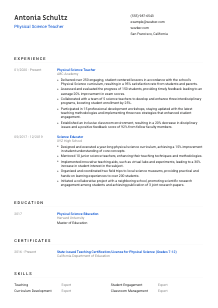
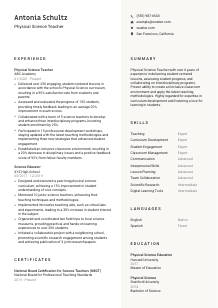
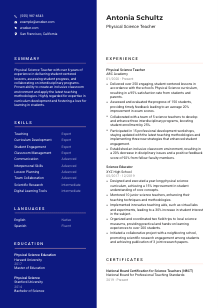
Unraveling the wonders of the universe, but your resume feels out of orbit? Propel your profile forward with this Physical Science Teacher resume example, created with Wozber free resume builder. Learn how to fuse your scientific expertise with job expectations, positioning your career trajectory on a path just as fascinating as a chemical reaction!
Physical science teaching is judged in the classroom long before test scores arrive. Schools want teachers who can explain force, energy, matter, and scientific reasoning in ways students can actually follow, while keeping labs safe, lessons structured, and curiosity alive. Your resume should make that teaching practice visible, not just list school names and duties.
A tailored resume helps a hiring team quickly see whether your background matches the grade level, curriculum depth, and classroom outcomes they need. Using Wozber's free resume builder to shape an ATS-compliant resume makes it easier to align your wording with the posting, surface details like licensure and student-centered instruction, and show that you can walk into a physical science classroom ready to teach effectively.
For a teaching role, the header needs to answer a few practical questions fast. Can the school contact you easily, do you match the role you are applying for, and do you meet any location requirement stated in the posting? Keep this section clean and direct so the hiring team can move straight to your classroom qualifications.
Use your full name in a clear, readable format at the top of the page. As a teacher, your resume should already reflect the professionalism and clarity you bring to lesson plans, parent communication, and classroom materials.
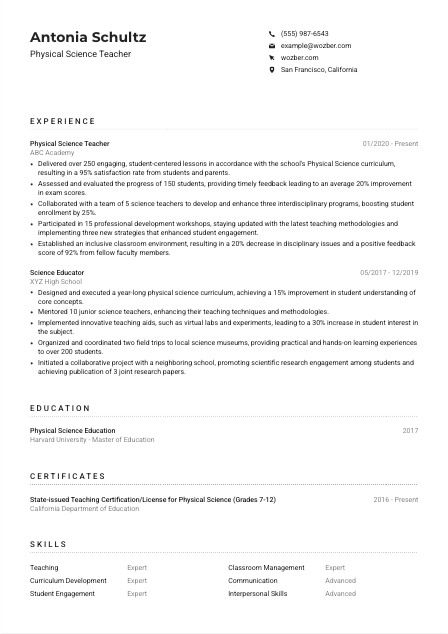
Place "Physical Science Teacher" directly under your name when that is the role you are pursuing. Matching the posted title helps with ATS alignment and immediately frames your experience around science instruction rather than broader education work.
List a reliable phone number and a professional email address. Hiring teams often move quickly when scheduling interviews, demo lessons, or screening calls, so this information needs to be accurate and easy to find.
If the employer asks for candidates in a specific area, show your city and state. In the example, "San Francisco, California" directly answers the posting's location requirement and removes an avoidable question about relocation.
Include LinkedIn or a professional teaching portfolio only if it strengthens your application. A useful link might show curriculum samples, lab activities, classroom projects, or your teaching philosophy, giving schools a better sense of how you teach physical science in practice.
This section should confirm the basics in seconds: who you are, what role you teach, how to reach you, and whether you meet any stated location requirement. Save the deeper story for the sections that follow.




This is where schools look for proof that you can teach physical science, manage a classroom, and help students learn measurable content. Strong experience bullets show what you taught, how you taught it, who you taught, and what improved as a result.
Start by marking the work the school emphasizes most. Here, the priorities include student-centered lessons, student assessment, interdisciplinary collaboration, professional development, and an inclusive classroom. Those ideas should appear in your experience section through concrete teaching examples, not copied phrases alone.
List roles in reverse chronological order so the hiring team sees your current classroom scope first. For teaching positions, recent experience often carries the most weight because it reflects the curriculum, instructional methods, and student support practices you are using now.
Each bullet should show action and result. Instead of saying you were responsible for lesson delivery or assessments, show what you delivered and what changed. The example does this well with bullets about teaching more than 250 lessons, assessing 150 students, and improving exam scores by 20 percent.
Quantify your work with measures schools understand: student growth, exam performance, class size, course load, program participation, behavior improvement, or parent and student feedback. Numbers work best when tied to actual teaching outcomes, such as increased engagement, better concept mastery, or fewer classroom disruptions.
Prioritize experience that shows subject knowledge and instructional range in physical science. Curriculum design, lab-based learning, modeling scientific concepts, cross-disciplinary work with other science teachers, and use of digital tools or virtual labs all strengthen your case. Broader education experience can stay, but the strongest bullets should show you can teach this subject with depth and structure.
A hiring team should be able to read this section and picture you teaching the subject, tracking progress, and contributing to the science department. That is far more persuasive than a list of generic teaching responsibilities.
For a Physical Science Teacher, education is not a formality. Schools look here for subject grounding and teaching preparation, especially when the posting asks for a bachelor's degree in physical science or a related field and prefers advanced study.
Make sure your listed degrees directly answer the academic requirement in the posting. If the role asks for a bachelor's in Physical Science or a related field, that information should be immediately visible without the reader having to infer it.
List degree, field, school, and graduation year in a consistent order. This keeps the section easy to scan for administrators, department heads, and ATS systems reviewing subject-area qualifications.
If you hold both a science degree and an education-focused graduate degree, show both clearly. The example's combination of a Bachelor of Science in Physical Science and a Master of Education in Physical Science Education works well because it signals content mastery and instructional preparation.
Most experienced teachers do not need to list classes, but it can help if you are early in your career or if your coursework directly supports the target role. Relevant examples might include adolescent learning, assessment design, lab safety, curriculum development, or science methods.
Honors, research projects, or academic society memberships can help when they strengthen your profile as a science educator. Keep them if they support your teaching credibility, especially in early-career resumes, and leave them out if your classroom results now speak more strongly.
This section should quickly confirm that you have the subject knowledge and educational preparation to teach physical science with confidence. If the school prefers advanced credentials, make that advantage easy to see.
Licensure is often one of the first filters for K-12 teaching roles. If your certification is missing, vague, or buried, the school may never get to the rest of your resume. Put the right credentials in plain view.
Start with the exact certification the role asks for. In this case, the posting calls for a state-issued teaching certification or license for middle or high school Physical Science.
Place required teaching licenses before optional certifications or professional memberships. Schools need to confirm legal classroom eligibility first, then they can appreciate added credentials such as National Board Certification or subject-specific endorsements.
Include issue dates, renewal ranges, or "Present" where appropriate. That helps the hiring team confirm your credential is active and current, which is especially important for state-regulated teaching roles.
If you hold additional certifications that strengthen your classroom practice, keep them here. Useful additions might include endorsements in science, STEM integration, or recognized teaching credentials that show continued development in instruction and assessment.
For a teaching resume, certifications are operational requirements, not side notes. Lead with the license that qualifies you to teach the subject and use the rest to reinforce your professional development.
The best skills sections for teachers are specific enough to support the rest of the resume. They should reflect how you teach, manage learning, and work with students and colleagues, not read like a generic list of soft traits.
Start with the skills the posting emphasizes. Here, that includes physical science knowledge, curriculum development, communication, interpersonal skills, student engagement, and collaboration with faculty. Those terms belong in your skills section when they match your actual classroom practice.
A Physical Science Teacher resume should usually combine content expertise with teaching execution. Good examples include curriculum development, lesson planning, classroom management, student assessment, lab instruction, digital learning tools, and collaboration with science departments or interdisciplinary teams.
Choose the skills that support the job you want now. In the example, skills like "Teaching," "Curriculum Development," "Student Engagement," and "Classroom Management" work well because they connect directly to the posting's priorities. Remove vague or dated entries that do not help explain your science teaching value.
Every skill you list should be backed up somewhere else on the page through results, responsibilities, or credentials. That connection is what makes the section useful to a school reviewing physical science teachers.
For teaching roles, language proficiency matters because instruction, parent communication, collaboration with colleagues, and student support all depend on it. List languages in a way that is accurate and relevant to the school environment.
If the posting specifies an English-speaking work environment, make English easy to find in this section. That is a practical hiring requirement for lesson delivery, assessment feedback, meetings, and written communication with families and staff.
List the required or most useful language at the top, followed by your proficiency level. Clear labels such as Native, Fluent, Advanced, or Intermediate are more helpful than broad claims that do not define your classroom communication ability.
Extra languages can strengthen your profile when they help you connect with students, families, or a diverse school community. They are especially worth keeping if they support communication beyond instruction alone.
Use honest proficiency levels. A school may rely on this section when considering family outreach, student support, or collaboration in multilingual communities, so accuracy matters more than impressiveness.
Language skills are most persuasive when they support real school needs. In many teaching environments, being able to communicate across a diverse student population or with multilingual families can strengthen classroom relationships and community trust.
Keep this section factual and relevant. For a Physical Science Teacher, it should clarify that you can fully operate in the school's instructional environment and, where applicable, connect with a broader student community.
Your summary should quickly establish the kind of Physical Science Teacher you are. It works best when it combines years of experience, subject focus, teaching strengths, and one or two concrete outcomes rather than broad statements about passion or dedication.
Before writing, identify the priorities the school is hiring for. In this posting, those include student-centered instruction, assessment, collaboration, curriculum knowledge, and an inclusive classroom environment. Your summary should reflect that mix in a few concise lines.
Start with your title and experience level. A line such as "Physical Science Teacher with 6+ years of experience" gives immediate context and helps the hiring team place your background before they read the rest of the page.
Follow with the qualifications that matter most for the job, such as physical science instruction, curriculum development, student progress monitoring, or interdisciplinary planning. The example summary works because it mentions student-centered lessons, assessment, collaboration, and inclusive teaching in language that matches the role.
Aim for a short paragraph that reads naturally and stays grounded in real work. Skip buzzwords and use only claims you can support elsewhere in the resume through teaching outcomes, certifications, and experience bullets.
After reading these lines, a school should already understand your subject area, your level of experience, and the kind of classroom results you bring. That context helps every section below land more clearly.
A well-tailored Physical Science Teacher resume should show far more than a general ability to teach. It should make your subject knowledge, classroom results, licensure, and approach to student learning easy to spot from the first scan to the final bullet.
Use Wozber to build an ATS-friendly resume format that reflects the posting's language, keeps your credentials organized, and strengthens ATS optimization without flattening your teaching story. When the resume is done well, a school can quickly see that you are prepared to teach physical science, support student growth, and contribute to the science team from day one.




