




Use Wozber and land your dream job
Create Resume
No registration required
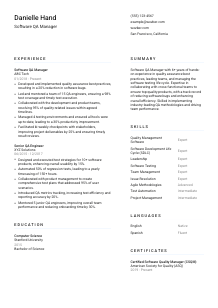
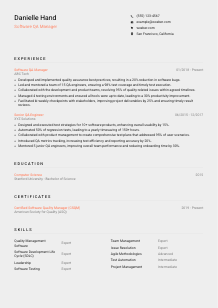
Debugging code, but your resume crashes? Check out this Software QA Manager resume example, built with Wozber free resume builder. Learn how to highlight your quality-focused leadership to match job requirements, and elevate your career to a level of stability and reliability that would make any software proud!
Software QA Managers are hired to bring order to release quality. That usually means building reliable QA processes, guiding engineers through fast development cycles, and keeping defects, test coverage, and environment stability under control without slowing delivery. Your resume should make that operating range visible early, especially how you lead testing work across teams rather than only executing test cases yourself.
A tailored resume changes how quickly a hiring team can place you at the right level. For this role, they need to see management scope, QA process ownership, and collaboration with engineering and product before they read too far. Wozber's free resume builder helps shape that story into an ATS-compliant resume, so terms like SDLC, Agile, test execution, and quality standards are easy to read by both the ATS and the people deciding whether you can run QA at team scale.
The header does more than identify you. For a Software QA Manager, it should immediately confirm seniority, professionalism, and any practical requirement that could affect hiring, such as location for an on-site or local search.
Lead with your full name, then place the job title directly beneath it. If you are applying for a Software QA Manager position, use that exact title when it reflects your background. This keeps your positioning clear from the first line and helps both recruiters and ATS tools classify your resume correctly.
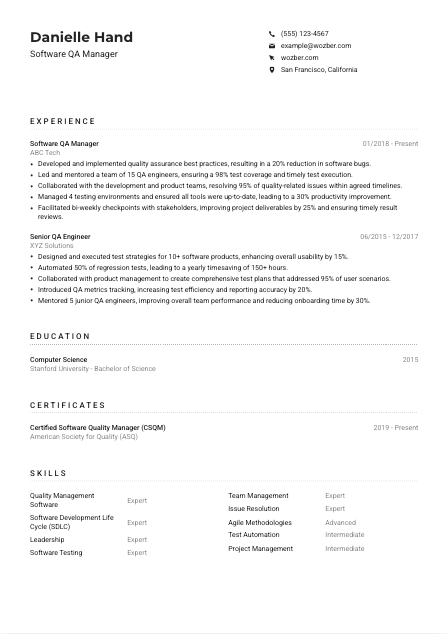
Use the posting's title when your experience supports it. A candidate moving from Senior QA Engineer to Software QA Manager should only make that match if the resume clearly shows team leadership, process ownership, stakeholder reporting, and testing oversight. In the example, the title works because the experience includes leading 15 QA engineers and managing testing environments, not just hands-on testing.
Include a reliable phone number and a professional email address. If you add a website or LinkedIn profile, make sure it supports your QA leadership story with details such as release quality improvements, automation initiatives, or cross-functional delivery work. Clean contact information removes friction when a hiring manager wants to move you to the next round.
Some QA management roles have a location requirement because they involve close coordination with engineering, product, and stakeholder groups. Here, San Francisco, California is explicitly requested, so listing it in your header helps address that filter immediately. Use location this way when it is relevant to the role, not as filler.
A LinkedIn profile, portfolio, or personal site can help if it shows the kind of work QA leaders are judged on, such as testing strategy, team growth, release governance, tooling decisions, or conference speaking on quality practices. Skip links that are outdated or thin. Every item in the header should support your candidacy.
When your header confirms who you are, what level you work at, and whether you meet practical requirements, the reader can move straight into your QA leadership experience without unanswered questions.




This is the section that carries the most weight for a Software QA Manager. Hiring teams want to see how you improved software quality, managed people and process, and kept testing aligned with release schedules, product goals, and engineering realities.
Before rewriting bullets, mark the recurring responsibilities in the posting. For this role, that includes QA best practices, team leadership, cross-functional issue resolution, testing environments and tools, and regular stakeholder checkpoints. Those themes should appear naturally across your recent roles so the resume reflects the work of a QA manager, not only a tester with senior tenure.
List your most recent and most relevant work first. For QA management hiring, recent scope matters because teams want to know what environments, release processes, and reporting responsibilities you are handling now. A clear timeline also helps separate hands-on execution work from later management responsibilities as your career progressed.
Focus each bullet on what changed because of your work. Good Software QA Manager bullets often show defect reduction, stronger test coverage, faster regression cycles, better release confidence, improved environment reliability, or more consistent reporting. The example does this well by tying QA best practices to a 20% reduction in bugs and linking environment management to a 30% productivity improvement.
Metrics help employers understand your operating range. Include team size, coverage rates, automation gains, number of products or environments, cycle time improvements, defect trends, or stakeholder cadence where those measures are accurate. For instance, leading 15 QA engineers, maintaining 98% test coverage, or running bi-weekly checkpoints gives a much clearer picture than saying you "oversaw testing."
Prioritize experience that shows testing strategy, process design, mentoring, tooling oversight, release coordination, and issue resolution with developers and product partners. Older or less relevant bullets can be trimmed unless they explain your path into QA leadership. The goal is a resume that reads like someone ready to lead quality across a software organization.
When your experience shows process ownership, team leadership, measurable quality results, and smooth coordination with engineering and product, the hiring team can picture you running QA instead of growing into it.
For a Software QA Manager, education usually works as a qualification check first and a differentiator second. Keep it clear, accurate, and aligned with the technical foundation the role expects.
When a role calls for a bachelor's degree in Computer Science, Information Systems, or a related field, make sure that information is easy to find. If you hold a directly related degree, state it plainly. In the example, a Bachelor of Science in Computer Science satisfies the requirement without any extra explanation.
List degree, field of study, school, and graduation year. This is enough for most mid-senior QA management applications. Hiring teams are usually scanning this section to confirm your academic background quickly before returning to your experience with SDLC, Agile delivery, and quality systems.
Avoid vague shorthand when a specific credential supports the role. "Bachelor of Science in Computer Science" is stronger than "BSc" on its own because it mirrors the employer's language and leaves no room for interpretation in an ATS parse or recruiter review.
If you completed coursework or academic projects in software engineering, test automation, systems analysis, or quality processes, include them only if they strengthen your case, especially earlier in your career. For an experienced QA Manager, this detail is optional unless it directly supports the target role or industry.
Honors, student projects, and academic awards can help when you are closer to graduation or moving into management from an individual contributor track. If you already have years of QA leadership experience, keep the focus on professional results and use education as a concise confirmation of your technical foundation.
A direct education entry does its job when it confirms the degree requirement quickly and leaves more room for the experience that will carry your application.
Certifications matter most here when they support your command of quality systems, testing practice, or management responsibility. They are especially useful if the role emphasizes process maturity, governance, or continuous improvement.
List certifications that relate to software quality, testing, process management, Agile delivery, or leadership in technical teams. A credential such as Certified Software Quality Manager aligns well because it supports the managerial side of QA, not just test execution.
Present each certification with its full name, issuing organization, and relevant date information. This helps recruiters and hiring managers understand the credential quickly and gives the ATS clean data to parse. The example handles this well by naming both the certification and ASQ.
If a certification is active, renewed, or held over a validity period, include that detail. It is a useful signal in QA and software delivery environments where methods, tooling, and governance expectations continue to evolve.
A smaller list of role-relevant certifications is stronger than a long list of loosely related badges. Keep the focus on credentials that support how you lead QA teams, shape process, improve release quality, or work effectively in Agile development settings.
The right certifications add credibility to your QA management profile, especially when they reinforce the process, leadership, and quality standards already visible in your work history.
For this role, the skills section should show a blend of technical depth and leadership range. Employers need to see that you understand testing practice and tooling, while also managing people, process, and collaboration across the SDLC.
Start with the language the employer uses, then keep only the skills you can support in your experience. Here, that includes quality management software, SDLC knowledge, Agile methodologies, leadership, communication, and testing operations. This creates closer alignment between the job description and your actual background.
Place the most important capabilities first. For a Software QA Manager, that usually means quality assurance processes, software testing, team leadership, issue resolution, environment oversight, and delivery methods such as Agile. In the example, SDLC, leadership, team management, and software testing are all appropriately prominent because they connect directly to the role's core responsibilities.
Group or order skills so the reader can quickly spot your technical and managerial range. Avoid turning this section into a keyword dump. A short, focused list that matches your work history will carry more weight than dozens of loosely related tools or soft skills with no supporting context.
A Software QA Manager should look credible in both quality operations and people leadership. Your skills section should reflect that balance at a glance.
Language skills are not the center of most Software QA Manager resumes, but they can matter when the job emphasizes written reporting, cross-team communication, or collaboration across distributed groups. List them in a way that supports the role rather than distracting from it.
If the job description calls out English communication, include English clearly with an honest proficiency level. For this position, strong verbal and written English is explicitly required, which makes it worth highlighting rather than assuming it will be inferred.
Additional languages can be an advantage in global software organizations, especially if you work with offshore QA teams, distributed engineering groups, or international stakeholders. They are secondary to QA leadership experience, but still worth listing when relevant. The example's Spanish entry adds breadth without taking attention away from the core role.
Terms such as Native, Fluent, Intermediate, and Basic are enough. They set practical expectations for meetings, written updates, and day-to-day collaboration. Keep the labels straightforward rather than trying to over-explain each language skill.
If the role involves frequent communication across regions, multilingual ability can support smoother defect triage, status reporting, and stakeholder coordination. Mention languages with that practical value in mind, not as a generic bonus section.
For QA managers, language skills matter most when they improve test reporting, issue escalation, stakeholder updates, and team guidance. Frame the section as support for those responsibilities, especially if the position emphasizes written and verbal clarity.
List the languages that support your ability to lead teams and communicate quality status clearly, then let the rest of the resume do the heavier work of proving your QA management value.
Your summary should quickly position you as someone who can lead software quality efforts, not just participate in them. It works best when it combines years of experience, management scope, and a few concrete strengths that match the target role.
Review the posting before writing the summary and identify the two or three themes that matter most. For this job, those are QA process leadership, team management, SDLC and Agile fluency, and stakeholder communication. Build your opening around that mix rather than using a generic statement about being results-driven.
Open with your current profession and years of relevant experience. "Software QA Manager with 6+ years of experience" works because it tells the reader right away where you sit in the field. Add one phrase that clarifies scope, such as leading QA teams, improving release quality, or managing end-to-end testing operations.
Use the summary to spotlight strengths that are central to QA management, such as implementing best practices, improving defect rates, increasing test coverage, guiding engineers, or coordinating with product and development teams. The example summary is effective because it combines process expertise with measurable improvement themes like reducing bugs and improving efficiency.
Aim for three to five lines with enough detail to establish credibility without repeating your bullet points. Strong summaries read like a tightly edited overview of your management profile, technical grounding, and business impact. Save the full metrics and examples for the experience section.
A well-focused summary tells the reader, within seconds, that you understand software quality at the team and process level. That makes the rest of the resume easier to read through the lens that matters most for this job.
A Software QA Manager resume should make three things easy to recognize. You can improve product quality, lead QA people and process, and keep testing aligned with how software is actually shipped. When those points are clear in your title, experience, skills, and summary, the document starts to read like a manager's resume rather than a senior tester's.
Use Wozber's free resume builder to tighten that alignment, keep the structure ATS-friendly, and refine the language around QA standards, Agile delivery, tooling, and stakeholder communication. Pair that with Wozber's ATS resume scanner when you want to check missing requirements and sharpen ATS optimization before applying. The finished resume should make it easy to judge whether you can lead quality with confidence from sprint planning through release.




