



Use Wozber and land your dream job
Create Resume
No registration required
Crafting ABAP with expertise, but your resume has syntax errors? Check out this SAP ABAP Developer resume example, created with Wozber free resume builder. Learn how to align your programming marvels with job specifics, positioning your career to execute flawlessly and elegantly!
SAP ABAP work gets reviewed through the quality of the systems behind it. Hiring teams want to see whether you can build and maintain custom ABAP programs that run reliably inside real business processes, whether that means improving report performance, handling production defects, or translating functional requirements into workable technical design. Your resume should make that operating range visible quickly.
For SAP ABAP roles, small wording choices change how your background is interpreted by both recruiters and ATS filters. When your resume uses the same technical language the job uses, such as debugging, performance tuning, BAPIs, SmartForms, or User Exits, Wozber's free resume builder helps you shape that experience into an ATS-compliant resume that makes your SAP module work, development scope, and support depth easier to recognize.
This section is simple, but it still carries screening value. For an SAP ABAP Developer, it should confirm who you are, how to reach you, and whether you meet practical filters like title alignment and location when the employer has stated one.
Use your full name in the largest text on the page so the header reads cleanly in both human review and ATS parsing. Skip extra labels, graphics, or credentials beside it unless they are directly relevant to SAP development and commonly used in your market.
Use the exact role title when it reflects your background. If you are applying for an SAP ABAP Developer position, placing "SAP ABAP Developer" directly under your name helps frame the rest of the resume around ABAP development, support, and enhancement work instead of broader SAP or general software experience.
Your phone number and email should look routine and easy to trust. Hiring teams moving quickly through technical applications should not have to decode usernames or second-guess whether a number is current.
Some SAP roles are flexible, others are tied to an office, client site, or support region. Here, the employer specifically asks for someone located in San Francisco, CA, so listing "San Francisco, California" in your header addresses that filter immediately. Treat this as tailoring to the opening, not a universal rule for every SAP ABAP resume.
A LinkedIn profile or personal site can help if it reinforces the same career story as your resume. Keep titles, dates, and SAP project summaries consistent, especially if your profile mentions module exposure, certifications, or implementation work that may come up in interviews.
Personal details do not win the role on their own, but they can remove early doubts. When your title, contact information, and any required location details are clear, the reviewer can move straight to your ABAP development experience.




This is the section most likely to decide whether you move forward. SAP ABAP hiring usually turns on whether your past work shows real development depth, stable delivery, and useful collaboration with functional teams, not just a list of employers.
Read the posting for the work patterns behind the keywords. Here, the priorities include designing and maintaining ABAP applications, debugging existing systems, performance tuning, system testing, and working with cross-functional teams. Those points tell you which parts of your experience deserve the most space and which older bullets can be cut.
List positions in reverse chronological order with job title, company, and dates easy to scan. For SAP resumes, titles matter because they help reviewers separate dedicated ABAP development from broader ERP support, analyst work, or adjacent technical roles.
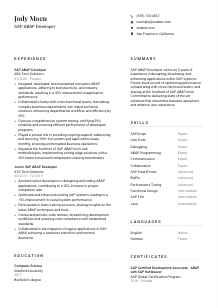
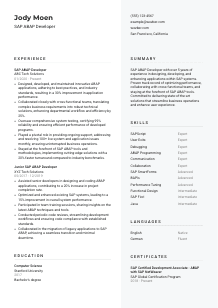
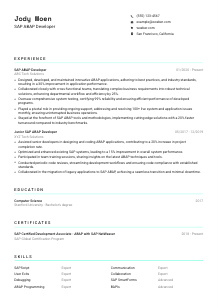
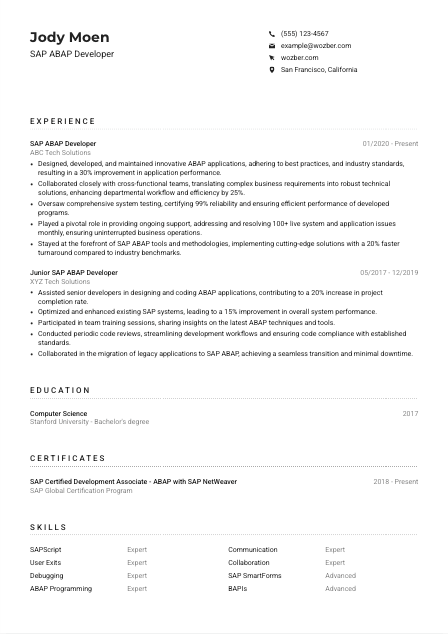
Each bullet should show what you built, improved, fixed, or supported inside SAP. Good bullets mention the kind of ABAP work performed, the business or system effect, and the scope of collaboration. The sample resume does this well by tying ABAP application development to a 30% performance improvement and linking business requirement translation to a 25% workflow gain.
Numbers carry more weight when they reflect how ABAP work is actually evaluated. Useful measures include program performance, issue volume resolved, reliability, turnaround time, migration downtime, code quality, or support load. A line such as resolving 100+ live issues monthly or reaching 99% program reliability says far more than saying you were "responsible for support."
Trim anything that does not strengthen your case for this role. If an achievement does not speak to ABAP coding, debugging, functional design, enhancement work, testing, SAP module support, or collaboration with business stakeholders, it probably belongs elsewhere or should be removed. Focus beats volume in this section.
Your experience section should leave little doubt about the kind of SAP environment you can step into. When your bullets show ABAP development, issue resolution, testing discipline, and measurable system improvement, hiring teams can picture you contributing from day one.
Education is often a straightforward check in SAP ABAP hiring, but it still matters. It confirms the formal background behind your programming work and helps satisfy degree filters in ATS screening.
This role asks for a bachelor's degree in Computer Science, Information Technology, or a related field. If you have that match, state it clearly rather than relying on abbreviations or vague program names. In the example, "Bachelor's degree" and "Computer Science" make the fit immediate.
Include your degree, field of study, school, and graduation year or date. That is usually enough for an experienced SAP ABAP Developer unless the employer has asked for something more specific.
If your degree is in Computer Science, Information Technology, Information Systems, or another related discipline, use the full field name as it appears on the diploma. Matching the employer's wording helps both ATS interpretation and fast manual review.
If you are newer to SAP development, a few relevant courses such as database systems, enterprise applications, software engineering, or programming languages can add context. For someone with several years of ABAP experience, coursework usually matters less than project and production experience.
Projects, honors, or technical student work can help when they connect to development, systems thinking, or enterprise software. Leave out unrelated activities that do not add to your case as an SAP developer.
Education does not need a lot of space, but it should answer the requirement without ambiguity. A clear degree entry helps your resume pass one more technical hiring checkpoint.
Certificates are especially useful in SAP because they show structured product knowledge and ongoing investment in the platform. They work best when they reinforce the type of ABAP work the role actually calls for.
List certifications that connect directly to ABAP programming, SAP platform knowledge, NetWeaver, or related SAP development tracks. If a certificate does not strengthen your story for coding, enhancements, integrations, or SAP system support, it can stay off the resume.
A recognized SAP credential can quickly boost confidence in your technical baseline. In the example, "SAP Certified Development Associate - ABAP with SAP NetWeaver" fits the role closely because it supports the employer's focus on ABAP development tools and methodology.
SAP tools and implementation approaches evolve, so dates matter. Showing when you earned a certification, and whether it remains active, gives useful context about how current your SAP knowledge is.
If you want to move deeper into SAP development, integration, Fiori-related work, or newer SAP environments, pursue certificates that support that direction. The value is not the badge alone. It is the clearer technical story it tells alongside your project experience.
For SAP ABAP roles, certificates are strongest when they confirm the platform knowledge your experience already suggests. Keep this section selective, current, and closely tied to the work you want to do next.
A skills section should read like the toolset of someone who works in SAP development environments, not a generic software inventory. Focus on the capabilities that support design, enhancement, debugging, integration, and support inside SAP systems.
Start with the terms the employer chose. Here that includes debugging, performance tuning, functional design, SAPScript, SmartForms, BAPIs, and User Exits. Those are better anchors than broad labels like "software development" because they map directly to ABAP work and ATS matching.
List the SAP-specific skills that reflect your hands-on work. For this kind of role, that may include ABAP programming, debugging, performance tuning, SAPScript, SmartForms, BAPIs, enhancements, User Exits, and module-related functional design. The sample resume shows a solid pattern by combining core ABAP tools with support skills such as collaboration and communication.
Cross-functional work matters in SAP because ABAP developers regularly translate business requirements from functional consultants, analysts, or stakeholders into technical solutions. Keep soft skills on the list only if they support how you work in delivery environments. A short set such as communication and collaboration is enough when the rest of the section is technically strong.
The best skills lists make it obvious which SAP development tasks you can handle. When the section reflects your real ABAP toolkit and the language of the posting, it supports both ATS optimization and a faster technical read.
Language sections are usually brief, but they still have value in SAP hiring. Enterprise teams often span business users, consultants, support teams, and offshore or international stakeholders, so communication ability can matter beyond a simple checkbox.
If the posting specifies English, list it first with an honest proficiency level. For an SAP ABAP Developer, that matters because requirement gathering, defect discussion, testing feedback, and production support all depend on clear written and spoken communication.
Extra languages are worth listing when they reflect real working ability. They can help in global SAP programs, multinational support models, or projects that involve business users across regions, even when the job ad only names English.
Choose straightforward terms such as Native, Fluent, Intermediate, or Basic and apply them consistently. Clear labels are more useful than vague claims because they set realistic expectations for meetings, documentation, and stakeholder communication.
Most SAP ABAP roles will not be decided by multilingual ability alone, so do not overbuild this section. Include what is true and useful, then let your technical sections carry the application.
If you speak more than one language, it can reinforce your ability to work across distributed teams or international business units. In the example, English and German suggest wider communication range, but the value still comes from how well the candidate connects that communication ability to SAP delivery work.
Your language section should confirm any required communication baseline and add global context where relevant. Keep it accurate, concise, and secondary to your ABAP development record.
The summary sets the technical lens for everything that follows. For an SAP ABAP Developer, it should establish your experience level, the kind of SAP development work you handle, and the results you tend to produce.
Start by identifying the recurring priorities in the posting, then reflect the ones you genuinely cover. Here, that means ABAP development experience, debugging, performance tuning, functional collaboration, and support for existing SAP systems.
Lead with a direct line such as "SAP ABAP Developer with 5+ years of experience" if that is accurate. It tells the reader immediately whether you meet the baseline and frames the rest of the summary around SAP development rather than broader IT work.
A useful summary does more than name skills. It connects them to results. The sample resume handles this well by pairing application design and enhancement work with performance optimization, cross-functional collaboration, and improved business operations. That structure is stronger than listing tools alone.
Aim for a short paragraph that sounds like someone ready to contribute in a live SAP environment. Mention your strongest ABAP capabilities, the kind of systems or teams you support, and one or two business results. Skip generic enthusiasm and save the deeper detail for your experience bullets.
A focused summary helps the reviewer place you fast. When it clearly states your ABAP background, core strengths, and delivery impact, the rest of the resume reads in the right context.
A tailored SAP ABAP Developer resume should now show three things clearly: that you meet the baseline requirements, that you know the ABAP tools and development patterns the role depends on, and that your work has improved system performance, support quality, or delivery outcomes in measurable ways.
Use Wozber to turn that experience into an ATS-friendly resume format with sharper role alignment, stronger wording, and practical ATS optimization. When the final version is focused, technically specific, and easy to scan, hiring teams can quickly judge where you fit in their SAP landscape.




