



Use Wozber and land your dream job
Create Resume
No registration required
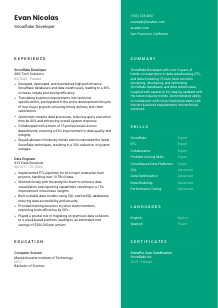
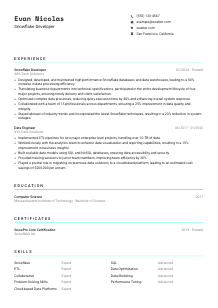
Crafting unique data patterns, but your resume seems too icy to stand out? Warm up to this Snowflake Developer resume example, created with Wozber free resume builder. Learn how to crystallize your cloud data expertise to match job criteria, ensuring your career journey is as distinct and beautiful as a snowflake!
Snowflake Developer resumes are read through the lens of execution. Hiring teams want to see who has actually built and tuned warehouse environments, translated messy business requests into stable data models, and kept pipelines performing under production pressure. If your resume stays at the level of tools alone, it misses the part that matters most in this work: how you improved query speed, data quality, scalability, or delivery across a real data platform.
A tailored resume changes how quickly that technical scope becomes visible. When the wording mirrors the target role's SQL, ETL, data modeling, and Snowflake priorities, an ATS-compliant resume is far more likely to surface for the right searches and move cleanly into human review. Wozber's free resume builder helps you align that language, structure, and ATS optimization so the hiring team can quickly see whether you can build reliable warehouse solutions, not just list the stack.
The header section is simple, but it still does real work. For a Snowflake Developer, it should immediately confirm who you are, what role you target, and whether practical requirements like location and professional contact details are already in place.
Use your full name in the largest text on the page so it is easy to identify in a recruiter inbox, PDF, or ATS record. Keep it clean and professional. In technical hiring, small presentation issues can create unnecessary friction before anyone reaches your Snowflake or ETL experience.
Place "Snowflake Developer" directly under your name when that is the role you are pursuing. Matching the target title helps position your background correctly, especially if your recent work also overlaps with data engineering, BI, or cloud platform development.
Your contact details should be complete and easy to scan so a recruiter can move straight to the next step.
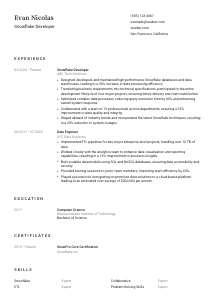
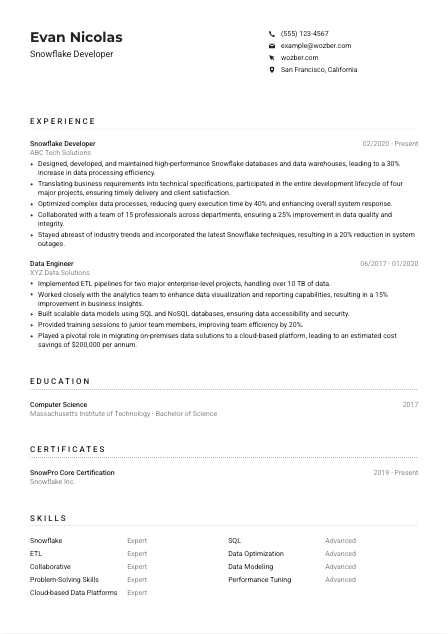
If the job requires you to be in a specific area, show that clearly in your header. In the example, listing San Francisco, California immediately answers a stated requirement. Use this only when it is relevant to the posting, not as a default rule for every Snowflake Developer resume.
Include a portfolio, GitHub, LinkedIn, or personal site if it supports your data engineering profile. For this profession, useful links often reinforce cloud projects, SQL work, certifications, warehouse architecture, or case studies that show how you handled data volume, performance tuning, or migration work.
Your personal details should remove basic doubts early. Make it easy to confirm your role focus, location when required, and how to reach you so the rest of the resume can stay focused on Snowflake delivery.




This is where hiring teams decide whether your background is operational or only theoretical. Snowflake Developer experience should show warehouse design, ETL implementation, SQL depth, performance tuning, and collaboration with analysts, engineers, or business stakeholders in a production setting.
List roles that connect directly to Snowflake development, data warehousing, ETL, cloud migration, or data modeling before adjacent work. If your title was broader, such as Data Engineer, keep the title accurate but use the bullets to surface the Snowflake, SQL, pipeline, and warehouse responsibilities that overlap with the target role.
Each role should describe the systems you designed, developed, or supported. Strong bullets mention Snowflake databases, warehouse layers, ETL pipelines, transformations, schema design, or production support. The example does this well by pointing to high-performance Snowflake databases and data warehouses rather than using vague claims about general data work.
Snowflake work is often evaluated through speed, volume, reliability, and cost. Use metrics that belong naturally in this field, such as faster query execution, improved processing efficiency, lower outage rates, larger data volumes, or savings from cloud migration. The sample's 30 percent efficiency gain, 40 percent query improvement, and 10 TB pipeline scope are the kind of specifics that make technical impact easier to judge.
A Snowflake Developer rarely works in isolation. Show where you translated business requirements into technical specifications, partnered with analytics teams, worked with QA or platform teams, or improved data integrity across departments. In the example, collaboration with a 15-person cross-functional group helps show that the candidate can work beyond the warehouse layer and support data quality outcomes.
Snowflake roles change with platform features, cloud practices, and data engineering standards. Mention ongoing work with newer Snowflake capabilities, certification progress, migration projects, automation improvements, or modern data stack practices when they are real parts of your background. That tells employers you can maintain and improve a live platform, not just repeat older ETL patterns.
Your experience section should make three things obvious: you can build in Snowflake, you can improve performance, and you can work across teams to keep data reliable. If those points are easy to find, the resume is doing its job.
For Snowflake Developer roles, education usually supports the profile rather than carrying it. Still, when a posting asks for a degree in Computer Science, Information Systems, or a related field, this section should confirm that requirement quickly and without clutter.
Start with your highest or most relevant degree, especially if it aligns directly with the posting. A Bachelor of Science in Computer Science, like the one in the example, maps cleanly to a Snowflake Developer role that asks for formal technical training.
Include the institution, degree, field of study, and graduation year. That is usually enough for an experienced Snowflake Developer. Keep the format neat so the section supports the resume instead of competing with your project and production experience.
When the employer specifically asks for a bachelor's degree in a related field, make sure that information is impossible to miss. This is straightforward tailoring, and it matters because some ATS filters and early screeners check for degree alignment before they ever get to warehouse design or SQL depth.
If you are earlier in your career, relevant coursework can help fill out the technical story. Topics such as database systems, distributed systems, data structures, data modeling, or cloud computing can support a transition into Snowflake-focused work. Once you have several years of experience, this is usually optional.
Academic honors, scholarships, or technical awards can be worth adding if they reinforce your analytical background or engineering discipline. Keep them brief. For experienced candidates, they should support the profile, not take attention away from production accomplishments like ETL performance or warehouse optimization.
Education should confirm that you meet the baseline technical requirement and then get out of the way. In most Snowflake Developer resumes, experience and project impact will carry far more weight.
Certifications carry extra weight in cloud data roles when they are current and relevant. They can quickly reinforce platform knowledge, especially when the rest of the resume already shows hands-on warehouse development, SQL work, and performance tuning.
List certifications that strengthen your case for building and maintaining Snowflake environments. A credential such as SnowPro Core Certification is directly relevant because it supports your familiarity with the platform's architecture, capabilities, and best practices.
Choose certifications that relate to Snowflake, cloud data platforms, ETL, database engineering, or adjacent tooling that appears in the jobs you target. A short list of strong, relevant credentials usually works better than a long list that drifts into unrelated software or generic training.
Show the year earned and, if applicable, the active period. This helps the reader understand whether your credential reflects current platform knowledge. In technical hiring, recency matters because cloud tooling, integration patterns, and optimization techniques change quickly.
Use this section to show that you keep your Snowflake knowledge current through recertification, advanced learning, or adjacent training in data engineering and cloud architecture. That matters for roles involving optimization, scalability, and lifecycle participation, where yesterday's approach may no longer be the best one.
Relevant certifications help validate platform knowledge fast. Pair them with concrete experience, and they become a useful multiplier rather than a standalone claim.
For Snowflake Developer roles, the skills section should read like a compact map of your technical toolkit. It needs to surface core platform strengths, data engineering fundamentals, and the collaboration skills that matter when warehouse work touches analysts, product teams, and business stakeholders.
Use the posting to identify the exact language the employer is using. For this role, that includes Snowflake, SQL, data warehousing, ETL, data modeling, cloud-based data platforms, data optimization, and performance tuning. Mirror those terms when they accurately describe your background so both ATS parsing and human review pick up the right match.
Do not let the section become a pure tool inventory. Snowflake Developers are often expected to troubleshoot, translate requirements, and work in a collaborative team environment. Skills such as problem-solving and cross-functional collaboration belong here when they are backed up elsewhere in your experience bullets.
Place the most relevant capabilities near the top. For a Snowflake-focused role, lead with platform and data engineering skills before broader traits. The example does this effectively by foregrounding Snowflake, ETL, SQL, data modeling, optimization, and cloud platforms. That ordering helps the reader understand your fit in seconds.
Every skill listed should connect to something you have used in real work. Prioritize the platform, data pipeline, and performance terms that hiring teams expect to see for Snowflake development.
Language skills are usually a supporting section for this profession, but they can matter when the role calls for strong written and spoken communication. Snowflake Developers often explain requirements, document data logic, and work across technical and non-technical teams, so communication ability is not incidental.
If the posting asks for strong English communication, list English clearly with an honest proficiency level. That helps confirm you can handle technical discussions, documentation, issue resolution, and collaboration across delivery teams.
Additional languages can support work in multinational teams, client-facing environments, or distributed data organizations. In the example, Spanish adds breadth, but English remains the primary hiring requirement because it is explicitly stated in the job description.
Choose transparent labels such as Native, Fluent, Intermediate, or Basic. Avoid vague descriptions. A recruiter or hiring manager should understand immediately whether you can participate in architecture reviews, stakeholder calls, or written technical communication.
Some Snowflake Developer roles support international reporting, shared service teams, or cross-border data programs. In those environments, another language can be a real advantage. If the role is entirely local and internal, keep the section brief and let your technical content lead.
Clear language skills support better requirements gathering, cleaner documentation, and fewer misunderstandings in data delivery. If communication is a known strength in your work, this section can quietly reinforce the collaboration side of your profile.
Languages will not outweigh your Snowflake and SQL experience, but they can strengthen the picture of how you collaborate, document, and work across teams.
Your summary should quickly position you as someone who can handle the actual demands of the role. For a Snowflake Developer, that usually means a short statement covering years of experience, platform focus, core data engineering strengths, and one or two outcomes that point to production-level impact.
Start with your role and experience level in direct terms, such as "Snowflake Developer with 6+ years of experience in data warehousing, ETL, and data modeling." That instantly sets the frame and tells the reader what kind of technical profile they are looking at.
Use the next sentence to name the work you actually do: designing Snowflake databases, building and maintaining data warehouses, optimizing SQL workloads, or translating business needs into technical solutions. The example summary works because it stays close to the responsibilities hiring teams already care about.
Aim for a short paragraph, usually three to five lines. Use enough detail to establish relevance, but do not repeat every skill from the resume. This section should frame your Snowflake experience, not duplicate the skills list or rewrite every accomplishment bullet.
End with something that supports the target role, such as staying current with Snowflake capabilities, improving warehouse performance, or collaborating across teams to deliver reliable data solutions. Keep it grounded in the work. A brief line about industry awareness or technical growth is enough when it connects back to the role's responsibilities.
A strong summary makes the rest of the resume easier to read in context. By the time a recruiter reaches your experience section, they should already understand your Snowflake focus, your data engineering depth, and the kind of results you deliver.
A Snowflake Developer resume works when it makes your technical scope easy to recognize. Warehouse design, SQL strength, ETL delivery, data modeling, optimization, and collaboration should all appear in the right places, supported by concrete outcomes instead of generic claims.
Use Wozber's AI resume builder and ATS resume scanner to tighten wording, align the resume with the target posting, and present your background in an ATS-friendly resume format. The final read should make one thing clear very quickly: you can build and improve Snowflake data environments in production.