




Use Wozber and land your dream job
Create Resume
No registration required
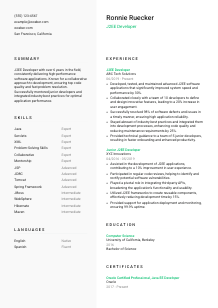
Mastering middleware but your resume feels like a deployment in progress? Check out this J2EE Developer resume example, created with Wozber free resume builder. Learn how to match your Java enterprise expertise to job specifications, scripting your career story to fit the buzz of every application server!
J2EE development work is usually judged in production terms. Teams want to see who can build and maintain Java enterprise applications that stay reliable under load, integrate cleanly with existing systems, and hold up through debugging, testing, and release cycles. Your resume should make that engineering range visible, from core Java EE work to defect resolution, performance tuning, and collaboration with other developers.
For this kind of role, the first pass often separates general Java candidates from developers who have actually worked in a J2EE stack. Using Wozber's free resume builder helps you shape an ATS-compliant resume around the exact language of the posting, so tools, frameworks, and delivery outcomes surface quickly. That makes it easier for a hiring team to recognize real experience with enterprise application development, not just broad Java exposure.
This section does one practical job. It identifies you clearly and removes basic friction before anyone gets to your Java EE experience. For a J2EE Developer role, that means matching the target title, using professional contact details, and addressing any explicit logistical requirement such as location when the posting calls it out.
Use your full name in a clean, readable font that stands out slightly from the rest of the page. It should be easy to find at a glance, especially when recruiters are reviewing several technical resumes in a row.
Place "J2EE Developer" directly under your name if that is the role you are targeting. This immediately frames your background around enterprise Java development instead of leaving the reader to infer whether you are a backend Java developer, full stack developer, or general software engineer.
Recruiters and hiring managers should be able to reach you without hunting through the document or second-guessing whether a contact method is current.
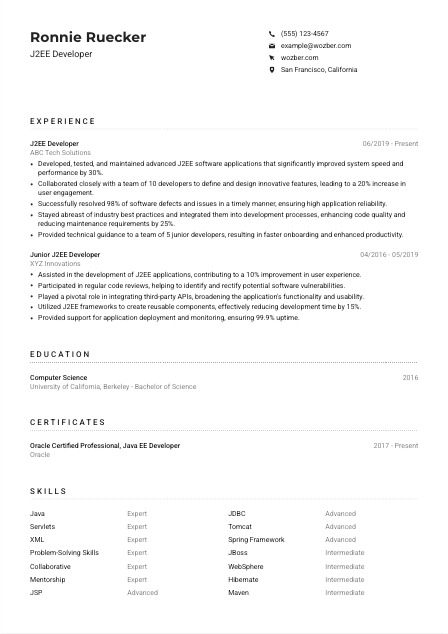
If the employer asks for candidates to be based in a specific city or willing to relocate, say so clearly in this section. In the example, listing "San Francisco, California" answers that requirement immediately and removes uncertainty before the resume moves into technical qualifications.
Add a LinkedIn profile, portfolio site, or GitHub link if it strengthens your candidacy. For J2EE roles, links are most useful when they support your resume with concrete engineering context such as project history, architecture work, code samples, or a consistent professional profile.
Personal details will not win the role on their own, but they can remove avoidable questions right away. Keep this section accurate, professional, and aligned with the posting so the reader can move straight to your enterprise Java experience.




For a J2EE Developer, the experience section carries the most weight. Hiring teams want to see the systems you worked on, the technologies you used, and what changed because of your work, whether that was faster application performance, fewer production issues, smoother deployments, or stronger support for new features.
Mark the responsibilities and technologies that define the opening before you write or edit anything. Here, the employer asks for J2EE application development, testing, maintenance, debugging, collaboration, code quality, and mentoring. Those points should shape your bullet selection and wording so your experience reads like a direct match instead of a generic Java history.
Start with your current or most recent position and work backward. For each entry, include your job title, company name, and dates of employment. That structure lets the reader quickly track your progression from junior development work into broader ownership, which matters in roles asking for 5+ years of professional J2EE experience.
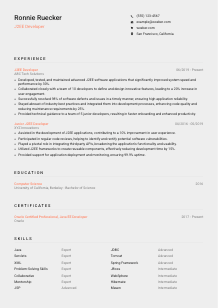
Each bullet should show real development work and a result. Focus on shipped features, maintained applications, resolved defects, refactored components, improved performance, or supported deployment and monitoring. The example bullet about developing and maintaining J2EE applications that improved system speed by 30% works well because it ties core responsibilities to a measurable technical outcome.
Quantify your impact where the numbers reflect actual engineering results. Good examples include performance gains, defect resolution rates, uptime, reduced maintenance load, faster delivery, or increased user engagement after a release. Metrics like resolving 98% of software defects or reducing maintenance requirements by 25% give hiring teams a clearer picture of your contribution than broad claims about success.
Prioritize experience that supports the target role, especially work involving Java, JSP, Servlets, JDBC, XML, application servers, testing, debugging, and team delivery. Side activities only belong here if they reinforce your professional value, such as code review leadership, architecture input, or mentoring junior developers in a production environment.
Your experience section should read like a history of enterprise application delivery, not a list of duties. When each bullet connects J2EE responsibilities to concrete outcomes, hiring managers can quickly see where you have already done the work they need.
Education usually plays a supporting role for experienced J2EE Developers, but it still matters because many postings use it as an initial qualification screen. Keep it straightforward and make sure the degree listed aligns with the technical foundation the employer expects.
Start by confirming whether the posting asks for a specific academic background. In this case, a bachelor's degree in Computer Science, Engineering, or a related field is requested, so your education entry should make that alignment easy to spot.
List your school, degree, field of study, and graduation year or date. Technical resumes work best when this section is easy to scan and does not bury the essentials under extra wording.
If your degree directly supports the role, use the exact field name. "Bachelor of Science in Computer Science" immediately aligns with the requirement and reinforces your technical background without needing extra explanation.
If you are early in your career, coursework in Java, distributed systems, database design, web application development, or software engineering can help. The same goes for academic projects involving servlets, JDBC, XML processing, or enterprise application architecture. For more experienced developers, this level of detail is usually less important than your production work.
Honors, scholarships, or standout technical projects can strengthen this section when they add real context. Use them if they support your candidacy, especially if they relate to enterprise development, performance engineering, or team-based software delivery. Otherwise, keep the section lean.
This section should confirm that you meet the academic baseline without distracting from your engineering track record. A clear degree entry that matches the posting is usually enough to do the job well.
Certifications are not mandatory for every J2EE role, but they can strengthen your profile when a posting mentions Java EE credentials as a plus. In enterprise environments, a relevant certification can reinforce your technical depth and your commitment to staying current with platform standards and professional practice.
Read the posting carefully for optional credentials. Here, J2EE-related certification is listed as a plus, which means it will not replace experience but can help differentiate you from other candidates with similar Java backgrounds.
List credentials that directly connect to enterprise Java work, application development, or related platform knowledge. The example certification, "Oracle Certified Professional, Java EE Developer," fits well because it speaks directly to the technology family named in the role.
Add the certifying organization and the date earned, or the valid date range if applicable. That makes the credential easier to understand and shows whether it reflects current or reasonably recent expertise.
If you hold certifications, maintain the ones that still support your target direction and remove anything outdated or irrelevant. For J2EE roles, recent Java ecosystem learning, platform-specific credentials, or related enterprise development certifications can strengthen your profile when they align with your actual work.
A relevant certification adds useful weight when it matches the role's technology stack. Keep the section focused on credentials that support your enterprise Java background rather than listing every course or badge you have collected.
The skills section should confirm your working stack quickly and cleanly. For J2EE Developer roles, that means surfacing the technologies and collaboration strengths that support enterprise application delivery, while avoiding an unfocused inventory of every tool you have touched.
Start with the technologies and competencies the employer names explicitly. In this case, that includes Java, JSP, Servlets, JDBC, XML, application server familiarity, problem-solving, teamwork, and strong written English. Those should guide what appears first.
Add the tools, frameworks, and technical capabilities you have actually used in production or substantial projects. A solid J2EE skills section might include Java, JSP, Servlets, JDBC, XML, Tomcat, JBoss, WebSphere, Spring Framework, Hibernate, Maven, debugging, code review, and mentoring, but only if your background supports them.
Order skills so the most relevant ones appear first and related items sit near each other. For example, core Java EE technologies can lead, followed by application servers and supporting frameworks, then collaboration-oriented strengths such as problem-solving or mentorship. That kind of structure makes the section easier for both ATS parsing and technical review.
A well-built skills section should quickly confirm that you speak the language of enterprise Java development. Lead with the technologies and working strengths that support the target role, and make sure every listed item is backed up elsewhere in the resume.
Language skills matter more in technical roles than many candidates assume. J2EE Developers spend plenty of time writing documentation, commenting code, discussing defects, and collaborating across teams, so any stated language requirement should be handled clearly and honestly.
If the posting names a required language, list it. Here, effective written English is specifically required, so English should appear prominently with a proficiency level that accurately reflects your ability to work in documentation, tickets, code reviews, and team communication.
List English first when it is essential to the role. Use a clear level such as "Native" or "Fluent" rather than vague wording. This gives the employer immediate confidence that you can handle written communication in a development environment.
If you speak additional languages, include them when they are relevant or simply reflect broader communication ability. In some engineering teams, extra languages can be useful for distributed collaboration, customer-facing technical discussions, or multinational product environments.
Choose consistent labels such as Native, Fluent, Intermediate, or Basic. Overstating language ability can quickly become obvious during interviews or written assessments, especially when the role requires clear technical communication.
Extra languages are usually secondary for J2EE hiring, but they can still add value in globally distributed teams or companies with cross-border engineering collaboration. Keep them on the resume if they are real strengths, but do not let them distract from core technical qualifications.
This section should make written communication ability easy to confirm, especially when English is required. After that, any additional languages simply add range without competing with your enterprise development experience.
Your summary should quickly frame you as a J2EE Developer with the right level of experience, technical grounding, and delivery history. In a few lines, it should connect your years in enterprise Java work with the kind of outcomes the employer cares about, such as application performance, defect resolution, cross-functional delivery, and support for junior developers.
Before writing, identify the few requirements that matter most in the opening. Here, the key themes are J2EE development experience, strong Java EE technologies, collaboration, troubleshooting, code quality, and occasional mentorship. Your summary should reflect those themes in a concise way, not try to cover your entire resume.
Start with your title and level of experience. A line such as "J2EE Developer with over 6 years of experience building and maintaining enterprise applications" immediately establishes role match and seniority for a posting that asks for at least 5 years.
Use the next sentence or two to highlight the work you are known for. Strong examples include performance-focused development, reliable defect resolution, collaboration across teams, or mentoring junior developers. The sample summary works because it points to high-performance applications, code quality, fast issue resolution, and guidance for junior team members without becoming a list of keywords.
Aim for 3 to 5 lines. That is enough space to establish your J2EE background, mention two or three relevant strengths, and align with the posting's priorities. Save detailed tool lists and project specifics for the experience and skills sections, where they can be supported properly.
A well-written summary helps the reader place your experience before they reach the first role entry. Keep it specific to enterprise Java development, grounded in real outcomes, and aligned with the work this employer needs done.
A J2EE Developer resume works best when it shows real enterprise application experience in concrete terms. Lead with Java EE technologies, support your claims with delivery metrics, and make collaboration, debugging, and code quality visible through specific examples.
Wozber can help you shape that experience into an ATS-friendly resume format, align your wording with the posting, and tighten each section around the requirements that matter most. The finished resume should make one thing easy to judge: you can step into a J2EE environment and contribute from day one.




