



Use Wozber and land your dream job
Create Resume
No registration required
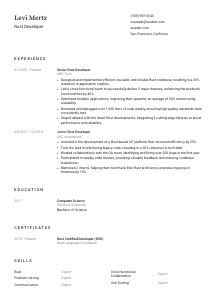
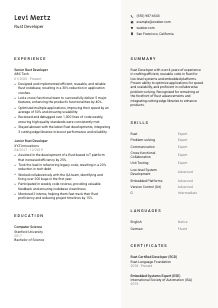
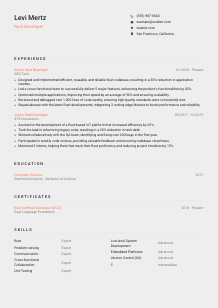
Building systems with Rust, but your resume feels a bit weathered? Hammer down this Rust Developer resume example, created with Wozber free resume builder. Learn how to match your Rust expertise to job descriptions, crafting a career path as robust and resilient as your code!
Rust development work is usually reviewed through the quality of the systems behind it. Hiring teams look for developers who can write reliable code under performance constraints, work close to memory and hardware boundaries when needed, and improve software without trading away maintainability. Your resume should make that engineering judgment visible through concrete work, not broad claims about being passionate or detail-oriented.
When a Rust resume is tailored well, the first scan quickly separates general backend experience from real Rust work in systems, embedded, or performance-sensitive environments. Wozber's free resume builder helps you shape that experience into an ATS-compliant resume with language that matches the posting, so the hiring team can immediately see where you have built, optimized, debugged, and shipped Rust code that holds up in production.
This section sets the operating context for your application. For a Rust Developer, it should make it easy to confirm who you are, how to reach you, and whether any practical requirement, such as location for an on-site or relocation-based role, is already covered.
Use your full name in a clear, readable style that stands above the rest of the page. In technical hiring, this section does not need design tricks. It needs clean structure that keeps the focus on your engineering background and makes the document easy to parse.
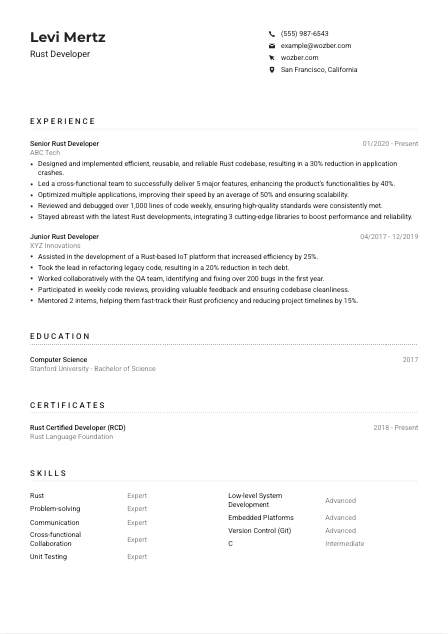
Place the job title directly under your name when it reflects the work you actually do. For this role, using "Rust Developer" immediately aligns your profile with the position and helps frame the rest of the resume around Rust systems work instead of broader software engineering experience.
Include a phone number, professional email address, and a relevant web link if you have one, such as a GitHub profile, portfolio, or personal site with systems or embedded projects. If you include a link, make sure it supports your resume with real code, tooling, or project context rather than a placeholder profile.
If a role specifies a city or relocation requirement, handle it directly in your personal details. Here, listing San Francisco, California, as shown in the example, answers that filter upfront. If you are relocating, state that clearly instead of leaving the employer to guess.
Rust roles often benefit from proof beyond the resume. A GitHub repository, engineering blog, crates contribution history, or systems project page can reinforce your experience with low-level work, debugging, performance tuning, or embedded development. Only include links you would be comfortable discussing in an interview.
Your personal details should remove friction, not add filler. If this section is clean and complete, the reader can move straight to your Rust experience, project scope, and technical depth.




This is where Rust hiring decisions usually take shape. Employers want to see what you built, what constraints you worked under, how you improved performance or reliability, and whether you can collaborate with product, QA, or platform teams while maintaining code quality.
Before rewriting your bullets, isolate the recurring themes in the posting. For this Rust Developer role, the emphasis is on efficient and reliable Rust code, low-level systems and embedded platforms, scalability, debugging, code review, and cross-functional delivery. Those themes should appear in your experience through real work examples, not copied phrases.
List positions in reverse chronological order and make each one sound like engineering work, not a task log. Name the role, company, and dates, then use bullets that show what you designed, optimized, or maintained. If your background includes systems programming, embedded software, platform tooling, or IoT work, bring that forward early because it maps closely to many Rust openings.
Rust work is often judged through outcomes such as lower crash rates, better throughput, reduced latency, safer refactors, or cleaner codebases. The example resume does this well by tying Rust implementation to a 30% reduction in application crashes and a 50% speed improvement. Use numbers where they reflect real engineering results, release scope, bug volume, or code quality improvements.
Every bullet should earn its place by reinforcing your fit for Rust development. If a bullet does not show systems thinking, low-level work, collaboration on shipped features, debugging, optimization, or maintainable code, rewrite it or remove it. A shorter list of highly relevant accomplishments will outperform a longer list of generic software duties.
Rust developers rarely work in isolation, especially when features touch firmware, infrastructure, QA, or product requirements. Include bullets that show code reviews, debugging with test teams, feature delivery with cross-functional partners, or mentoring that improved team output. In the example, leading delivery of five major features and working with QA to fix more than 200 bugs gives the technical work real project context.
Your experience section should let someone picture you in the codebase. Show the systems you worked on, the problems you solved, and the measurable results your Rust work produced.
Education matters most here as a qualification check and a signal of technical foundation. For Rust roles tied to systems, embedded development, or performance-sensitive software, a computer science or engineering degree supports the rest of the resume without needing much space.
If the posting asks for a bachelor's degree in Computer Science, Engineering, or a related field, list that credential clearly. A Bachelor of Science in Computer Science, like the example uses, directly satisfies the educational requirement and supports the technical depth expected in systems-oriented development.
Include degree, school, field of study, and graduation year in a clean line structure. Education is usually a straightforward scan item for software roles, so clarity matters more than extra description unless you are early in your career.
Spell out the degree rather than using a shortened or vague label. "Bachelor of Science in Computer Science" is stronger than a generic reference because it aligns with the technical training employers expect for low-level programming, data structures, operating systems, and related fundamentals.
If you have limited professional Rust experience, coursework can help bridge the gap. Include classes such as systems programming, operating systems, compiler design, computer architecture, networking, or embedded systems when they genuinely support the role you are applying for.
Honors, research, student engineering teams, hackathons, or programming competitions can add value when they connect to systems development or technical rigor. Once your professional experience is established, keep this section tighter and let shipped work carry more weight.
For most Rust developers, education confirms the technical base. The main job of this section is to satisfy the requirement cleanly and reinforce the kind of engineering foundation your experience already demonstrates.
Certificates are secondary to real Rust delivery, but they can strengthen your profile when they reinforce a technical niche. They are especially useful if they point to Rust proficiency, embedded systems work, or continuing study in areas that affect reliability and performance.
List certifications that connect directly to the role's technical demands. A Rust-focused credential or an embedded systems certification is more useful here than a general software certificate because it supports the exact kind of codebase and platform work the employer is hiring for.
Use this section to deepen your profile, not broaden it indiscriminately. Two relevant certifications are usually more persuasive than a long list of unrelated coursework badges. The example's Rust and embedded systems certifications work because both reinforce the job's focus.
Rust evolves quickly, and systems practices do too. Adding issue or validity dates helps show whether the credential reflects recent knowledge, which is more useful than leaving the timeline unclear.
If you maintain certifications or complete advanced training over time, that can support your claim that you stay current with Rust tooling, libraries, and engineering practices. Keep the wording factual and let the relevance of the certificate speak for itself.
A certificate will not replace real experience in Rust, debugging, or optimization. It can, however, strengthen your profile when it clearly supports the systems or embedded focus of the role.
For Rust positions, the skills section works best as a targeted technical inventory. It should reflect the language, tooling, and working habits that show up in the role, while staying grounded in abilities you can defend through projects and production work.
Start with the skills the employer names explicitly, then match them to your real background. Here that includes Rust, low-level systems, embedded platforms, problem-solving, communication, and collaboration. Use the employer's wording where it is accurate so both ATS screening and human review connect your background to the role quickly.
Rust alone is rarely enough to describe your working range. Include supporting skills that naturally appear alongside systems work, such as Git, unit testing, debugging, C or C++, Linux environments, concurrency concepts, embedded tooling, or performance profiling, depending on your actual experience. The example's mix of Rust, low-level system development, embedded platforms, Git, and C creates a more believable technical picture.
Soft skills belong here when they affect delivery. Problem-solving, communication, and cross-functional collaboration matter because Rust developers often review code, diagnose defects with QA, and work with product or hardware teams to ship features safely. Include them, but do not let them crowd out the technical core.
This section should read like the environment you can step into. Prioritize the Rust ecosystem, systems-facing tools, and the collaboration habits that help you ship stable software.
Language skills are usually a supporting section for software roles, but they still matter when the posting names communication requirements directly. Keep this section brief and factual, with English listed clearly if the role depends on written collaboration, code review discussion, or documentation work.
This posting explicitly requires the ability to read and write in English effectively, so list English with an accurate proficiency level. For distributed engineering teams, design discussions, pull request reviews, and debugging handoffs all depend on clear written communication.
Additional languages can be useful in multinational teams, global product environments, or companies with distributed engineering groups. They are not usually decisive for a Rust role, so keep them as a bonus rather than a centerpiece.
Terms like "Native," "Fluent," "Intermediate," and "Basic" are easy to scan and hard to misread. Keep the labels honest. Inflated language claims are easy to test during interviews and team conversations.
If the company works across offices or international clients, extra language ability can support collaboration and documentation flow. If not, keep the emphasis on English and avoid overexplaining the section.
Language skills are most useful when they complement the rest of the resume. They can suggest adaptability in cross-border teams, but the main hiring decision will still rest on your Rust depth, systems work, and engineering outcomes.
For this kind of role, languages are a supporting detail. Confirm the communication requirement cleanly, then let the resume return to your code, systems knowledge, and delivery record.
Your summary should sound like an engineer describing the kind of problems they solve. For a Rust Developer, that usually means concise proof of Rust experience, the technical environments you work in, and the kind of outcomes you deliver in reliability, speed, or maintainability.
Start with the role you actually perform and the scale of your experience. "Rust Developer with 4+ years of experience" works because it answers the first screening question immediately and sets up the technical context for the rest of the summary.
Use the next sentence to show where your work has mattered most. For Rust roles, that might be performance optimization, low-level systems work, embedded software, safer code, or maintainable architecture. The example summary points to efficient reusable code, speed, scalability, and current Rust knowledge, which fits the target role closely.
A summary should be short enough to scan quickly and specific enough to differentiate you from a general software engineer. Avoid soft introductions and broad statements. Use concrete terms tied to Rust development, production systems, debugging, code quality, or platform constraints.
Close by reinforcing the qualities that matter in the target role. If the job emphasizes collaboration, embedded platforms, or staying current with the Rust ecosystem, include that in a natural way. The best summaries echo the role's technical priorities without sounding copied from the job description.
A strong summary gives the reader an immediate sense of your Rust background and the kind of engineering problems you handle well. If it is tailored properly, the rest of the resume feels like proof rather than explanation.
A Rust Developer resume works when each section points back to the same story: you can write reliable Rust code, work effectively in systems or embedded contexts, collaborate across teams, and improve software in measurable ways. That is what hiring teams need to see quickly.
Use Wozber's free resume builder to shape that story into an ATS-friendly resume format, align your wording with the job description, and tighten each section around the technical work that matters most. The final result should make your Rust depth, engineering judgment, and delivery record easy to recognize.




