




Use Wozber and land your dream job
Create Resume
No registration required
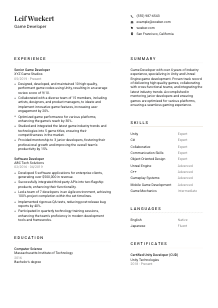
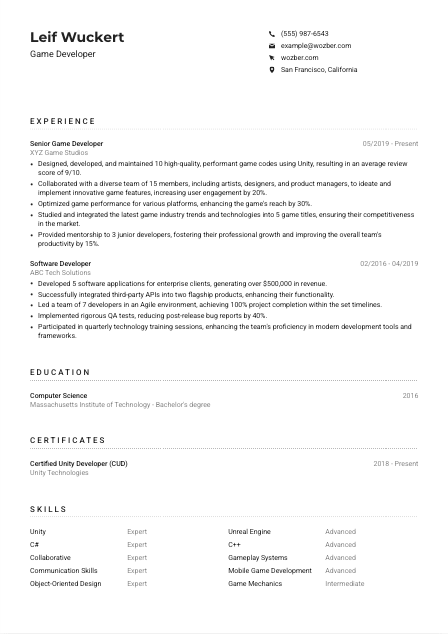
Building virtual realms, but your resume feels like a glitch? Check out this Game Developer resume example, created with Wozber free resume builder. It shows how to code your gaming genius to match job expectations, setting your career on a path as epic as the quests you design!
Game development resumes are reviewed through the lens of shipped work. Hiring teams want to see whether you can build stable gameplay features, work inside an engine-based production pipeline, and keep performance under control as a project moves from prototype to release. Your resume should make that practical contribution visible, not just list tools and titles.
When the wording mirrors the job's engine, language, and gameplay requirements, the resume is easier to route through an ATS and easier for a lead developer or hiring manager to read quickly. Wozber's free resume builder helps you align that phrasing into an ATS-compliant resume, so your Unity, Unreal, C#, C++, optimization, and cross-functional delivery work are surfaced in the terms this kind of team is already using.
Game teams move fast, and basic logistics can affect whether your application moves forward at all. Your personal details should confirm role alignment immediately, especially for title, contact accuracy, and any location requirement named in the posting.
Use your full name in a clear, readable format so it anchors the resume right away. Keep styling simple. In technical hiring, visual flair matters far less than clean structure and fast access to your experience, engine background, and code work.
Place "Game Developer" directly under your name if that is the role you are pursuing. This helps frame the rest of the resume around gameplay systems, engine work, and production-ready code. If your current title is broader, such as Software Developer, the target title still helps position your relevant experience correctly.
Include a phone number and professional email address that you check regularly. If you maintain a portfolio site, GitHub, or shipped-project page, add it here as well. For game development, links to playable builds, code samples, or project breakdowns can add context that a resume alone cannot show.
Some studios filter early for on-site or local candidates. When a posting specifies a location, reflect it clearly if you meet that requirement. In the example, listing San Francisco, California directly supports the employer's stated need without forcing them to look for it elsewhere.
If you link to a website or professional profile, make sure the roles, dates, engines, and project claims match what is on the resume. A mismatch around shipped titles, tech stack, or years of experience can create doubt quickly, especially in roles where technical credibility matters.
This section should confirm that you are reachable, correctly positioned for the role, and aligned with any stated logistics. That clears space for the resume to focus on your gameplay, engine, and development work.




For a Game Developer, experience is where the hiring decision usually sharpens. Teams look for evidence that you have implemented features, worked across design and art constraints, optimized performance, and contributed to games or interactive products in a real production setting.
Before rewriting bullets, identify the technical and delivery themes in the posting. Here, the priorities include Unity or Unreal, C# or C++, object-oriented design, gameplay systems, performance tuning, collaboration, and support for junior developers. Your experience section should answer those points directly through past work, not through generic claims.
Use reverse chronological order so reviewers reach your latest engine and feature work first. If you have both game and non-game experience, keep the game-focused role at the top and make sure the older software role still highlights transferable strengths such as QA discipline, API integration, Agile delivery, or team leadership.
Each bullet should show what you built, how you built it, and what changed because of it. In game development, that often means gameplay systems implemented, features launched, platforms supported, bugs reduced, frame rate improved, or engagement lifted. The example does this well by connecting Unity development to review scores, engagement growth, and platform reach.
Numbers are especially persuasive when they reflect how games are actually evaluated. Useful metrics include number of titles or features delivered, user engagement, crash or bug reduction, optimization gains, team size, release cadence, or productivity improvements. "Optimized game performance for various platforms, enhancing reach by 30%" is stronger than a plain statement about optimization because it ties technical work to audience impact.
Not every past project deserves equal space. Keep bullets that reinforce engine fluency, coding discipline, collaboration with artists and designers, testing, or delivery under deadlines. If a role was outside games, trim it to the parts that still matter here, such as leading developers, reducing defects by 40%, or shipping on schedule in an Agile environment.
A hiring team should be able to see your engine experience, feature ownership, technical judgment, and production impact from this section alone. Make each bullet pull its weight.
Education carries weight in game development when it confirms the underlying technical base for engine work, systems thinking, and programming. It matters most when it clearly matches the degree level or field named in the posting, then stays concise.
If the job asks for a Bachelor's degree in Computer Science, Game Design, or a related field, list that information plainly. In the example, a Bachelor's degree in Computer Science aligns directly with the requirement and supports the candidate's programming background.
Include school name, degree, field of study, and graduation year or date range. Keep it easy to scan. Technical hiring rarely rewards decorative formatting here. Clear structure is enough, especially when your professional experience already carries most of the decision weight.
If you are earlier in your career, a capstone project in gameplay programming, graphics, AI, networking, or physics can strengthen the section. For someone with several years of shipped experience, those details are usually less important than production work in Unity, Unreal, or custom toolchains.
Honors, competitions, game jams, or research projects can add value if they relate to game systems, interactive media, or software engineering. Keep them if they deepen your technical story. Leave them out if they distract from stronger professional evidence.
Formal education is only one part of staying current in game development. New rendering workflows, platform constraints, engine updates, and tooling changes matter. You do not need to force that message into the education section if your experience and certifications already show you continue learning.
For this role, education should confirm the technical baseline and then step aside for your gameplay, engine, and shipping experience.
Certifications are not required for every Game Developer role, but the right one can strengthen your case when it supports a specific engine, workflow, or technical specialization. They work best as supporting proof, not as a substitute for shipped work.
When a posting names Unity or Unreal, certificates connected to those ecosystems can help. A Certified Unity Developer credential, for example, reinforces engine familiarity in a way that feels directly relevant to gameplay implementation and production work.
Keep this section selective. One strong, recognizable certification related to game development or engine tooling is usually more useful than a long list of loosely related courses. Make the certificate easy to spot and easy to connect to the target role.
Certification dates show whether the credential is current or recently maintained. In fast-moving engine environments, recency matters because tools, editor workflows, and best practices change over time.
This is a good place to reflect that you keep up with evolving development practices, whether through engine certification, platform-specific training, or specialized courses in optimization, graphics, or multiplayer systems. Keep the focus on learning that supports real game production.
Relevant certificates can strengthen your engine profile and show continued growth, especially when they line up with the tools named in the job description.
The skills section should read like a realistic snapshot of how you contribute to game production. Hiring teams look for engine fluency, programming depth, gameplay understanding, and collaboration skills that make feature development smoother across design, art, and product.
Start with the language of the job description. Here, that includes Unity or Unreal Engine, C# or C++, object-oriented design, gameplay systems, game mechanics, collaboration, and communication. These are the skills your resume should foreground if they reflect your actual background.
Do not list only engines and languages. Game development happens across disciplines, so collaboration with artists, designers, QA, and product managers belongs here too when it is a real strength. The example balances Unity and C# with communication and collaborative work, which fits the responsibilities well.
Avoid turning this section into a complete inventory of every tool you have touched. Prioritize the skills that support the target role most directly, such as engine expertise, programming languages, gameplay systems, optimization, object-oriented design, and platform experience. A focused list gives the rest of the resume more credibility.
This section should reinforce the same story told in your experience bullets: you can build gameplay, write reliable code, collaborate across disciplines, and work inside the engine environment the team uses.
Language skills matter in game development when they affect day-to-day collaboration, documentation, standups, or work with distributed teams and international partners. Keep this section practical and accurate.
If the role calls for strong English, list English first and state your proficiency clearly. That matters because feature discussions, bug reports, code reviews, and cross-functional planning all depend on precise communication.
Terms like Native, Fluent, Intermediate, and Basic are enough. In the example, "English - Native" confirms the stated requirement quickly and without extra wording.
Additional languages can be useful for global studios, player-facing products, localization coordination, or collaboration across regions. Japanese, for example, may be relevant in some game markets or partnership environments, but it should stay secondary to the required language unless the role calls for more.
Do not overstate language ability. If you can join design discussions, write documentation, or support cross-team communication in another language, say so through an honest proficiency label rather than exaggeration.
For most Game Developer positions, language is a supporting section, not a centerpiece. Include it to confirm communication readiness, then let your coding, gameplay, and engine work stay in the foreground.
A concise language section reassures the team that you can work effectively in meetings, documentation, and day-to-day development conversations.
The summary should give a quick, technically grounded picture of what kind of Game Developer you are. In a few lines, it should connect your years of experience, engine focus, programming strengths, and the kind of production impact you bring.
Use the job description to decide what belongs in this opening paragraph. For this position, that means game development experience, Unity or Unreal, C# or C++, gameplay systems, optimization, collaboration, and mentoring. Choose the themes you can prove elsewhere on the resume.
Start plainly with your title and years of experience, such as "Game Developer with 4+ years of experience." This immediately helps the reader place you within the seniority range of the role and sets up the technical detail that follows.
Mention the engine environments, coding focus, or gameplay work you are strongest in, then connect that to outcomes. The example summary works because it does not stop at naming Unity and Unreal. It also points to cross-functional delivery, trend awareness, mentoring, and optimization across platforms.
Aim for a short paragraph that reads cleanly in one pass. Avoid broad claims like "passionate developer" or "results-driven professional" unless you immediately ground them in concrete game work. This section should sound like a clear technical profile, not a generic introduction.
A sharp summary helps the reader understand your engine background, gameplay focus, and production value before they reach the first bullet. Finish with a resume that is tailored for the role, structured in an ATS-friendly resume format, and checked with Wozber's ATS resume scanner so the right technical details surface early and clearly.
When the resume is tailored well, it shows more than enthusiasm for games. It shows engine fluency, gameplay implementation, performance awareness, team collaboration, and the kind of delivery record a studio can trust on an active project.
Use Wozber's free resume builder to shape that story into an ATS-friendly resume template, align your wording with the job description, and strengthen ATS optimization before you apply. The final document should make it easy to judge whether you can step into production and contribute to the game from day one.




