



Use Wozber and land your dream job
Create Resume
No registration required
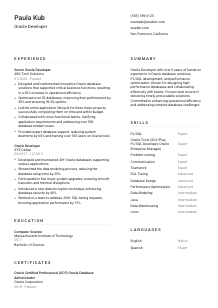
Crafting with the Oracle, but your resume feels like a SQL query gone wrong? Refactor it with this Oracle Developer resume example, created with Wozber free resume builder. Learn how to align your database finesse with job requirements, positioning your career to execute with maximum efficiency!
Oracle Developer resumes are reviewed through a practical lens. Teams need people who can write solid PL/SQL, tune SQL that is slowing down production, and build database solutions that hold up under real business load. A vague list of duties will not carry much weight here. Your resume needs to show where you improved performance, stabilized systems, supported releases, or solved database issues that affected users and applications.
Screening gets much faster when your resume uses the same Oracle language the role uses. With Wozber's free resume builder and its ATS optimization workflow, you can align terms like Oracle database development, SQL tuning, data modeling, and high availability in an ATS-friendly resume format without turning the document into a keyword dump. That makes it easier for a hiring team to see whether your background matches the production, support, and performance demands of the job.
For an Oracle Developer, the personal section should be simple and exact. Hiring teams are not looking for personality here. They want reliable contact details, a role title that matches the work, and any location information that removes friction early in the process.
Use your full name in a clean, readable format at the top of the page. Keep it slightly more prominent than the rest of the header so it is easy to find in a quick scan or after ATS parsing. Treat it like the label on a production system. It should be unmistakable and easy to reference.
Use the job title "Oracle Developer" when that is the role you are pursuing and your experience supports it. This immediately frames the rest of the resume around Oracle database development, PL/SQL work, and performance-focused responsibilities. If your recent title was more senior, such as "Senior Oracle Developer," you can still align your headline to the target role while preserving the seniority in your experience section.
List a current phone number and a professional email address. For technical hiring, this sounds basic, but missed digits or an outdated address can stall an interview request just as quickly as a failed deployment. Make sure every channel you include is one you actually monitor.
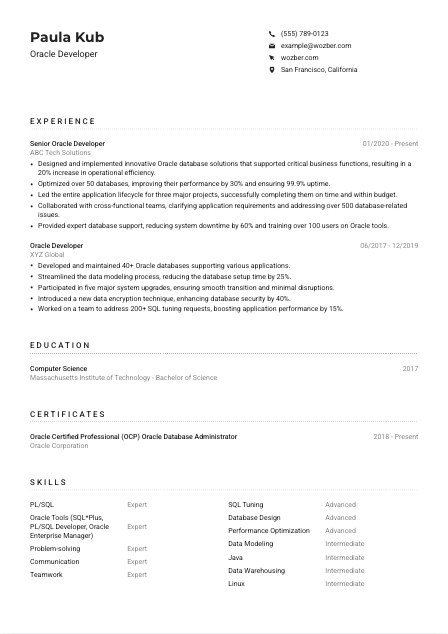
If a posting specifies a location requirement, reflect it clearly in your header when accurate. In the example, listing "San Francisco, California" directly addresses the employer's stated location filter and avoids unnecessary questions about relocation or availability. Use this only when it is true for you and relevant to the role you are targeting.
Include a LinkedIn profile or personal site if it adds useful context, such as project history, certifications, or a fuller career timeline. Keep it current and consistent with your resume, especially around Oracle tools, database project scope, and dates. If the link does not strengthen your technical profile, leave it out.
Keep the header lean, accurate, and aligned to the role. When the contact details, title, and location are clear, the reader can move straight to your Oracle development experience without distractions.




This is the section that carries the most weight for an Oracle Developer. Hiring teams want to see production work, database scale, tuning results, delivery across the application lifecycle, and examples of how you handled stability or support issues. Generic bullets about "working with databases" miss the mark. Show what you built, improved, or kept running.
Read the job description for the operating priorities behind the title. Here, the emphasis is on Oracle database solutions, SQL tuning, high availability, lifecycle participation, and cross-functional support. Your bullets should echo those realities with your own experience, whether that means designing schemas, optimizing stored procedures, supporting releases, or resolving production incidents.
List positions in reverse chronological order and make each entry easy to scan. Include the company, title, and dates first, then move into accomplishment bullets. For Oracle work, recent experience usually matters most because tools, environments, and performance practices change. If your latest role involved heavy PL/SQL development or Oracle database support, put that evidence front and center.
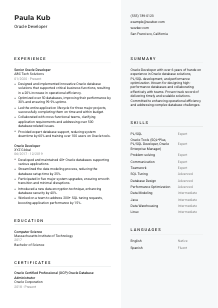
Write bullets around outcomes the business or engineering team would notice. Strong Oracle examples include reducing query runtime, improving uptime, increasing throughput, shortening deployment cycles, or resolving a large volume of database issues. The sample resume does this well with bullets like optimizing more than 50 databases for a 30% performance gain and maintaining 99.9% uptime. That gives the reader a concrete picture of both scope and result.
Numbers matter here because database work is often judged by performance, reliability, scale, and support volume. Include figures tied to database count, issue volume, response time, uptime, project delivery, user training, or efficiency gains. A bullet about handling 200+ SQL tuning requests or reducing downtime by 60% says much more than "improved database performance."
Keep the focus on Oracle-relevant work such as PL/SQL packages, SQL tuning, data modeling, database design, environment support, release participation, and collaboration with analysts, developers, or operations teams. If you have broader development experience, keep only the parts that support the target role. A hiring manager for an Oracle Developer opening is trying to understand how you perform around database reliability, performance optimization, and production support.
Your experience section should make your Oracle work easy to trust. By the end of it, the reader should understand the environments you handled, the performance problems you solved, and the business systems you helped keep stable.
Education matters most here as a baseline qualification. It tells the employer you have formal grounding in computer science, information systems, or a related discipline, then your experience takes over. Keep this section straightforward and relevant.
If the role asks for a bachelor's degree in Computer Science, Information Systems, or a related field, place that information clearly and exactly. When your degree aligns directly, as in the example's Bachelor of Science in Computer Science, it removes a screening hurdle right away and supports the technical depth shown elsewhere on the resume.
List your degree, school, and graduation year in an order that is easy to scan. There is no need to overdesign this section for an Oracle Developer resume. Clear structure works better than extra detail unless you are early in your career or your coursework fills a real experience gap.
Do not bury the major. For technical roles, "Computer Science" or a closely related field matters because it connects directly to database design, data structures, systems thinking, and software fundamentals. Make that connection obvious in the way you format the entry.
If you are earlier in your career, relevant coursework can help, especially in database systems, data modeling, algorithms, operating systems, or software engineering. For someone with 5+ years of Oracle development experience, this usually becomes optional. Let experience lead unless coursework fills a meaningful gap for the target role.
Add honors, technical awards, or standout academic projects only if they support the role and do not crowd out stronger professional evidence. A database-focused capstone or systems project can be useful early on. For experienced Oracle Developers, this section should stay concise and let production achievements do most of the work.
Use education to confirm you meet the formal baseline, then move the reader back to your Oracle experience. Clear degree information is enough when the rest of the resume already shows strong database work.
Oracle certifications are not required for every job, but they can strengthen your case when they point directly to the platform, tools, or development work the employer cares about. They are most useful when they support experience rather than trying to replace it.
List certifications that reinforce the database and PL/SQL responsibilities in the role. For an Oracle Developer, credentials connected to Oracle Database administration, PL/SQL development, or related platform knowledge are more valuable than broad technical certificates with little relevance to SQL tuning or database design.
When the job calls for Oracle database development and performance work, certificates like Oracle Certified Professional or Oracle PL/SQL Developer Certified Associate help underline that specialization. The example resume uses both, which strengthens the technical narrative already established in the experience section.
Add the year or active period so the reader can see whether the certification is recent or still current. That matters more in technical roles where platform versions, tooling, and best practices evolve over time. Use a clean format and avoid overexplaining renewal details unless they are important.
If you are actively building expertise in newer Oracle features, performance practices, security, or adjacent database technologies, include recent learning that supports the role. This works well when your target jobs value staying current with tools, optimization techniques, or support environments. Keep the emphasis on relevant development depth, not collecting certificates for volume.
Certifications should sharpen your Oracle profile, not distract from it. Include the ones that support your database development, PL/SQL, and performance optimization story, then let your project results carry the rest.
The best Oracle Developer skills sections are focused and deliberate. They show the database technologies, tuning capabilities, and collaboration strengths that the role actually requires. Long generic lists dilute the message, especially when the hiring team is scanning for Oracle-specific terms first.
Start with the exact technical areas the role names. In this case, that includes Oracle database development, PL/SQL, SQL tuning, database design, data modeling, performance optimization, and Oracle tools such as SQL*Plus, PL/SQL Developer, and Oracle Enterprise Manager. When these appear naturally in your skills and experience, ATS matching improves and the technical focus is immediately clearer.
Place the most role-critical skills near the top and keep your proficiency labels believable. If PL/SQL and Oracle tools are central to your recent work, they should come before broader items like Java or Linux. The sample resume handles this well by leading with Oracle-specific capabilities and placing supporting technologies lower in the list.
Oracle Developers rarely work in isolation. Database issues often involve application developers, business analysts, support teams, and end users. That makes problem-solving, communication, and teamwork worth listing when they are backed by your experience, such as resolving hundreds of database issues, supporting releases, or training users on Oracle tools.
A focused skills section should tell the reader, in seconds, that you can build, tune, and support Oracle environments. Keep the list relevant enough that every item reinforces your value in a database-heavy role.
For Oracle Developer roles, language requirements usually matter when the work involves user support, cross-functional collaboration, documentation, or global teams. Keep this section factual. Its value comes from clarity, not from detail.
If the posting asks for advanced English, list English first and state your level plainly. This is especially relevant when the role includes troubleshooting, user training, or collaboration across departments, as clear communication affects day-to-day delivery as much as technical skill does.
Additional languages can be useful when companies operate across regions or teams, or when the role involves support for diverse user groups. They are usually secondary to your Oracle qualifications, so include them as supporting information rather than a major selling point.
Use honest, standard labels such as Native, Fluent, Advanced, or Intermediate. Overstating language ability can quickly create problems in interviews or on the job, especially in roles that require written incident updates, technical explanations, or user-facing support.
Some Oracle Developer jobs are heavily backend and internal. Others involve frequent coordination with analysts, QA, operations, or business users. When language ability supports that collaboration, it becomes more relevant. The requirement for advanced English in this posting points to a role with meaningful cross-team communication.
Language skills should support your overall profile, not compete with your technical core. A short, accurate section is enough. The main point is to confirm you can communicate effectively in the environments where Oracle development, troubleshooting, and user support happen.
List the languages that matter, state your level clearly, and move on. For this profession, language supports delivery and collaboration, but it should not overshadow your database expertise.
Your summary should tell the reader, in a few lines, what kind of Oracle Developer you are and where your value shows up. This is where you connect years of experience with the work you actually do well, whether that is PL/SQL development, performance tuning, database support, or delivery across the application lifecycle.
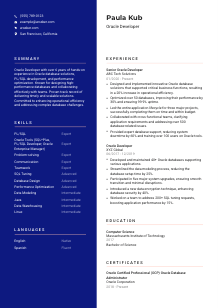
Start with your title and years of experience in Oracle database development. Be direct. A line such as "Oracle Developer with 6+ years of experience in Oracle database solutions, PL/SQL development, and performance optimization" works because it quickly matches the role's technical core and seniority level.
Use the next phrase or sentence to show the kind of environments or responsibilities you handle. That might include designing database solutions, tuning SQL, improving uptime, supporting enterprise applications, or troubleshooting production issues. This gives the hiring team a sense of your operating level before they read the full experience section.
Choose two or three points that reflect the role's priorities and your strongest evidence. The sample summary points to performance optimization, collaboration, and timely scalable delivery, which fits a job that spans design, implementation, support, and issue resolution. Keep these strengths specific enough to sound earned.
Aim for three to five lines. Include role-relevant terms such as Oracle database solutions, PL/SQL, SQL tuning, data modeling, or performance optimization when they reflect your real work. This helps both ATS matching and human review, especially when the summary flows naturally instead of reading like a compressed keyword list.
By the time someone finishes your summary, they should already understand your Oracle focus, your level of experience, and the kind of database impact you bring. That sets up the rest of the resume to confirm the claim.
A strong Oracle Developer resume makes three things easy to see. You know Oracle deeply, you can improve database performance and stability, and you can work through the full cycle from design to support. When each section is tailored around those points, the resume reads like someone who has already handled production systems, not someone who has only listed tools.
Use Wozber to tighten that alignment before you send the application. Wozber's AI resume builder, ATS resume scanner, and ATS-friendly resume templates help you match the language of the job description, surface missing requirements, and present your work in an ATS-compliant resume that stays easy to read. The final result should make your database strengths, tuning results, and delivery record clear from the first scan.




