



Use Wozber and land your dream job
Create Resume
No registration required
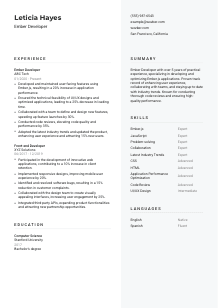
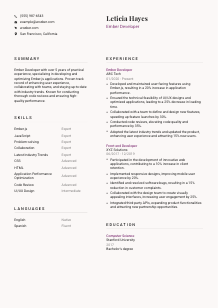
Crafting user interfaces with Ember, but your resume isn't sparking any interest? Check out this Ember Developer resume example, created with Wozber free resume builder. Learn how to highlight your Ember expertise to match job specifics, ensuring your career burns as bright as your code!
Ember teams look for developers who can keep complex front-end applications stable while still shipping features at a steady pace. A resume for this work needs to show more than general JavaScript experience. It should make your Ember.js depth visible through the kind of UI you built, the performance issues you solved, and how you contributed to code quality across a shared codebase.
Resume tailoring changes which parts of your front-end background rise to the top first. When an employer is scanning for Ember.js experience, code review habits, and UI performance work, generic web bullets get skipped quickly. Wozber's free resume builder helps you shape that experience into an ATS-friendly resume that reflects the language of the posting, so hiring teams can immediately see where you match the framework, workflow, and delivery expectations.
This section should remove friction before anyone reaches your technical experience. For an Ember Developer, that means making your identity, target role, contact path, and any location requirement easy to confirm without cluttering the top of the page.
Your name should be the most visible text on the page, set apart with clean formatting rather than decorative styling. In engineering hiring, clarity matters more than personality flourishes, and a simple, readable header keeps the focus on your application details.
Use the job title you are pursuing right under your name when it reflects your actual background. Writing "Ember Developer" immediately tells both the ATS and the reviewer that your experience is centered on this framework, not front-end work in the broadest sense.
Add a phone number and a professional email address that are easy to scan. If you also have a GitHub profile, portfolio, or personal site with Ember.js projects, components, or production UI work, include it. For front-end roles, a visible code or project link can strengthen what your bullets claim.
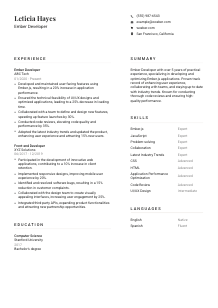
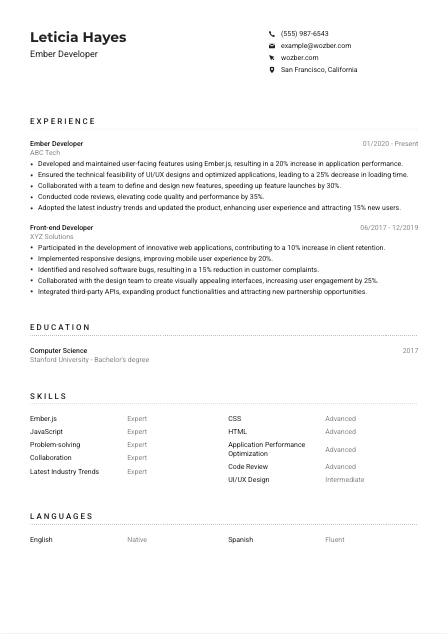
If the role has a stated location requirement, reflect it plainly in your header. Here, listing "San Francisco, California" aligns with the employer's request and removes an early question about availability. Treat this as tailoring to the posting, not a rule for every Ember Developer resume.
Skip details such as birth date, marital status, or any other information that does not help explain your ability to build, optimize, or maintain web applications. Keep the opening of the resume focused on professional relevance and hiring logistics.
A clean header tells the employer who you are, what role you are targeting, and how to reach you without distracting from your Ember.js experience. That is all this section needs to do, and doing it well keeps the rest of the resume moving.




For Ember Developer hiring, the experience section carries the most weight. This is where you show framework depth, UI delivery, performance improvements, collaboration with design and product, and the discipline to maintain code quality in a live application.
Before rewriting bullets, identify the work the employer emphasizes most. In this description, the core themes are building user-facing features with Ember.js, checking the technical feasibility of UI/UX designs, improving performance, collaborating across teams, and contributing through code reviews. Those themes should shape which achievements you surface first.
List your roles from most recent to oldest, including job title, company, and dates. This lets reviewers trace how your front-end work developed from broader web development into framework-specific ownership. If your latest role is the one with direct Ember.js responsibility, make sure that progression is easy to see within seconds.
Each bullet should connect an action to a result. For an Ember Developer, that often means feature delivery, faster load times, improved rendering performance, fewer defects, cleaner code, or smoother team execution. The sample resume does this well by tying Ember.js feature work to a 20% performance gain and UI optimization to a 25% decrease in loading time.
Metrics matter when they reflect how front-end work is judged in practice. Use numbers tied to page speed, release pace, defect reduction, engagement, or code quality improvements. Results such as speeding up feature launches by 30% or raising code quality through review standards are far more persuasive than saying you "helped improve the app."
Prioritize experience that shows component-driven UI development, JavaScript-heavy problem solving, collaboration with designers and engineers, and maintenance of production applications. Older front-end work still helps if it supports that story, such as responsive design, API integration, or bug resolution. Cut bullets that do not strengthen your case for building and maintaining Ember-based interfaces.
By the end of this section, the reader should understand the scale of the interfaces you worked on, the technical problems you handled, and the results you delivered. That is what turns past front-end work into a credible Ember Developer profile.
Education is usually a supporting section for an Ember Developer, but it still matters when a posting calls for a bachelor's degree in a related field. Present it cleanly so the requirement is easy to confirm and the rest of the resume can stay focused on shipped work.
If the role asks for a bachelor's degree in Computer Science, Engineering, or a related field, list that information plainly. In the example, "Bachelor's degree, Computer Science" lines up directly with the requirement and removes any ambiguity early in the review.
Use a simple structure with degree, field of study, school, and graduation year. Education sections in software resumes work best when they are quick to scan and do not interrupt the technical story built by your experience section.
If your degree matches the employer's requirement, say so in standard terms rather than abbreviations that could be missed. A clearly written "Bachelor's degree in Computer Science" maps cleanly to ATS parsing and to human review.
Relevant coursework, capstone projects, or university-built web applications can help if you are early in your career or if they show strong JavaScript or front-end architecture foundations. For experienced Ember developers, keep these details brief unless they add something your work history does not already cover.
Academic distinctions, technical scholarships, or meaningful extracurricular engineering work can add value, especially for newer candidates. Just make sure they support your software development profile rather than taking space from professional experience.
Your education section should confirm that you meet the academic baseline and then get out of the way. For most Ember Developer applications, the real persuasion happens in your shipped features, performance work, and framework expertise.
The skills section should mirror the technical language of the role without turning into a keyword dump. For an Ember Developer, that means balancing framework expertise, core front-end languages, and the collaborative habits that affect delivery quality.
Read the posting for both explicit and implied requirements. Here, the obvious ones include Ember.js, JavaScript, CSS, HTML, code review, performance optimization, problem-solving, and communication. Those are the terms worth reflecting if they match your real background.
Put Ember.js and JavaScript near the top, then support them with CSS, HTML, UI performance optimization, code review, and collaboration. The example resume follows this pattern well by centering Ember.js and JavaScript first, then adding supporting technical and team-based strengths.
Avoid filling this section with every tool you have touched. Hiring managers should be able to glance at it and understand your core front-end stack, how you contribute to team development practices, and whether your strengths line up with the work of shipping and maintaining Ember applications.
A well-built skills section should quickly confirm your framework fit and your working style. For this role, that means clear Ember.js depth, solid command of the front-end basics, and the habits needed to build reliable production UI.
Language skills matter most when the role names them directly or when the team works across regions. For this posting, English proficiency is stated as mandatory, so your resume should make that easy to confirm.
When the employer specifies English speaking and writing as mandatory, list English clearly with an honest proficiency level. That avoids unnecessary doubt about your ability to work in code reviews, written updates, product discussions, and day-to-day collaboration.
Additional languages can be worth listing when they reflect real proficiency and may help in cross-functional or international environments. They are secondary to the core technical qualifications, but they can still round out your profile.
Stick with standard terms such as "Native," "Fluent," "Intermediate," or "Basic." These are easy to understand at a glance and prevent recruiters from guessing how comfortably you can communicate in professional settings.
For an Ember Developer resume, language ability should support the application, not overshadow the engineering sections. Include what is relevant, especially when a posting names a required language, and keep the presentation concise.
For this application, the language section mainly confirms that you can communicate clearly in English across development work, reviews, and team collaboration. Any additional language skills are a useful extra, not the center of the case.
The summary needs to tell a front-end hiring team, very quickly, why your background belongs in an Ember-focused seat. It should highlight framework experience, the kind of product work you handle, and the outcomes you tend to drive in production applications.
Before writing the summary, identify what this position is really asking for. In this case, the emphasis is on Ember.js depth, building user-facing features, performance-minded development, and effective collaboration. Those should shape your opening lines.
Open with your years of experience and your front-end focus. If Ember.js is a genuine area of specialization, say that directly. The example summary works because it establishes both tenure and framework focus right away instead of staying at the level of general software development.
Include concrete themes that matter for Ember work, such as optimizing application performance, improving user experience, contributing to code reviews, or partnering with cross-functional teams to ship features. Choose details that are backed up later in your experience bullets.
Aim for a short paragraph that reads cleanly and avoids broad claims. Four focused lines can do more than a longer paragraph filled with vague strengths. The summary should make the reviewer expect solid Ember.js project work, measurable improvements, and dependable collaboration.
A sharp summary gives the reader an immediate frame for everything that follows. For an Ember Developer, that frame should be clear: you know the framework, you can build and improve production UI, and you work well inside a team shipping real features.
An effective Ember Developer resume makes a few things easy to spot right away: direct Ember.js experience, strong command of JavaScript, CSS, and HTML, measurable front-end outcomes, and steady collaboration with design and engineering peers. When those details are specific and well ordered, the resume reads like production experience rather than generic web development.
Wozber's free resume builder can help you turn that experience into an ATS-compliant resume with clean structure, targeted language, and stronger alignment to the posting. Use its ATS resume scanner and ATS-friendly resume templates to refine sections, surface missing keywords, and present your work in an ATS-friendly resume format that keeps the focus on what matters for the role. The final version should make one thing clear without effort: you can step into an Ember codebase and contribute with confidence.