



Use Wozber and land your dream job
Create Resume
No registration required
Building web kingdoms in Drupal, but your resume feels obscured? Check out this Drupal Developer resume example, created with Wozber free resume builder. Learn how to shape your code kingdom to match job castle specs, and present your drupalicious skills in a way that reigns over hiring monarchs!
Drupal hiring usually turns on practical execution. Teams want to see who can build and maintain production sites, extend modules and themes without breaking core behavior, and solve the debugging work that keeps content, performance, and releases on track. Your resume should make that day-to-day Drupal judgment easy to reach.
When the resume mirrors the language of the role, it becomes easier for both reviewers and an ATS to connect your work to Drupal development rather than general web work. Wozber's free resume builder helps you shape that alignment clearly, so Drupal API customization, site-building, front-end delivery, and issue resolution show up in an ATS-compliant resume as experience directly tied to the opening.
For Drupal roles, the header should answer a few practical questions fast: who you are, what kind of developer you are, and whether basic logistics line up. Keep it clean and targeted so the reader can move straight into your technical background.
Use your full name as the most visible text on the page. It should be easy to spot above your role title and contact details, the same way a site header establishes structure before any deeper content appears. Clean formatting matters here because it sets the tone for an organized, developer-minded resume.
Place "Drupal Developer" directly under your name if that matches your target role and recent experience. This helps frame you as a CMS specialist rather than a broad web developer, which matters when employers need someone with module development, theme work, and Drupal-specific troubleshooting experience.
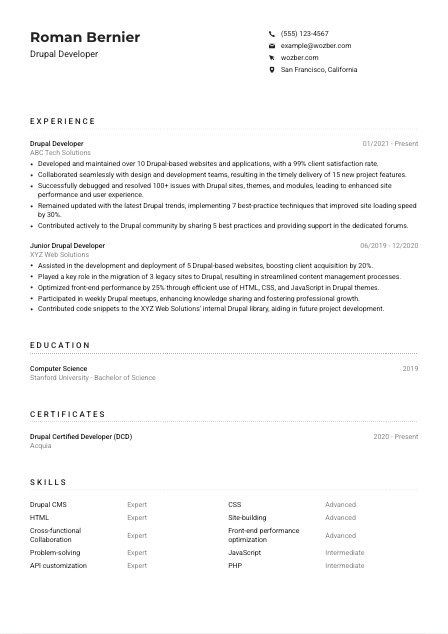
List a working phone number, a professional email address, and your city and state. In this example, "San Francisco, California" supports a stated location requirement, which is worth surfacing in the header rather than leaving it buried elsewhere. If a posting does not mention location, your city is usually enough unless relocation or remote eligibility is relevant.
Include a personal site, GitHub, LinkedIn, or Drupal community profile if it adds useful proof of your work. For this profession, a link is most valuable when it shows code samples, contributed modules, case studies, or technical writing about Drupal architecture, theming, or performance issues.
Skip details that do not affect your candidacy, such as age, marital status, or a full street address. Hiring teams need ways to contact you and quick confirmation that you match the role's logistics, not personal data unrelated to Drupal delivery or team collaboration.
Your personal details section should handle the basics quickly and professionally, while reinforcing that you are a Drupal developer whose location and contact information already fit the application.




This is the section most likely to separate a Drupal specialist from a generalist developer. Hiring teams look for shipped sites, Drupal-specific customization, front-end implementation, debugging depth, and the kind of cross-functional work that gets features from requirement to release.
Read the posting closely and pull out the work themes it emphasizes: Drupal site development, maintenance, module and theme customization, front-end development, issue resolution, and team collaboration. Then reflect those same priorities in your bullets using language that matches your real experience. If the role stresses "develop and maintain Drupal-based websites and applications," your experience should say exactly where you did that and at what scope.
List positions in reverse chronological order with employer name, job title, and dates. For a Drupal resume, the timeline should make your progression easy to follow, such as moving from junior implementation and migrations into full Drupal development, performance improvements, and broader ownership of production sites.
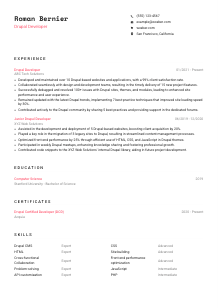
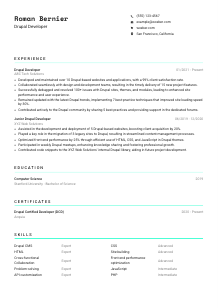
Each role should open with results that matter in web development. The example does this well by leading with accomplishments such as maintaining more than 10 Drupal-based websites, shipping 15 new features, and resolving 100+ issues across sites, themes, and modules. Those bullets tell the reader you have handled both build work and support work in a live environment.
Numbers carry weight when they describe scale, speed, reliability, or user impact. Good Drupal metrics include number of sites supported, features delivered, bugs resolved, page speed improvements, migration volume, or client satisfaction. A bullet like improving load speed by 30% through best-practice implementation is much stronger than a vague claim about "optimizing performance."
Keep the section centered on work that supports your case for this role. General web tasks are fine if they connect back to Drupal delivery, such as front-end theme work in HTML, CSS, JavaScript, or PHP-based customization. Unrelated experience should stay brief unless it adds something clearly transferable, like production troubleshooting or client-facing collaboration.
Your experience section should read like a record of Drupal work in production: what you built, what you fixed, how you collaborated, and what improved because you were on the project.
Education matters here mostly as a qualification check. Once that box is covered, the section should stay brief and clearly connected to the technical foundation expected for Drupal development.
If the posting asks for a bachelor's degree in Computer Science, Information Systems, or a related field, list that credential prominently. In the example, a Bachelor of Science in Computer Science directly meets the requirement, so it should be easy to find without extra wording.
Use a straightforward format: degree, field, school, and graduation year. "Bachelor of Science, Computer Science, Stanford University, 2019" gives the hiring team everything needed in one line and keeps attention on your Drupal experience, where most of the evaluation will happen.
If your degree aligns with the requirement, name it clearly instead of using shorthand or vague labels. That helps both human reviewers and ATS parsing connect your background to the stated qualification. Only mirror the posting when it is truthful to your actual credential.
For early-career Drupal developers, relevant projects can help if they show CMS implementation, PHP development, database work, or front-end engineering. If you already have several years of Drupal experience, coursework is usually less important than shipped sites, module customization, and debugging results.
Honors, scholarships, or standout capstone work can stay if they add meaningful technical credibility. Keep them short and relevant. A strong resume for this field does not need a long academic section once your professional Drupal experience is established.
Use education to satisfy the degree requirement cleanly, then let your Drupal projects, production work, and technical results carry the stronger argument.
Certifications are not always required for Drupal jobs, but they can strengthen your profile when they point to current platform knowledge, PHP depth, or ongoing professional development. They are especially useful when the employer wants someone who stays close to Drupal standards and community practice.
Start with the job ad. If it does not require certifications, treat this section as supporting proof rather than the centerpiece of your candidacy. For Drupal roles, platform-recognized credentials can still help show commitment to the ecosystem and familiarity with current development practices.
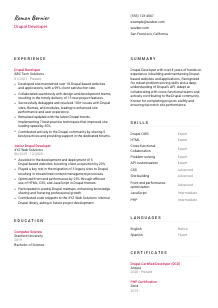
List the certifications most connected to the role you want. In the example, "Drupal Certified Developer" is directly relevant because it reinforces platform expertise, while a PHP certification adds useful technical depth behind module customization and back-end logic.
Add issue dates or active date ranges to show how recent the credential is. That matters in a CMS environment where best practices, version changes, security expectations, and implementation patterns continue to evolve.
A short list of current, credible certifications works better than a long catalog of loosely related courses. If you are actively learning, include training that supports real Drupal work, such as modern theming approaches, API integration, performance tuning, or security-focused development.
Certifications should support the picture your experience already paints: a Drupal developer who keeps technical knowledge current and relevant to production work.
A Drupal skills section works best when it reads like the toolkit behind your project outcomes. The mix should show platform depth, front-end capability, and the collaboration habits needed to ship features and resolve issues with designers, developers, and stakeholders.
Use the job description to identify the exact technical and workflow skills the employer names, then include the ones you genuinely use. For this opening, that means Drupal CMS, module and theme development, site-building, HTML, CSS, JavaScript, API customization, problem-solving, and collaborative team work.
Lead with the capabilities that define you as a Drupal developer. Platform-specific strengths such as Drupal CMS, site-building, module development, theme development, and API customization should appear before broader tools. Supporting skills like HTML, CSS, JavaScript, and PHP then show how you implement and extend that work.
Technical depth alone is not enough when the role involves cross-functional feature work and ongoing troubleshooting. Include soft skills that connect directly to the job, such as cross-functional collaboration and problem-solving, rather than generic traits. In the example, those pair well with bullets about feature delivery, issue resolution, and community participation.
Choose skills that explain how you build, customize, troubleshoot, and collaborate in Drupal, not a generic list of developer buzzwords.
For a Drupal developer, language ability usually matters less than technical work, but it still affects collaboration. Clear communication helps with requirement discussions, bug reporting, code review feedback, and support across design, development, and client-facing teams.
If the posting states that English is required, list it first with an honest proficiency level. "English: Native" or "English: Fluent" gives immediate confirmation that you can handle documentation, meetings, tickets, and day-to-day collaboration in the working language.
Additional languages can be useful in agencies, global product teams, or support environments with varied stakeholders. In the example, Spanish adds a practical secondary communication skill, even though English remains the key requirement for the role.
Stick to standard levels such as native, fluent, intermediate, or basic. Avoid inflated claims. Hiring teams do not need a dramatic description here. They need a reliable sense of how you communicate in meetings, documentation, or client exchanges.
If you speak more than one language, frame it as helpful context rather than a major selling point unless the role specifically requires it. For most Drupal positions, this section supports your ability to work across teams and audiences rather than replacing technical qualifications.
Do not overstate the importance of languages for every Drupal opening. In some environments, multilingual ability is a nice addition. In others, only English proficiency matters. Let the posting guide how much attention this section gets.
Use the language section to confirm communication ability where it matters, especially for English-language collaboration, documentation, and cross-team delivery.
The summary is where you quickly establish your version of Drupal experience. In a few lines, it should tell the reader whether you work mainly in site-building, custom development, performance improvement, maintenance, or a mix of all four.
Before writing, pull out the two or three priorities that define the role. Here, that includes Drupal development experience, API and customization knowledge, front-end capability, problem-solving, and collaboration. Your summary should reflect the parts you genuinely bring instead of trying to mention every keyword in the posting.
Start with a direct statement such as "Drupal Developer with 4+ years of experience building and maintaining Drupal-based websites and applications." That immediately tells the reader your specialization and level, which is more useful than a broad label like "web developer."
Follow with two or three specifics that sharpen your profile. The sample summary does this well by calling out Drupal API knowledge, problem-solving, cross-functional collaboration, and site performance. Those details place the candidate closer to production Drupal work than to generic front-end development.
Aim for a concise paragraph with real substance. Mention achievements or patterns of contribution that matter in this field, such as maintaining multiple Drupal sites, improving performance, resolving complex issues, or helping deliver features on schedule. The summary should create a clear expectation for the experience section that follows.
A good Drupal summary quickly tells the reader what kind of Drupal work you do, how much experience you have, and what technical value you usually bring to a team.
Once each section is aligned, your resume should present a clear picture of a Drupal developer who can build, customize, troubleshoot, and collaborate in a production environment. That is the standard most hiring teams are trying to confirm.
Use Wozber to tighten that alignment from top to bottom. Wozber's AI resume builder helps you match the job description with more precise Drupal language, and its ATS resume scanner can surface missing requirements so your ATS-friendly resume format reflects the technical scope the role actually asks for.
The final read should make one conclusion easy: you are prepared to step into Drupal work and contribute quickly.




