



Use Wozber and land your dream job
Create Resume
No registration required
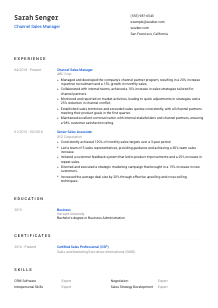
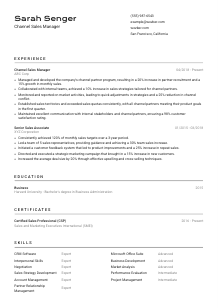
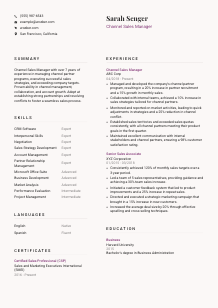
Mastering channels, but your resume seems off air? Tune into this Channel Sales Manager resume example, created with Wozber free resume builder. Learn how to pitch your distribution expertise in a way that matches company frequencies, creating a career path that's always in the prime time spot!
Channel sales lives in the space between direct revenue pressure and long-term partner trust. A Channel Sales Manager resume needs to show that you can recruit and activate partners, set workable territory and quota plans, and keep internal teams aligned when channel friction starts affecting pipeline or customer experience.
Hiring teams usually scan first for proof that your partner network work turned into measurable sales movement. Using Wozber's free resume builder to tailor your wording and keep an ATS-compliant resume cleanly structured helps those outcomes surface fast, especially when the role calls for channel program ownership, quota management, and polished negotiation in English.
For channel sales roles, the header does more than identify you. It confirms whether you are easy to contact, professionally presented, and available for the territory or market the company needs covered.
Place your name at the top in a clean, readable format. In sales leadership roles, that header should look polished and direct, the same way you would present yourself to a new partner or enterprise account.
Use the exact job title under your name when it reflects the role you are pursuing, such as "Channel Sales Manager." This helps ATS matching and immediately positions your background around partner programs, revenue targets, and channel relationships instead of broader sales work.
List a reliable phone number and a professional email address, then check both carefully. A missed digit or informal email can derail outreach, which is especially avoidable in a role built on responsiveness, follow-up, and partner communication.
If the employer names a location requirement, address it in your contact section. In this example, San Francisco, California is part of the brief, so showing that city or a clear willingness to relocate removes an early screening question.
Include LinkedIn or a professional website if it supports your sales credibility with consistent titles, dates, and achievements. For channel sales, that profile can reinforce account scope, partner ecosystem experience, and progression into territory or program ownership.
Keep the top of the resume practical and aligned. The hiring team should be able to confirm your role focus, reach you quickly, and see that basic logistics will not slow the process.




This section carries the most weight for a Channel Sales Manager. Employers want to see how you built partner revenue, handled account complexity, and worked across internal teams to keep the channel moving without conflict or confusion.
Read the posting closely and translate the core responsibilities into your experience section using your own real results. For this kind of role, that usually means partner recruitment, onboarding, quota setting, channel strategy, market feedback, and conflict management. When those ideas appear naturally in your bullets, your background reads as directly relevant instead of adjacent.
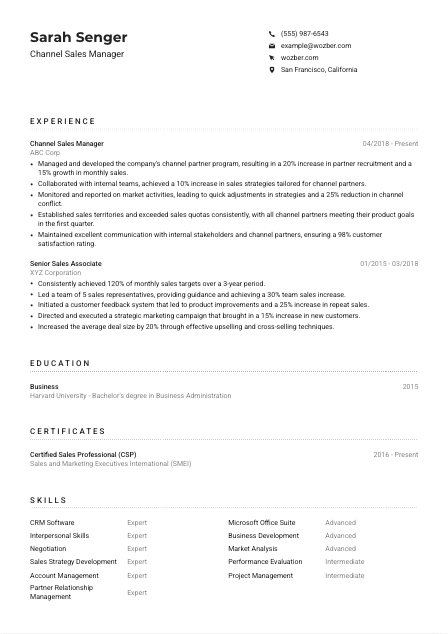
List jobs in reverse chronological order with company, title, and dates clearly shown. For sales roles, the title progression matters. Moving from Senior Sales Associate to Channel Sales Manager, as in the example, tells a stronger story when the bullets also show larger account responsibility, partner ownership, and broader commercial influence.
Avoid generic lines like "responsible for partner management." Show what changed because of your work. The sample resume does this well with points such as a 20% increase in partner recruitment and 15% monthly sales growth, which connects channel program management to business results.
Use metrics that make sense for channel sales: quota attainment, partner activation rates, deal growth, account retention, customer satisfaction, conflict reduction, or territory performance. Numbers such as 120% of monthly targets, 25% lower channel conflict, or 98% customer satisfaction give hiring managers a concrete read on execution.
Keep the emphasis on experience that speaks to indirect sales, account growth, partner enablement, and cross-functional execution. If an older role was not a pure channel position, keep the bullets that still show negotiation, sales performance, team leadership, or market expansion, and trim the rest.
Your experience section should show a consistent pattern of partner growth, sales delivery, and disciplined execution. By the end of it, the reader should understand the scale you managed and the revenue outcomes you produced.
Education will not outweigh channel sales results, but it still helps close the loop on core requirements. Present it cleanly so the hiring team can confirm the degree background without searching for it.
If the job calls for a Bachelor's degree in Business, Sales, or a related field, make that easy to find. A degree such as Business Administration, like the one in the example, clearly supports the commercial and operational side of channel management.
List the school, degree, field of study, and graduation year in a straightforward structure. Clean formatting supports ATS readability and keeps the focus on confirming qualifications rather than decoding the layout.
When your field of study directly supports sales planning, account management, or business operations, let that connection stand on its own. You do not need extra explanation if the degree already matches what the employer requested.
Honors, relevant coursework, or business competitions can help early-career candidates or those moving into channel sales from adjacent roles. If you already have 5+ years of sales experience, keep this section lighter unless the academic detail strengthens your commercial profile.
If you have completed additional sales training, leadership coursework, or partner management programs, reference them where they fit best. Formal certifications usually belong in the certificates section, but they still reinforce that you keep current with sales practice and market expectations.
Education only needs to do one job here: verify that you meet the stated academic baseline and support the business side of the role. Keep it concise and easy to validate.
Certifications are optional for many channel sales roles, but the right one can sharpen your profile. They work best when they reinforce sales method, account leadership, negotiation, or partner development rather than filling space.
Even when the posting does not require a credential, a relevant certification can support your positioning. A designation like Certified Sales Professional, shown in the example, signals continued investment in sales discipline and professional standards.
Choose credentials that relate to revenue growth, strategic selling, account management, channel development, or negotiation. Certifications should strengthen the case that you can guide partners, handle large accounts, and execute against commercial targets.
Show issue dates or active periods, especially for credentials that require renewal. That small detail helps the employer see whether the certification is current and still relevant to how you work today.
Channel strategy changes with partner models, product mix, and market conditions. Recent training in sales operations, CRM workflows, forecasting, or partner enablement can be worth adding if it reflects how the role is actually performed.
A certificate should reinforce your channel sales profile, not decorate it. Include the ones that add commercial relevance and show that your methods are current.
A Channel Sales Manager needs a mix of relationship skills, commercial judgment, and operational tools. Your skills section should reflect how you actually run partner business, track performance, and negotiate toward target.
Start with the skills the employer named directly, then add closely related ones you genuinely use. In this brief, CRM software, Microsoft Office Suite, interpersonal strength, and negotiation are explicit, while partner management, account growth, and sales strategy are natural supporting skills.
Lead with the capabilities most tied to the job: partner relationship management, channel sales strategy, account management, quota ownership, negotiation, and CRM fluency. That ordering helps the resume read like a channel sales profile rather than a general business development resume.
Group or order skills so the most relevant ones appear first and weaker fillers stay out. The example uses a useful mix of CRM software, partner relationship management, sales strategy development, market analysis, and account management, which reflects the day-to-day mechanics of the role.
This section should echo the work in your experience, not introduce a different identity. When done well, it confirms that you have the tools and commercial instincts to manage a partner channel effectively.
Language skills matter in channel sales when they affect negotiation, partner enablement, or regional coverage. List them clearly, especially when the employer names a required business language.
If the role specifies that you must negotiate effectively in English, make that visible. This is a functional requirement for partner calls, pricing discussions, internal coordination, and written communication.
List English at the top with an honest proficiency level such as Native or Fluent. That makes it easy for the employer to confirm the communication standard before reviewing the rest of your profile.
Additional languages can be useful when partner networks span regions or customer segments with multilingual communication needs. The example includes Spanish, which could be an advantage in some markets, though it is not a universal requirement.
Choose standard labels such as Native, Fluent, Advanced, or Conversational. Straightforward ratings set accurate expectations for negotiation, presentations, and day-to-day partner interaction.
If the role covers international distributors, regional resellers, or cross-border accounts, language capability becomes more strategically relevant. If not, keep the section concise and let English proficiency do the essential work.
For this role, languages should clarify where you can communicate and negotiate effectively. Lead with business-ready English, then add extra languages only when they expand your channel reach.
Your summary should quickly establish the kind of channel leader you are. In a few lines, it needs to connect years of experience with partner growth, revenue performance, and the specific commercial strengths the role depends on.
Start with your experience level and functional focus. If you have spent several years building partner programs, managing reseller relationships, or driving indirect revenue, say that plainly in the opening sentence.
Use a clear opening such as "Channel Sales Manager with 7+ years of experience in partner program development and sales growth." This quickly places you in the right lane and mirrors the level of experience the employer is seeking.
Follow with two or three specifics that fit the job, such as quota delivery, cross-functional sales strategy, large account management, market feedback, or conflict resolution. The example summary works because it ties channel management to partnership building and smoother sales execution.
Aim for a short paragraph, not a biography. Two to four sentences are enough if they include experience level, channel focus, and one or two concrete strengths or outcomes tied to revenue, partner performance, or account growth.
By the time someone finishes this section, they should already understand your channel focus, your level of commercial ownership, and the kind of sales results you are likely to bring into the partner network.
A Channel Sales Manager resume should make partner growth, sales execution, and cross-functional coordination easy to spot from the first scan. When each section supports that story, your application reads like someone ready to manage a channel, not someone hoping to grow into it.
Use Wozber to tighten structure, tailor language to the posting, and strengthen ATS optimization with an ATS-friendly resume format that highlights the experience and results this role depends on. The final resume should make your ability to grow partner revenue and manage the channel with confidence easy to judge.




