



Use Wozber and land your dream job
Create Resume
No registration required
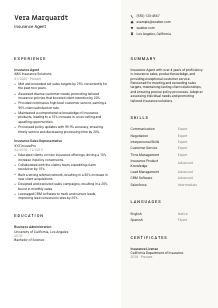
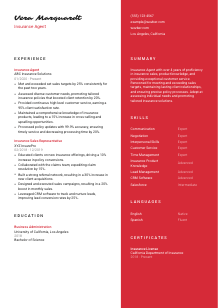
Securing policies, but your resume feels uninsured? Anchor it with this Insurance Agent resume example, created with Wozber free resume builder. Learn how to match your coverage expertise to job specifications, making sure your career path is as well-protected as the policies you sell!
Insurance Agent hiring usually turns on a practical question fast: can this person bring in business, explain coverage clearly, and keep policy details accurate once the sale is made? A resume for this field needs to make that mix visible. Sales numbers matter, but so do retention, renewals, client service, and the accuracy of policy updates, claims support, and account changes.
When the resume is tailored well, it becomes much easier to connect your background to the book-of-business demands in the posting. Wozber's free resume builder helps organize that experience into an ATS-compliant resume that uses the same language employers use for quotas, renewals, customer needs analysis, and licensing. That gives hiring teams a clearer read on whether you can sell, advise, and manage client accounts with confidence.
Insurance is a relationship-driven business, and the contact block at the top of the resume should feel dependable from the first glance. For an Insurance Agent, this section should confirm who you are, how to reach you, and whether you already meet practical requirements such as local availability.
Use your full name in the largest text on the page so it anchors the document immediately. Keep the styling simple and professional. In insurance sales, where trust and clarity matter, overdesigned headers can work against you.
Place "Insurance Agent" directly under your name if that is the role you are pursuing. This removes ambiguity, especially if your recent work includes nearby titles such as Insurance Sales Representative, Account Manager, or Producer. Matching the posting language also helps ATS sorting and quick recruiter review.
Add a phone number and professional email address that you check regularly. Accuracy matters here as much as it does in policy processing. A missed digit or outdated email can cost you an interview just as easily as an incomplete application.
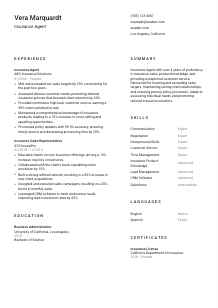
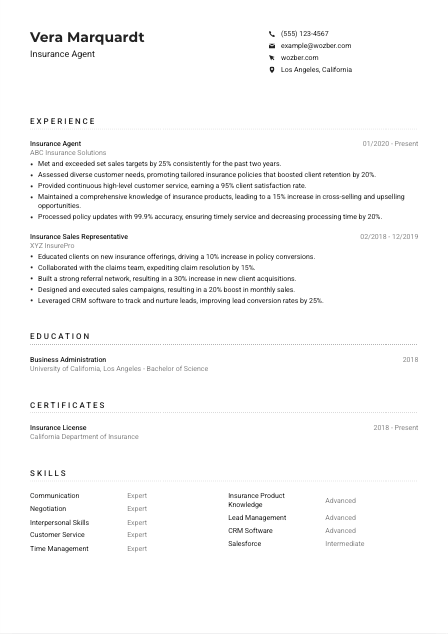
If the employer requires candidates to be based in a specific market, include your city and state. In the example, listing Los Angeles, California directly addresses the stated location requirement. Do this when geography affects licensing, territory coverage, branch access, or in-person client meetings.
A LinkedIn profile or professional website can help if it reinforces your insurance background, sales history, or client-facing credibility. Make sure the job titles, dates, and licensing details match your resume exactly so the employer sees one consistent professional profile.
Keep this section factual, polished, and easy to scan. For an Insurance Agent, it should quickly confirm availability, professionalism, and alignment with any location-based requirement before the reader gets into your sales record or client portfolio.




This section carries the most weight for most Insurance Agent roles. Hiring managers look for proof that you can generate revenue, guide clients to suitable coverage, keep accounts active, and handle policy administration without errors that create risk or churn.
Before editing bullets, identify what the employer is actually hiring for. In this case, the priorities include meeting quotas, assessing customer needs, explaining plan options, maintaining product knowledge, and handling renewals or updates accurately. Those points should shape which achievements you feature first and which terms you mirror.
List positions in reverse chronological order with title, employer, and dates. That format works well for insurance hiring because it shows progression from sales support or representative work into broader client ownership, production responsibility, or account management.
Focus on production, retention, conversion, client satisfaction, policy accuracy, renewal activity, and cross-sell performance. The example does this well by showing a 25% over-target sales result, a 20% boost in retention, and 99.9% accuracy on policy updates. Those are the kinds of details that show both revenue contribution and operational discipline.
Metrics give context to your work and help separate you from candidates who only list duties. Use percentages, conversion rates, satisfaction scores, processing improvements, referral growth, or monthly production gains when they are real and relevant. Insurance employers want to know how consistently you performed against goals, not just that you "handled clients" or "processed policies."
Keep older or less relevant accomplishments brief unless they strengthen your case in sales, relationship management, compliance, or financial advising. Every bullet should move the reader closer to seeing you as someone who can sell coverage, retain clients, and manage account activity accurately.
Your experience section should make it easy to picture you in front of clients and inside the workflow. Strong Insurance Agent resumes show revenue performance, client relationship depth, and dependable execution on renewals, claims coordination, and policy changes.
Education is rarely the most persuasive section for an experienced Insurance Agent, but it still matters when the posting names a degree preference or requirement. Present it clearly so the employer can confirm the academic background without hunting for details.
If the job asks for a bachelor's degree in Business, Finance, or a related field, list that information in a way that is unmistakable. The example's Bachelor of Science in Business Administration lines up well with that requirement because it supports sales, financial products, and client advisory work.
Include degree, field of study, school, and graduation year or date. Keep it clean and consistent. This section should answer the requirement quickly, not compete with your experience section for attention.
If you have multiple degrees, place the one most connected to insurance sales, finance, business operations, or risk-related work first. Hiring teams usually want a fast confirmation that you meet the stated educational bar.
Newer candidates can mention relevant coursework in sales, personal finance, risk management, business law, or customer relationship management. For candidates with several years of production history, that space is usually better spent on measurable insurance results.
Honors, scholarships, or leadership roles can help if they reinforce discipline, communication, or commercial awareness. If you are already established in the field, these details are secondary to quota attainment, client growth, and licensing.
Education should confirm that you meet the academic expectation and move the reader back to your production history. For most Insurance Agent applications, clarity beats detail here.
For Insurance Agent roles, certifications are not decorative. Licensing determines whether you can advise, sell, or service policies legally, so this section needs to be complete, current, and easy to spot.
If the posting requires a valid state insurance license, place it prominently and use the official naming where possible. That is a core qualification, not an extra credential. Without it, many employers will not move the application forward.
List licenses and certifications that directly support your ability to handle the products in question. The example keeps the focus on the California insurance license, which is exactly right for a role that requires in-state eligibility. Avoid crowding this section with unrelated certificates.
Add the issuing authority and the date range or expiration information so the employer can see the credential is current. "California Department of Insurance, 2018 - Present" works because it confirms both source and active standing.
Continuing education, product training, or specialized certifications can strengthen the section when they relate to the business you want to write, such as life, health, property, casualty, or annuities. Use them to show range or up-to-date market knowledge, not to pad the resume.
In insurance hiring, current licensing clears an immediate threshold. Present your credentials so the employer can confirm legal eligibility, market relevance, and professional upkeep in seconds.
The best skills sections for Insurance Agents do not read like a generic list of soft traits. They point to abilities that affect prospecting, policy recommendations, renewals, account growth, and day-to-day client communication.
Start with the wording the employer already uses. Here, communication, negotiation, and interpersonal skills are explicit priorities. Add the role-specific capabilities that support those strengths, such as customer service, insurance product knowledge, lead management, and CRM use if they reflect your background.
Put the most relevant abilities first. For many Insurance Agent roles, that means sales communication, needs analysis, objection handling, relationship management, cross-selling, policy knowledge, and follow-through on renewals or updates. The example reinforces this by pairing people skills with customer service and product knowledge rather than listing generic business terms.
Choose skills you can substantiate with bullets elsewhere on the resume. If you list CRM software, negotiation, or lead management, the experience section should show better conversion, stronger retention, or more efficient follow-up. A short, believable list is stronger than a long inventory with no proof.
This section should quickly tell the reader how you sell, advise, and manage client relationships. For Insurance Agent roles, the right mix usually combines sales ability, client communication, and operational follow-through.
Language ability can matter more in insurance than candidates sometimes realize. Agents often work with clients making complex decisions about coverage, risk, and claims, so clear communication can directly affect trust, conversions, and long-term retention.
If the posting requires English proficiency, list English clearly with an honest proficiency level. That gives the employer an immediate match on a stated requirement and signals that you can handle policy explanations, sales conversations, and service follow-up in the primary business language.
Additional languages are valuable when they help you serve a broader client base or build stronger local relationships. In a market like Los Angeles, Spanish can be especially useful for client acquisition and service continuity, which makes the example's bilingual profile a practical advantage rather than a decorative extra.
Use clear labels such as Native, Fluent, Professional, or Conversational. Insurance work depends on precision, so vague wording around language ability can create doubt about whether you can explain policy terms, exclusions, or claims steps accurately.
Even when the posting does not require another language, include one if it genuinely helps you work with your target market. This is especially relevant for community-based agencies, multilingual urban markets, or roles built around relationship-driven referrals.
Frame multilingual ability as something that supports stronger conversations, smoother onboarding, and better long-term account handling. In insurance, communication is tied to trust, and trust often drives renewals and referrals.
List languages that you can use confidently in real client conversations. For Insurance Agents, multilingual ability can strengthen service quality, improve access to local markets, and support long-term client relationships.
The summary should read like a concise case for why you belong in front of clients and on a sales target. For an Insurance Agent, that means blending production history with policy knowledge, relationship management, and accuracy in account servicing.
Before writing the summary, identify the few themes that define the job. Here, those themes include insurance sales experience, quota performance, tailored policy recommendations, customer service, and licensing. Build around those points instead of writing a generic opening statement.
Lead with your professional identity and years of experience, such as Insurance Agent with 4+ years in insurance sales or client advisory work. That quickly places you at the right level and helps the reader understand whether you match the requested level of experience.
Choose strengths that carry weight in insurance hiring, such as exceeding sales targets, retaining clients, explaining coverage options clearly, or maintaining accurate policy processing. The example summary works because it combines sales results, lasting client relationships, and precise policy handling in a compact way.
Aim for a short paragraph that earns every line. Avoid broad claims like "results-driven professional" unless you immediately support them with insurance-specific detail. Your summary should create a clear expectation for the experience section that follows.
A useful summary tells the employer, in a few lines, what kind of Insurance Agent you are and where your value shows up. Keep it focused on sales performance, client advisory strength, and dependable policy execution.
Once each section reflects the actual demands of the role, your resume becomes much easier to shortlist. It should show a licensed professional who can sell policies, explain options clearly, manage renewals accurately, and hit performance targets.
Use Wozber to turn that experience into an ATS-friendly resume format, strengthen wording with role-specific terminology, and check alignment with an ATS resume scanner before you apply. The finished resume should make your production record and client-handling strength easy to judge.