




Use Wozber and land your dream job
Create Resume
No registration required
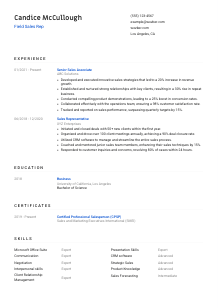
Hustling with prospects, but your resume isn't closing deals? Check out this Field Sales Rep resume example, created with Wozber free resume builder. It shows how to blend your field experience with job requirements to pen a career story that rings up success!
Field sales resumes work best when they show movement in the market. Hiring teams want to see who can open doors, run persuasive meetings, grow territory revenue, and keep client relationships productive after the first deal. If your resume only lists duties, it misses the part that matters most in sales: the results you created through outreach, presentations, negotiation, and follow-through.
A tailored resume helps separate field sellers from broader sales candidates by making your pipeline work, client-facing wins, and reporting habits easy to find in an ATS scan and a quick human review. Wozber's free resume builder helps you organize that experience in an ATS-friendly resume format, so the first read shows whether you can manage accounts, present products well, and convert activity into revenue.
Field sales is a people business, so the top of your resume should feel direct, credible, and ready for contact. This section does not need flair. It needs accuracy, professionalism, and any practical detail that removes friction for a hiring manager reviewing territory coverage or travel readiness.
Use your full name in a clear, slightly larger font so it is easy to spot at the top of the page. For a field sales role, that simple choice matters because your resume should read like polished business communication, the same way your emails, proposals, and meeting materials would.
Place "Field Sales Rep" directly under your name when that reflects the role you are targeting. A matched title helps recruiters quickly connect your background to outside sales, client visits, product demos, and territory-based revenue work instead of assuming a more general sales profile.
List a current phone number and a professional email address, then check both carefully. Sales hiring often moves fast, and missed calls or an unprofessional email can undercut the polished client-facing image the role requires. Add a website or LinkedIn profile only if it supports your case with relevant sales experience, recommendations, or results.
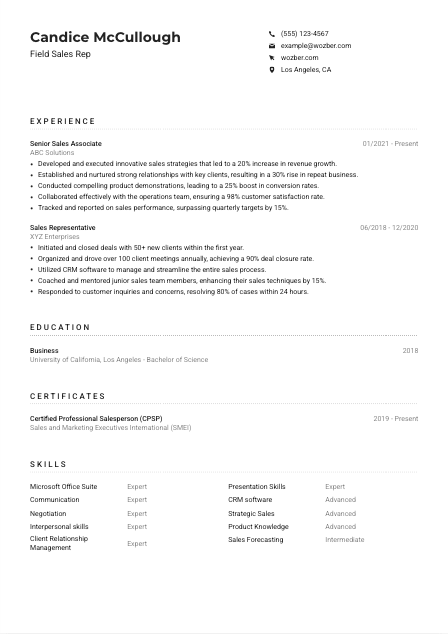
Field sales roles often depend on territory access, travel efficiency, and local client coverage. If a posting specifies a location, reflect it clearly in your personal details. Here, Los Angeles, CA matters because the employer explicitly asks for someone based there or willing to relocate.
If your LinkedIn profile shows consistent titles, measurable wins, account growth, or industry relationships, include it. Treat it like an extension of your sales profile, not an extra link. The content should reinforce the same story your resume tells about quota performance, client management, and market-facing communication.
Keep this section simple and accurate. For field sales, the best personal details confirm who you are, how to reach you, and whether you can realistically cover the market the job requires.




Experience is the section that carries the most weight for a Field Sales Rep. Hiring managers look for commercial traction: how you generated revenue, handled prospecting and demos, managed accounts, worked with operations or customer teams, and reported performance against targets.
Read the posting for the actions that define success. In this case, that includes building sales strategies, maintaining client relationships, running product demonstrations, collaborating across teams, and tracking performance. Use those priorities to decide which achievements deserve space and which older or less relevant bullets can be cut.
Start with your most recent sales job and include title, employer, and dates. That structure helps the reader follow your progression from earlier selling roles into broader ownership of revenue, client relationships, and sales planning. If your background includes both inside and field sales, use your bullets to show where you handled in-person meetings, territory work, or on-site presentations.
Field sales hiring is driven by proof of performance. Replace generic lines like "responsible for client meetings" with outcomes tied to revenue, retention, conversions, or order fulfillment. The sample resume does this well by linking product demonstrations to a 25% boost in conversion rates and client relationship work to a 30% rise in repeat business.
Use metrics that sales leaders actually track: revenue growth, quota attainment, repeat business, close rate, new accounts opened, meeting volume, renewal rate, or customer satisfaction. Numbers help the reader judge scale and consistency. Examples like surpassing quarterly targets by 15% or closing 50+ new clients show more than effort. They show production.
Choose bullets that show face-to-face selling, presentations, negotiation, partnership development, account growth, and coordination with internal teams after the sale. A line about using CRM software to streamline the sales process also matters here because it connects client activity to pipeline management and reporting, which are central to many field sales roles.
When this section is working, a sales manager can quickly see your territory impact, client-facing strength, and ability to turn activity into revenue. That is the standard your experience section should meet.
Education usually plays a supporting role in sales hiring, but it still matters when the employer has stated a degree preference. For a Field Sales Rep opening, this section should confirm the business foundation behind your sales work without taking space away from stronger commercial evidence.
If the job asks for a bachelor's degree in Business, Marketing, or a related field, make that match easy to spot. A degree such as a Bachelor of Science in Business directly supports the posting's requirement and reinforces your grounding in topics like market analysis, customer behavior, and commercial decision-making.
List your degree, field of study, school, and graduation year in a clean order. Hiring teams are usually scanning this section quickly, so keep it easy to verify without extra text or design elements getting in the way.
If your degree aligns closely with sales or business development, keep the field of study explicit rather than abbreviated. In the provided example, "Business" does useful work because it mirrors the employer's stated preference and supports the candidate's move into a field-based commercial role.
Early-career candidates can include a few relevant courses or projects if they connect to selling, marketing, or client strategy. Coursework in sales management, consumer behavior, market research, or business communication can help when your professional record is still growing.
Honors, competition results, or leadership in sales clubs and business organizations can add value when they show initiative, presentation ability, or commercial interest. Keep them only if they add useful context and do not crowd out stronger sales experience.
Use this section to satisfy the stated degree requirement and support your commercial background. In field sales, education is most useful when it is clear, relevant, and brief.
Certifications are rarely the main reason a Field Sales Rep gets hired, but they can strengthen your profile when they connect directly to selling methods, account management, or professional development. They are especially useful when the job posting names one as a plus.
Place certifications tied to sales practice or customer-facing work at the top of this section. A credential such as Certified Professional Salesperson, which the job description mentions as a plus, helps reinforce that your approach is grounded in recognized sales standards rather than ad hoc experience alone.
Only include certifications that support your value in selling, relationship management, presentations, negotiation, or business development. A shorter list of relevant credentials is stronger than a crowded section with unrelated courses that do not help explain your performance in the field.
Include the year earned and, when relevant, whether the credential remains active. This helps the employer understand how current your training is. In sales, recent certification can signal that you stay engaged with updated techniques in prospecting, objection handling, and closing conversations.
If you hold a certification that requires renewal or continuing education, keep it up to date before listing it. That small detail reflects professional discipline, which matters in roles that also depend on consistent pipeline follow-up, reporting accuracy, and account management.
Use this section to underline relevant training, not to decorate the page. The right certification supports your credibility as someone who takes sales craft seriously and keeps skills current.
A Field Sales Rep skills section should reflect the actual mechanics of the job. That means balancing selling ability with the tools and communication habits that support pipeline management, client meetings, demos, negotiations, and follow-up across internal teams.
Start with the language used in the posting. Here, CRM software, Microsoft Office Suite, communication, negotiation, and interpersonal skills are clearly requested. Those belong in your skills section if they genuinely reflect how you work, because they help both ATS matching and hiring-manager review.
Every skill you list should connect to evidence in your experience section. If you claim client relationship management, your bullets should show repeat business, retention, or account growth. If you list presentation skills, your experience should include product demos, customer meetings, or conversion results tied to those interactions.
Group the most relevant skills first, mixing core sales strengths with practical tools. A Field Sales Rep might lead with negotiation, client relationship management, CRM software, presentation skills, and sales forecasting before listing broader tools like Microsoft Office. The sample resume handles this well by combining sales capabilities with systems knowledge instead of treating them as separate worlds.
Choose skills that reflect how you win business, manage client relationships, and keep sales activity organized. The section should sound like the day-to-day reality of field selling, not a generic list of soft skills.
Language skills matter in field sales when they affect communication with prospects, account growth, territory coverage, or relationship-building. Present them clearly and honestly, especially when the posting names a required language for presentations, negotiation, or day-to-day client contact.
If the role specifically requires strong English communication, list English prominently with an accurate proficiency level. That directly answers the posting and reassures the employer that you can handle sales conversations, follow-up emails, product presentations, and reporting without friction.
Place the most job-relevant languages first. For many field roles, that means the language required for internal communication and customer meetings, followed by any additional language that can help in the territory or customer base you serve.
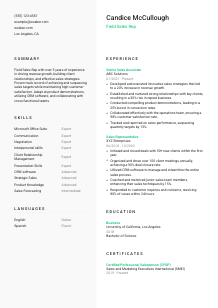
Extra languages can strengthen your profile when they support relationship-building with a broader set of clients. In some markets, a second language can help with rapport, local trust, and smoother conversations during prospecting or account management. The sample's Spanish fluency is a good example of an added advantage, even though English is the stated requirement.
Stick to direct labels such as Native, Fluent, Intermediate, or Basic. Sales roles depend on real communication ability, so vague descriptions create uncertainty. Clear ratings help the employer judge whether you can present, negotiate, and respond to customer questions comfortably.
When a territory includes multilingual communities or international accounts, language ability can become commercially useful rather than simply interesting. Mention languages that genuinely help you build relationships, explain products, or move deals forward.
Keep this section accurate and relevant. In field sales, language skills matter most when they help you communicate clearly with the customers and teams that drive revenue.
Your summary should quickly establish the kind of seller you are. For a Field Sales Rep, that usually means your years of experience, the markets or activities you handle well, and the business results you consistently produce through client-facing work.
Before writing, identify the two or three themes the role emphasizes most. In this posting, those are revenue growth, client relationship management, product demonstrations, CRM use, and collaboration across teams. Your summary should pull from those themes rather than trying to cover every part of your background.
Open with your title or sales specialization, then add your years of experience and one clear performance area. A line such as "Field Sales Rep with 5+ years of experience driving revenue growth and building client relationships" works because it immediately tells the reader what kind of seller you are and where you deliver value.
Use the next sentence to mention strengths that matter for the job, such as product demonstrations, pipeline management in CRM, account growth, or consistent target achievement. The sample summary works well because it pairs revenue growth and customer satisfaction with practical execution details instead of relying on broad claims alone.
Aim for three to five lines. That is enough space to establish your sales identity, show relevant strengths, and create context for the experience section. Avoid generic adjectives if you can replace them with a concrete skill, market-facing activity, or measurable result.
A well-written summary gives the hiring manager an immediate sense of your sales scope, client-facing strengths, and commercial results. By the time they reach your experience section, they should already understand the kind of revenue contributor they are reading about.
A Field Sales Rep resume should make one thing clear quickly: you know how to generate business, manage client relationships, and track performance in a structured sales process. When each section supports that message, the document starts reading less like a biography and more like a commercial case for your hire.
Use Wozber to build an ATS-compliant resume that reflects the language of the role, highlights missing requirements, and keeps your structure clean for both hiring teams and ATS screening. The final version should make it easy to judge your territory readiness, client-facing strength, and ability to turn meetings into revenue.




