



Use Wozber and land your dream job
Create Resume
No registration required
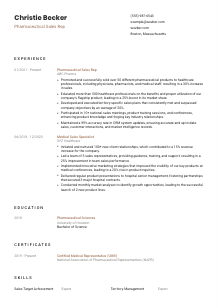
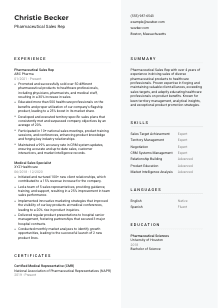
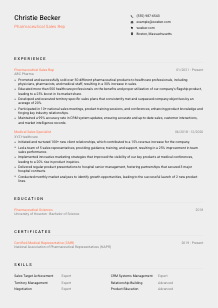
Clinching medical deals, but your resume isn't selling your worth? Amp up your presentation with this Pharmaceutical Sales Rep resume example, created with Wozber free resume builder. Learn how to pitch your sales expertise and product knowledge to match the job criteria, ensuring your career trajectory has no negative side effects!
Pharmaceutical sales resumes are strongest when they show how you move a territory, not just how often you visited accounts. Hiring teams want to see proof that you can build trust with physicians and pharmacists, explain product value clearly, and convert that work into prescription growth, account retention, or quota performance. Your resume should make those commercial results visible early.
A tailored application helps separate pharmaceutical reps from broader healthcare sales candidates by making product education, territory planning, and CRM discipline easy to spot in an ATS-compliant resume. Wozber's free resume builder helps you line up your language with the posting, organize role-specific metrics, and present the kind of field sales record that shows you can manage accounts and hit targets.
In pharmaceutical sales, contact details do more than identify you. They also answer practical questions fast, especially when the job involves field travel, territory coverage, and location requirements. Keep this section clean, professional, and aligned with the posting.
Your name should be the easiest element to find on the page. Use a simple, readable format so it anchors the top of the resume cleanly, the same way a strong opening line anchors a sales call with a physician's office.
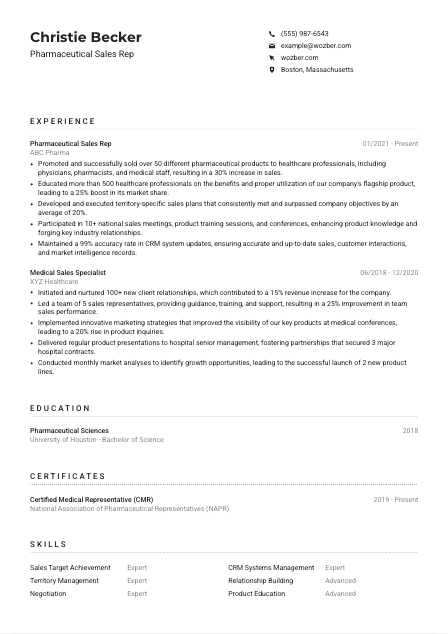
Use the job title "Pharmaceutical Sales Rep" directly under your name when that is the role you are pursuing. This keeps your positioning clear and helps the employer connect your background to the opening right away, especially if your previous title was something adjacent, such as Medical Sales Specialist.
List a phone number you answer reliably and an email address that looks business-ready. For a field-based role where interview scheduling, territory discussions, and follow-up move quickly, small mistakes here can slow down your application unnecessarily.
If a posting specifies a city or relocation expectation, include that clearly in your location line. In this example, listing Boston, Massachusetts directly addresses the employer's stated requirement and removes uncertainty about territory availability.
If you include LinkedIn or a professional website, make sure it reinforces your resume with consistent titles, dates, and sales achievements. For pharmaceutical sales candidates, that profile should support your account coverage, healthcare relationships, and product-facing experience rather than read like a generic networking page.
This section should answer the basics without friction. Clear contact details, the right job title, and location alignment let the employer move straight to your sales track record.




This is the section hiring managers read for territory ownership, sales execution, and customer-facing credibility. Pharmaceutical sales employers look for past performance in account growth, product education, and disciplined follow-through, not broad claims about being persuasive or hardworking.
Start by marking the core responsibilities in the job description. Here, the priority areas are promoting pharmaceutical products to healthcare professionals, educating accounts on proper use, building territory plans, attending training and sales events, and maintaining accurate CRM records. Those points should shape which achievements you choose and how you phrase them.
List roles in reverse chronological order and include job title, employer, and dates for each one. That format helps reviewers quickly trace your progression from related healthcare sales work into direct pharmaceutical selling, and it supports ATS parsing when you use an ATS-friendly resume template.
Each bullet should show what you owned and what changed because of your work. Instead of writing that you "promoted products," show the result. The sample resume does this well with details like selling more than 50 products, educating 500+ healthcare professionals, and building territory plans that exceeded objectives by 20% on average.
Metrics give hiring teams a concrete read on your performance. Prioritize figures such as sales growth, market share lift, target attainment, number of HCPs educated, new accounts opened, contract wins, CRM accuracy, or revenue impact. A line like "increased sales by 30%" or "maintained 99% CRM accuracy" tells far more than a generic claim about success.
Keep the emphasis on work that strengthens your case for pharmaceutical selling. Healthcare sales, medical device exposure, account management, provider education, and market analysis all help if they connect to the role. Less relevant details should be trimmed so the page stays focused on territory execution, customer relationships, and results.
By the end of your experience section, the employer should be able to see a pattern of quota delivery, account growth, and credible communication with healthcare professionals. That is the core proof for this role.
Education often serves as a quick qualification check in pharmaceutical sales, especially when the employer asks for a degree in Pharmaceutical Sciences, Healthcare, or a related field. Present it clearly so that requirement is easy to confirm.
If your bachelor's degree is in Pharmaceutical Sciences, Healthcare, Biology, or another closely related field, show that field name plainly. In the example, "Bachelor of Science in Pharmaceutical Sciences" directly supports the employer's requirement.
Include degree, field of study, school, and graduation year in a simple layout. This section does not need extra design. A clean ATS-friendly resume format helps the system and the reader find the credential without effort.
When your education lines up closely with the posting, do not bury that detail. A degree in Pharmaceutical Sciences signals baseline industry knowledge, product vocabulary, and comfort discussing clinical use with healthcare professionals.
If you are earlier in your career, relevant coursework, research, or health-science organizations can strengthen this section. Focus on items that support pharmaceutical knowledge, communication, or commercial exposure rather than listing general student activities.
Honors, scholarships, or notable projects are worth mentioning if they reinforce discipline, subject knowledge, or leadership. Once you have several years of field experience, keep those additions brief so your sales record stays front and center.
Your education section should make the degree requirement easy to confirm and, when applicable, reinforce your credibility in a healthcare-facing sales conversation.
Certifications are rarely the main hiring factor in pharmaceutical sales, but the right one can support your professional development and subject familiarity. Include credentials that genuinely add to your case for the role.
Review the posting first, then add certifications that strengthen your relevance even if they are not mandatory. A credential such as Certified Medical Representative can reinforce your commitment to pharmaceutical sales and industry standards, as shown in the example.
Do not crowd this section with every course certificate you have earned. Keep the focus on credentials tied to pharmaceutical products, medical sales, compliance awareness, or healthcare communication.
Certification dates help employers see whether your training is current, especially for credentials connected to ongoing industry knowledge or professional membership. That timeline also shows continued engagement with the field.
Pharmaceutical sales changes with new products, clinical updates, and shifting provider needs. Recent training in therapeutic areas, product education, or sales methodology can support your resume when it reflects skills you actively use in the field.
Relevant certifications can strengthen your profile by showing current industry engagement and a deliberate investment in pharmaceutical sales expertise.
The best skills sections in pharmaceutical sales read like a summary of how you operate in the field. They should connect directly to account growth, provider communication, sales planning, and disciplined follow-up, not drift into vague personality traits.
Start with the language in the posting, then add the skills it assumes. Here that includes interpersonal communication, relationship building, territory and account planning, CRM use, product education, and sales target achievement. These are the practical capabilities behind day-to-day rep performance.
Choose skills you genuinely use and phrase them in language close to the employer's wording. If your background includes territory management, negotiation, CRM systems management, and market intelligence analysis, those are far more useful here than broad labels such as "people person" or "team player."
A shorter list of highly relevant sales skills works better than a crowded inventory. Prioritize skills tied to physician and pharmacy relationships, account planning, target attainment, product presentations, and CRM discipline. An ATS-friendly resume format helps those terms stay readable to both systems and hiring teams.
Your skills section should quickly confirm that you can manage a territory, communicate with healthcare professionals, and support revenue goals with organized field execution.
Language skills can be useful in pharmaceutical sales, especially in diverse territories or health systems. Present them in a practical way, starting with the language required to do the job well.
If the posting requires professional English, list English clearly with an accurate proficiency level. That makes it easy for the employer to confirm you can handle account conversations, product explanations, and written follow-up.
Additional languages can strengthen your profile when they help you communicate across a broader patient or provider community. In the example, Spanish adds extra value, but it should follow the required business language rather than replace it as the priority.
Terms like Native, Fluent, Advanced, or Conversational work well when they reflect your real ability. In a role that involves education and relationship management, overstating language skills can create problems quickly during interviews or in the field.
You do not need to hide a secondary language if you can use it meaningfully in professional settings. Just be realistic about your level so employers understand whether you can handle greetings, routine communication, or more detailed product discussions.
For some pharmaceutical sales roles, extra languages can help you build rapport across clinics, pharmacies, and community providers. Keep that advantage in perspective, though. It supports the application best when the rest of your sales and account management experience is already solid.
List languages in a way that shows you can handle professional communication first, then add any broader territory advantage your additional language skills provide.
The summary needs to establish your commercial value fast. In pharmaceutical sales, that usually means years in the field, the kind of customers you cover, and the business results you have delivered across products or territories.
Read the posting closely before writing this section. If the employer wants at least 2 years of pharmaceutical sales experience, quota achievement, relationship building, and product education, your summary should reflect those points in a compact way.
Lead with your title or close equivalent, your years of experience, and your main area of strength. The example summary does this effectively by positioning the candidate as a Pharmaceutical Sales Rep with 4+ years of experience driving sales with healthcare professionals.
Focus on strengths that translate directly to performance, such as exceeding sales targets, educating providers on product benefits and proper use, or building durable account relationships. Keep the emphasis on territory outcomes and customer credibility rather than general enthusiasm.
Aim for a short paragraph that can be read in seconds. A concise summary with clear sales language, role-relevant keywords, and one or two concrete strengths will carry more weight than a longer introduction full of broad claims.
A well-written summary gives the reader an immediate sense of your sales scope, customer audience, and performance level. It should set up the rest of the resume as a credible pharmaceutical sales track record.
Your resume should now make three things clear without forcing the reader to hunt for them: you can sell pharmaceutical products responsibly, manage a territory with discipline, and build productive relationships with healthcare professionals. That combination is what turns experience into a convincing application.
Use Wozber's free resume builder to organize your content in an ATS-friendly resume format, tailor your language to the posting, and strengthen weak spots with targeted revisions. When the final version reads clearly on both screen and system, hiring teams can focus on the part that matters most, your ability to deliver sales results in the field.




