



Use Wozber and land your dream job
Create Resume
No registration required
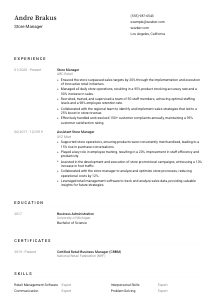
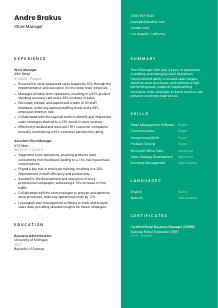
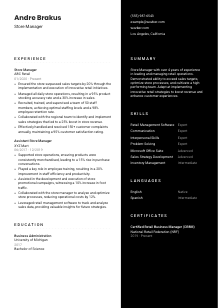
Commanding aisles, but your resume isn't stacking up? Check out this Store Manager resume example, created with Wozber free resume builder. Learn how to present your leadership cred and sales savvy in line with store success, keeping your career aisle always customer-ready!
Store management is measured in daily execution. Sales targets, staffing coverage, merchandising standards, inventory accuracy, and customer issues all land on one desk, often at the same time. A Store Manager resume needs to show that you can run a floor, coach a team, and protect profitability without losing control of the customer experience.
Screening usually moves fast for this role because hiring teams look for direct proof of store performance, people leadership, and operational range. Wozber's free resume builder helps you tailor that proof into an ATS-friendly resume format by aligning your language with the posting, so your sales results, scheduling scope, and retail systems experience are easy to pick up early.
For a Store Manager, the header does more than identify you. It confirms whether you meet practical filters such as location, professional title, and contact accessibility before anyone reviews your sales numbers or leadership history.
Use your full name at the top in the clearest text on the page. Store leadership roles involve visibility and accountability, so your resume should open the same way: direct, easy to scan, and professionally presented.
Place "Store Manager" directly beneath your name if that is the role you are pursuing. Matching the job title helps position you correctly against adjacent profiles such as Assistant Store Manager, Retail Supervisor, or Operations Lead, especially when recruiters sort resumes quickly.
Include a current phone number and a professional email address. If you add a LinkedIn profile or portfolio link, make sure it supports retail leadership with relevant information such as multi-store exposure, team size, sales performance, merchandising work, or customer service recognition.
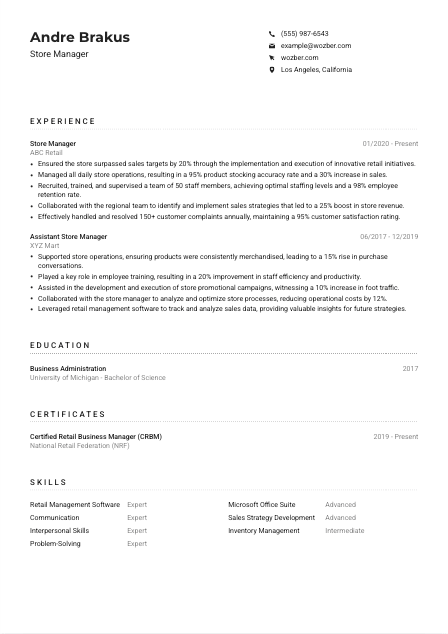
Some retail employers screen for local availability because store coverage, opening schedules, and interview timing move quickly. Here, listing "Los Angeles, California" directly answers a stated requirement and removes doubt about relocation or commute logistics.
A website or LinkedIn profile should strengthen your case, not distract from it. If your online presence highlights leadership progression, retail results, or training responsibilities, include it. If it is sparse or outdated, leave it off until it reflects the same story as your resume.
Your header should confirm the basics in seconds: who you are, which role you want, how to reach you, and whether you meet any practical screening requirements tied to the store.




This section carries the most weight in a Store Manager resume. Hiring teams look for signs that you can deliver sales, maintain standards on the floor, manage labor, develop staff, and respond when performance slips or customer issues escalate.
Before you edit a single bullet, mark the operational themes in the job description. For this role, that includes sales and profitability, daily store operations, merchandising, staffing, coaching, data analysis, customer complaint handling, and collaboration with regional or corporate teams. Those are the threads your experience section should repeat in your own language.
List your most recent retail leadership role first, then work backward. For each position, include job title, employer, and dates. This makes progression easy to follow, especially if you moved from assistant management into full store ownership of staffing, sales targets, and operational accountability.
Generic bullets like "managed store operations" do not show scale or results. Write bullets that connect actions to performance. The sample resume does this well with points like exceeding sales targets by 20%, reaching 95% stocking accuracy, and increasing store revenue by 25%. Those details tell a hiring manager what kind of operation you actually ran.
Store management performance is usually measured through sales growth, conversion, average transaction value, shrink control, stocking accuracy, retention, scheduling efficiency, customer satisfaction, and promotional lift. Add numbers where you genuinely have them. Even one or two solid metrics per role can make your experience more credible and easier to compare.
Prioritize achievements that reflect leadership, operations, and commercial performance over tasks that belong to junior retail roles. If a bullet does not show staffing decisions, floor execution, KPI ownership, training, or revenue impact, it may not be helping enough. Shape the section around the responsibilities of a Store Manager, not a general retail employee.
By the end of your experience section, the reader should understand your store scope, the teams you led, the results you improved, and the kinds of operational problems you can handle without close supervision.
Education matters most here as supporting qualification, not as the main proof of retail leadership. It helps confirm business grounding, especially when the posting prefers a degree related to operations, management, or administration.
If you hold a bachelor's degree in Business Administration or a related field, make that easy to find. In the example, the Bachelor of Science in Business Administration aligns directly with the employer's preference and reinforces readiness for store-level planning, reporting, and team management.
List the degree, school, field of study, and graduation year. That is usually enough for retail management roles unless you are early in your career or the employer has strict education criteria. Keep it concise so the focus stays on operational experience.
When your education connects naturally to the role, you do not need to over-explain it. A business-related degree already suggests exposure to subjects like finance, management, marketing, and organizational behavior, all of which support store leadership.
Most experienced Store Managers do not need to list classes. Add coursework, projects, or academic distinctions only when they strengthen your case, such as retail operations, supply chain, consumer behavior, or leadership-focused work that complements limited experience.
Academic awards, student leadership, or retail-related extracurriculars can help if they show initiative, team coordination, or commercial interest. Once you have several years of management experience, keep these details brief so they do not compete with store results.
For this role, education should support your credibility and align with the posting when relevant, while your experience continues to carry the main case for hiring you.
Certifications are not always required for Store Manager roles, but they can strengthen your profile when they reinforce retail operations, team leadership, customer experience, or business management.
List certifications that relate to retail leadership rather than general online course completions. A credential such as "Certified Retail Business Manager (CRBM)" fits because it supports the same themes employers care about: store performance, operational discipline, and leadership development.
If a certification supports the target role, give it its own section and present the name, issuing body, and date clearly. This is especially useful when the credential speaks directly to retail management rather than a broad business topic.
Dates matter when certifications reflect active professional development or current standards. Include the year earned and, if applicable, the active date range so the employer can quickly tell whether the credential is recent and maintained.
Retail changes through staffing models, reporting tools, customer expectations, and promotional strategy. Ongoing certification or training can show that you keep pace with those shifts, particularly if your recent experience is strong but concentrated in one retail environment.
Relevant credentials can sharpen your management profile, especially when they reinforce the business and operational side of running a store.
A Store Manager skills section should read like the operating toolkit behind your results. Employers expect a mix of floor leadership, commercial judgment, systems use, and customer-facing problem solving, not a generic list of soft skills.
Start with the exact capabilities named in the posting. Here, that includes retail management software, Microsoft Office Suite, communication, interpersonal strength, and problem-solving. Then add role-linked skills the description implies, such as scheduling, merchandising, inventory control, sales strategy, team supervision, and performance management.
Every major skill should be supported elsewhere on the resume. If you list sales strategy development, your experience should show revenue growth or promotional execution. If you claim inventory management, include evidence such as stocking accuracy, shrink reduction, or replenishment discipline.
Group the most relevant skills first instead of trying to cover every retail ability you have ever used. The example strikes a useful balance with retail software, communication, problem-solving, Microsoft Office, sales strategy, and inventory management. That gives the reader a practical view of both systems and leadership capability.
When this section is tailored well, it echoes the store results, team leadership, and operational tools already shown in your experience instead of repeating vague strengths.
Language ability can matter in retail because store managers coach employees, resolve customer concerns, and communicate with a wide range of shoppers and internal partners. The value depends on the market served and the employer's stated requirements.
If the posting names a required language, list it clearly. In this case, English is essential, so it should appear in the section with an honest proficiency level that matches your day-to-day ability to lead staff, handle complaints, and communicate with management.
Additional languages can be valuable in many retail settings, especially in large and diverse markets. The sample resume includes Spanish at an intermediate level, which can be a useful extra asset in customer interaction and team communication without claiming fluency you do not have.
Use straightforward labels such as Native, Fluent, Advanced, Intermediate, or Basic. Store managers often deal with escalations and coaching conversations, so accuracy matters more than optimism when describing how well you communicate.
If you speak more than one language, list the ones that are useful in a retail environment or relevant to the employer's customer base. If a language is very basic and unlikely to help on the floor or with staff communication, it may not need space on the resume.
Retail employers may see multilingual ability as a practical advantage when stores serve varied communities or employ multilingual teams. It is not a substitute for management experience, but it can support stronger service and smoother communication in the store.
This section should tell the employer exactly how you can communicate on the sales floor, with staff, and with customers, especially when a required language is part of the posting.
Your summary should quickly establish the level of store responsibility you can handle. In two to four lines, show your management experience, your commercial results, and the parts of store leadership you do especially well.
Review the posting first, then pull out the few themes that matter most. For this Store Manager opening, that means sales performance, daily operations, team leadership, staffing, and customer issue resolution. Your summary should reflect those priorities rather than broad statements about being hardworking or passionate.
Open with your title and years of relevant experience. Then add the kind of environment you have led, such as high-volume retail, multi-department operations, larger teams, or fast-paced promotional settings. This helps the reader place your background immediately.
Use compact proof points that sound native to retail management. The example summary works because it references exceeding sales targets, optimizing store processes, and building a high-performing team. Those themes map directly to what employers want from a store leader.
A summary should be brief enough to scan quickly and concrete enough to set up the rest of the resume. Aim for a few focused lines that mention experience, strengths, and outcomes, without repeating every skill or turning the section into a long profile paragraph.
A well-written summary gives the employer an immediate read on your leadership level, your retail results, and the type of store performance you are prepared to own.
A Store Manager resume works when every section points back to the same hiring question: can you lead people, run operations cleanly, and hit commercial targets? Keep your examples grounded in sales results, staffing responsibility, merchandising execution, customer service, and the retail systems you use to manage performance.
Use Wozber's free resume builder to shape that experience into an ATS-compliant resume with clear role language, stronger keyword alignment, and structure that supports fast review. When your resume is tailored well, hiring teams can quickly see your ability to run the store, coach the team, and improve results.




