



Use Wozber and land your dream job
Create Resume
No registration required
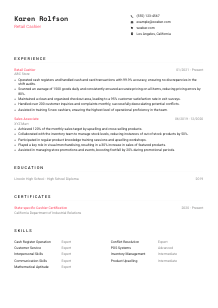
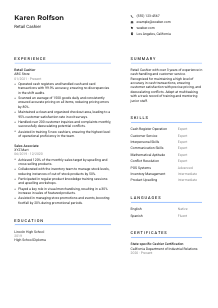
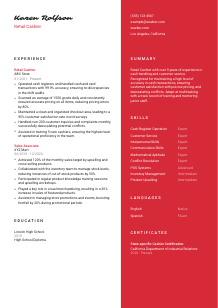
Ring up sales, but your resume feels price-tagged? Check out this Retail Cashier resume example, created with Wozber free resume builder. It shows how to scan your cash-handling expertise to match the job's monetary requirements, propelling your retail career to the check-out lane of success!
Retail cashier work looks simple from a distance, but the hiring standard is tighter than many candidates expect. A cashier is trusted with money, pricing accuracy, returns, customer questions, and the pace of the checkout line. Your resume needs to show that you can keep transactions clean, stay composed with customers, and keep the front end running without avoidable errors.
A tailored resume helps hiring teams quickly separate general retail experience from true checkout readiness. With Wozber's free resume builder, you can align your wording with the posting, build an ATS-compliant resume, and make core strengths like POS use, cash handling, and customer-facing problem solving easier to spot in a first review.
For a retail cashier, the contact section does more than identify you. It confirms practical details a store may screen for early, such as location, professional communication, and whether you are clearly applying for a front-end role rather than a broad retail position. Keep this section clean, current, and easy to scan.
Use your full name in a clear, readable format at the top of the resume. A hiring manager reviewing cashier applications quickly should not have to search for it. Keep the styling simple and professional so the focus stays on your experience with checkout operations, customer service, and reliability.
Place "Retail Cashier" directly under your name if that is the role you are pursuing. This immediately frames your resume around register work, payment handling, and customer interaction. It also helps if your recent experience includes adjacent titles such as Sales Associate, since it tells the reader which part of your background is most relevant.
List a phone number you answer reliably and a professional email address, ideally in a simple format like firstname.lastname@email.com. Cashier hiring often moves quickly, especially for shift-based roles, so missed calls or an unprofessional email can create unnecessary friction before your experience is even reviewed.
If the employer specifies a city or area, include it in your personal details. In the example, Los Angeles, California belongs here because the posting explicitly requires candidates to be located there. You do not need a full street address. City and state are usually enough to confirm you meet the location filter.
A LinkedIn profile or personal website is optional for most cashier roles. Include one if it is current and consistent with your resume. If your profile expands on customer service experience, retail promotions, or training responsibilities, it can add context. If it is sparse or outdated, leave it off.
At a glance, your personal details should tell the employer who you are, how to reach you, and whether you meet practical requirements such as role focus and location. Keep it tidy and functional, just like a well-run checkout station.




This section carries the most weight for a retail cashier. Hiring teams want to see whether you have handled real transaction volume, worked accurately with cash and cards, supported customers under pressure, and kept the front end organized. General retail experience helps, but your bullets should make checkout responsibility unmistakable.
Before writing or revising bullets, note the work the store is actually hiring for. For cashier jobs, that usually includes greeting customers, operating registers or POS systems, scanning items accurately, handling returns or complaints, and keeping the checkout area clean. Build your experience around those duties so the employer sees direct overlap instead of having to infer it.
Start with your most recent position and work backward. That structure lets employers see your current level of front-end experience first, including whether you are already trusted with register accuracy, shift audits, or customer issue handling. If a recent role is broader retail work, lead each bullet with the cashier-related parts of the job.
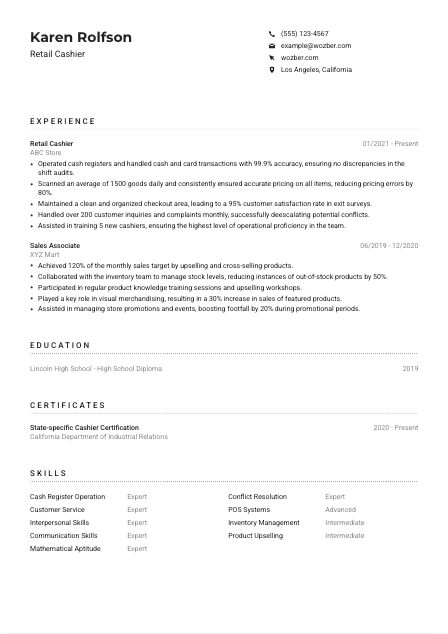
Do not stop at "worked the register" or "helped customers." Show how well you performed the work. In the example resume, "handled cash and card transactions with 99.9% accuracy" tells a far stronger story than a generic cash-handling line. Similar details could include low till discrepancies, fast transaction volume, strong customer satisfaction scores, or effective return processing.
Retail managers often respond well to metrics because they map directly to store operations. Transaction accuracy, number of items scanned, customer interactions handled, pricing error reduction, and training support are all useful measures. The example's "scanned an average of 1500 goods daily" works because it shows pace and consistency, not just activity.
Choose achievements that support the case for cashier work. Clean checkout areas, deescalating complaints, assisting with returns, and training new cashiers all reinforce trust in a front-end setting. Even if you include broader retail wins such as upselling or merchandising, make sure most bullets point back to payment accuracy, service quality, and day-to-day store support.
Your experience should show that you can keep the line moving, handle money accurately, and deal with customers without creating more work for a supervisor. When those points are clear, the resume reads like someone already ready for the register.
Education is usually a supporting section for a retail cashier, but it still matters when the posting names a minimum qualification. Most employers simply want to confirm that you meet the baseline and can present the information clearly. Keep the entry concise and factual.
If the posting asks for a high school diploma or equivalent, list it plainly. That is the case here, so "High School Diploma" should appear exactly as such rather than being buried in a longer education description. This is a simple screening item, and clarity helps.
Include the school name, the credential, and the graduation year or date. For cashier roles, that is usually enough. Hiring teams are not looking for an elaborate academic profile here. They want fast confirmation that you meet the educational requirement and can present information neatly.
If an employer says "high school diploma or equivalent," use that language if it accurately reflects your background. Small wording choices can help with ATS matching and reduce ambiguity. In the provided resume, the education entry works because it directly names the required credential without extra clutter.
Short courses in customer service, retail operations, or basic business math can be worth adding if they are real and recent. They are optional, though. Do not pad this section with unrelated classes when your experience already shows stronger proof of cashier performance.
Honors, student leadership, or school activities can help if you are early in your career and need more evidence of responsibility, teamwork, or reliability. If you already have solid retail experience, keep the focus on work history and use education simply to confirm the requirement.
For most retail cashier resumes, education should confirm the baseline qualification without taking attention away from your front-end experience. Short, accurate entries do the job well.
Certifications matter most when a cashier role includes a legal, state, or store-specific requirement. If the posting mentions one, treat it as essential information rather than an extra. This section should quickly show whether your certification is relevant and current.
Read the posting closely before deciding what to include. Here, the employer asks for a valid state-specific cashier certification if required by law, so that document should be visible on the resume. For other cashier roles, a certification may be optional, and in that case it supports the application without defining it.
List certifications that strengthen your ability to work the front end, follow procedure, or meet compliance expectations. A cashier certification belongs first when relevant. Customer service training, fraud prevention training, or retail safety certifications can also help if they are legitimate and support the job you are targeting.
Dates matter because employers may need to know whether a certification is active. In the example resume, the certification includes a date range, which helps the employer understand that it is current. Use the issuing body and dates so the entry is easy to verify and easy to trust.
Retail payment systems, return procedures, and service standards change over time. If you have completed additional training on POS systems, customer conflict handling, or loss prevention, those can strengthen your profile when they relate directly to front-end operations. Keep the list selective and current.
When a cashier certification is required, your resume should make that clear immediately. When it is optional, list only the credentials that reinforce your ability to handle transactions, follow policy, and serve customers at the register.
A retail cashier skills section should reflect the work that actually happens at the front end of the store. That means register operation, POS fluency, pricing accuracy, customer communication, and enough composure to handle busy periods, returns, and minor complaints without losing control of the transaction.
Start with the employer's wording. If the job calls for cash register operation, POS system proficiency, interpersonal skills, and communication skills, use those terms where they truthfully match your experience. This improves alignment and keeps your resume grounded in the store's actual needs.
Cashiers need both operational and people skills. Include hard skills such as cash handling, POS systems, basic math, pricing accuracy, and returns processing, then balance them with customer service, communication, conflict resolution, and teamwork. The example resume handles this well by pairing register and POS skills with service-oriented strengths.
Order matters. Lead with the capabilities that affect daily checkout work, not broader retail abilities that sit further from the register. For this kind of job, cash register operation, POS systems, customer service, and communication should typically come before skills like merchandising or inventory support unless the posting places unusual emphasis on them.
Your skills section should reinforce what your experience already proves. When the top skills reflect checkout accuracy, customer interaction, and POS confidence, the resume feels aligned with the real demands of cashier work.
Language ability can be a practical advantage in retail, especially in stores that serve a diverse customer base. For cashier roles, it matters most when it improves customer interaction at the register, helps with questions or returns, and reduces friction during busy store hours.
If the posting specifies English communication, list English prominently with an accurate proficiency level such as "Native" or "Fluent." In this case, proficient English is required, so this belongs at the top of the section. Keep the wording clear and direct.
Additional languages can strengthen a cashier resume when they support customer service. Spanish, for example, may be valuable in many retail settings because it helps with greetings, item questions, and payment or return conversations. Include extra languages only if you can actually use them with customers.
Use straightforward labels such as Native, Fluent, Intermediate, or Basic. Retail managers may assume a bilingual cashier can assist directly with customer concerns, so accuracy matters. Overstating proficiency can create problems quickly in a customer-facing role.
Language skills are most persuasive when they clearly help the work. A cashier who can explain pricing, answer common questions, or calm a frustrated customer in another language adds practical value at checkout. Keep that real-world usefulness in mind when deciding which languages to list.
If you know the store serves a community where another language is commonly spoken, that can make your language skills more relevant. Use that insight carefully. It is a supporting advantage, not a substitute for the core cashier strengths of accuracy, courtesy, and dependable register handling.
For a cashier, language skills matter when they improve customer interaction and make checkout smoother. Present them accurately and let them support, rather than distract from, your core retail strengths.
Your summary should give a fast, specific picture of you as a cashier. In a few lines, show your level of experience, the kind of front-end work you handle well, and one or two performance points that make an employer trust you with the register.
Read the posting and identify what the employer is most likely trying to solve. For cashier hiring, that usually means dependable transaction handling, customer-facing communication, POS proficiency, and accuracy under routine pressure. Let those priorities shape the summary rather than writing a broad statement about wanting to work in retail.
Lead with a direct introduction such as "Retail Cashier with over 3 years of experience" if it is true for you. This works because it immediately sets the context and tells the employer you have relevant time on the front end. Keep the wording plain and factual.
Choose strengths that matter in cashier work, such as accurate cash and card handling, pricing accuracy, conflict deescalation, or helping train new team members. The sample summary is effective because it mentions transaction accuracy, customer satisfaction, and mentoring, all of which point to dependable front-end performance.
Three to five lines is usually enough. Avoid vague adjectives and use concrete language tied to retail operations. A concise summary with real cashier terms such as POS systems, cash handling, returns, or customer service will do more than a longer paragraph filled with general enthusiasm.
By the time someone finishes your summary, they should already understand your cashier experience, your reliability with transactions, and the kind of customer service you bring to the register.
A retail cashier resume works best when it shows everyday execution clearly: accurate payments, steady customer service, clean checkout habits, and confidence with POS systems. If each section points back to those strengths, the employer gets a consistent picture of someone who can step onto the floor and handle the front end well.
Use Wozber's free resume builder to shape that experience into an ATS-friendly resume format, tighten your wording with job-specific language, and check alignment with an ATS resume scanner before you apply. The finished resume should make your checkout readiness easy to see.




