



Use Wozber and land your dream job
Create Resume
No registration required
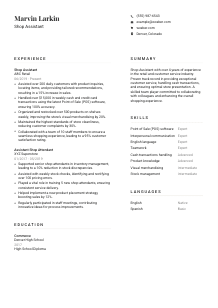
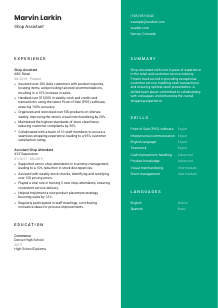
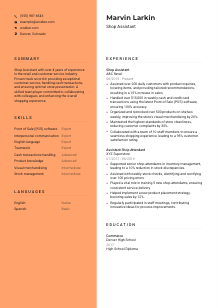
Helping customers, but your resume seems out of stock? Browse this Shop Assistant resume example, created with Wozber free resume builder. Learn how to merchandise your service skills to fit job requirements, ensuring your career is always in high demand!
Shop Assistant hiring moves quickly because the work is visible and immediate. Employers want proof that you can help customers on the floor, keep shelves orderly, process transactions accurately, and stay dependable during busy periods. Your resume should make that retail rhythm easy to see, not bury it under vague claims about being friendly or hardworking.
A targeted resume changes how your background is read in a retail screening process. When your wording matches the store's needs, whether that is POS use, cash accuracy, stock replenishment, or visual merchandising, Wozber's free resume builder helps you shape it into an ATS-compliant resume that surfaces the right experience fast. That gives the hiring team a clearer view of how you would support day-to-day store operations.
Retail employers need to know quickly whether they can contact you, where you are based, and whether your application is aligned with the opening. In a Shop Assistant resume, this section should be clean, practical, and free of distractions.
Use your full name as the heading in a clear, readable font. Keep it slightly larger than the rest of the text so it stands out at a glance, especially when a manager is reviewing several retail applications in one sitting.
Place "Shop Assistant" directly under your name if that is the role you are pursuing. Matching the advertised title helps both ATS filters and store managers connect your resume to the position without guessing whether you are applying for sales support, cashier, or general retail work.
List a reliable phone number and a professional email address. For store-based roles, fast contact matters because interviews are often scheduled quickly around shift coverage, so make sure the details you provide are the ones you actually monitor.
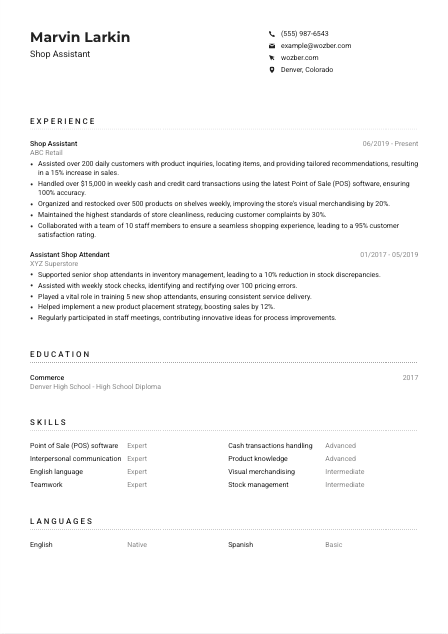
If the job asks for a candidate in a specific area, include your city and state. In the example, Denver, Colorado matters because the posting explicitly requires local availability. You do not need a full street address. City and state are enough to confirm you are geographically aligned.
Include LinkedIn or a professional website only when it reinforces your retail background. If your profile shows customer service experience, promotions, or store operations achievements, it can add credibility. If it is outdated or unrelated, leave it off.
This section does not need personality or extra explanation. It needs accuracy, local relevance when required, and a straightforward setup that makes contacting you simple.




For a Shop Assistant, experience is where hiring managers look for day-to-day retail competence. They want to see customer interaction, transaction accuracy, shelf upkeep, stock handling, and teamwork in a live store environment, preferably with clear numbers or scope.
Read the job description and mark the responsibilities that appear most often or carry operational weight. In this case, customer assistance, POS transactions, cash handling, replenishing stock, store tidiness, and team coordination are the core themes. Those are the tasks your bullet points should reflect using similar language when it is truthful to your background.
List your most recent retail or customer-facing role first, then work backward. Include job title, employer, and dates. For store hiring, recent experience usually carries the most weight because it shows your current pace with customer service, product handling, and checkout routines.
Do not stop at "helped customers" or "restocked shelves." Show volume, accuracy, or business impact. The example bullet "Assisted over 200 daily customers with product inquiries, locating items, and providing tailored recommendations" works because it combines service activity with scale and a sales outcome. That is much stronger than a generic task list.
Retail metrics make your experience more believable and more useful to the reader. Good examples include daily customer count, weekly transaction value, stock volume, pricing corrections, shrink reduction, sales lift, or customer satisfaction scores. The sample's "$15,000 in weekly cash and credit card transactions" and "100% accuracy" are strong because they show trust and precision at the register.
Prioritize experience that shows you can serve customers, operate a register, maintain presentation standards, and work well with store staff. If you have unrelated jobs, pull forward the parts that still transfer, such as handling payments, solving customer issues, or keeping inventory organized. The more closely your bullets map to daily store operations, the stronger your case becomes.
A strong experience section should leave no doubt that you can step into a retail shift and contribute quickly. Focus on customer volume, transaction accuracy, stock upkeep, and team support, then use Wozber's ATS optimization tools to keep that language aligned with the role.
Education usually plays a supporting role in Shop Assistant hiring, but it still matters when the posting sets a baseline. Keep this section simple, accurate, and easy to scan so the employer can confirm you meet the stated requirement without digging.
If the posting asks for a high school diploma or equivalent, make sure that credential appears clearly. In this role, that requirement is explicit, so there is no reason to leave it vague or incomplete.
List the qualification, school name, field if relevant, and graduation year. A straightforward structure works best because education is usually a quick checkpoint for this kind of role, not a section that needs extra detail.
If you have college coursework, vocational study, or training related to business, retail, communications, or customer service, include it when it strengthens your application. Keep the emphasis on relevance, not on filling space.
When you are early in your career, a short note about classes in business math, communication, merchandising, or basic accounting can help connect your education to cashiering, stock work, or customer interaction. Use this selectively and only when it adds something practical.
Clubs, volunteer roles, or school projects can be worth including if they show teamwork, responsibility, customer interaction, or event support. Those experiences can help if you do not yet have much retail history, but they should still relate to service, organization, or collaboration.
For a Shop Assistant resume, education should confirm that you meet the requirement and, where useful, show a bit of related preparation. It works best when it is tidy, factual, and easy to scan.
A Shop Assistant skills section should read like the real operating mix of the role. That means customer-facing ability, checkout accuracy, stock awareness, and teamwork, all presented in terms that match how retail jobs are actually described.
Use the job description to identify the skills the employer expects on day one. Here, that includes POS software, cash handling, interpersonal communication, product knowledge, visual merchandising, teamwork, and independent work. If you genuinely have them, use those terms so your resume aligns naturally with both ATS filters and human review.
Retail resumes need both technical and interpersonal skills. Pair operational skills such as POS use, cash transactions, stock management, and merchandising with customer communication, teamwork, and service recovery. The example does this well by combining checkout capability with strong communication and collaboration.
Do not overload this section with every ability you have. Keep the focus on the skills that matter in a customer-facing retail setting. A concise list built around sales floor support, checkout work, stock upkeep, and communication will carry more weight than a long unfocused inventory.
Your skills section should confirm that you can support customers, work the register, maintain product presentation, and contribute to the team. With Wozber's ATS optimization, those skills can be matched cleanly to the language used in the job description.
In retail, language ability matters when it improves customer interaction, product guidance, and team communication. This section should stay honest and practical, with emphasis on the languages that support service in the store's customer base.
If the posting specifically calls for English communication, list English first and describe your level accurately. In this case, that requirement is clear, so it should not be buried lower in the section.
Additional languages can strengthen a Shop Assistant application when they help you answer questions, explain products, or assist a broader customer mix. Spanish, for example, can be valuable in many retail settings, but include any language only if you can genuinely use it in customer interaction.
Use realistic levels such as Native, Fluent, Intermediate, or Basic. Overstating language ability can create immediate problems in a customer-facing role where you may be expected to assist shoppers without backup.
Language skills become more relevant when they match the community the store serves. If a location regularly sees multilingual foot traffic, that can be worth highlighting because it supports service quality and smoother customer conversations.
Only include languages that add real communication value. A shorter, accurate list is better than padding the section with minimal familiarity that would not help on the floor or at checkout.
For a Shop Assistant, language skills matter when they help customers get answers, make decisions, and complete purchases comfortably. Accuracy matters more than range.
Your summary should quickly establish the kind of retail support you provide. In a few lines, show your experience level, the parts of store work you handle well, and the value you bring to customer service and daily operations.
Before writing the summary, identify the few priorities that define the role. For this opening, those are customer assistance, POS and cash accuracy, stock presentation, communication, and teamwork. Build your summary around two or three of those themes rather than trying to mention everything.
Lead with your title or closest equivalent and your years of experience. A line like "Shop Assistant with over 4 years of experience in retail and customer service" works because it immediately places you in the right environment and level of responsibility.
Follow with a sentence that captures your most relevant strengths, such as helping customers find products, processing transactions accurately, maintaining shelves, or supporting smooth store operations. The sample summary works because it ties customer service, cash handling, and store presentation into one coherent retail profile.
Aim for 3 to 5 lines with no filler. Store managers often read summaries quickly before deciding whether to continue into the experience section, so each sentence should earn its place by naming relevant work, tools, or results.
A well-written summary should make it clear, within seconds, that you can support customers, handle transactions, and keep the store running smoothly. Wozber's ATS-friendly resume template and ATS resume scanner can help you tighten that message around the language each Shop Assistant posting uses.
Your Shop Assistant resume should now show the parts of retail work that matter most: customer service, accurate checkout handling, shelf and stock upkeep, store presentation, and reliable teamwork. Keep the language close to the job posting, support it with real numbers where you can, and make sure each section helps the employer picture you on the shop floor.
Use Wozber's free resume builder to organize that experience into an ATS-friendly resume format, then refine it with the ATS resume scanner so the final version reflects the role's actual requirements. The finished resume should make one thing easy to judge: you can step into the store and contribute from day one.




