



Use Wozber and land your dream job
Create Resume
No registration required
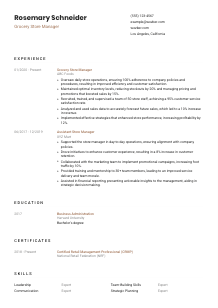
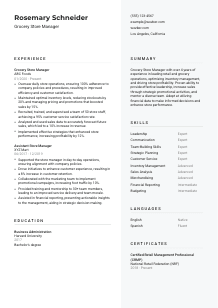
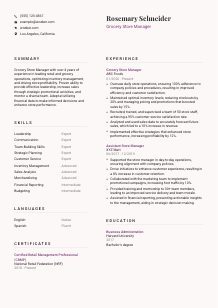
Navigating the aisles, but your resume seems misplaced? Grab this Grocery Store Manager resume example, created with Wozber free resume builder. Learn how to stock your leadership skills and customer service savvy to match job requirements, as you weave through this fresh and fruitful career path!
Store managers are trusted with the rhythm of the business every day. Shelf availability, labor coverage, pricing execution, shrink control, customer service, and daily sales all show up on the floor at once, and your resume needs to reflect that kind of operational command. Hiring teams want to see that you can keep a store running smoothly while improving margin, service standards, and team performance.
A tailored resume changes how quickly that picture comes into focus. When your experience uses the same language as the posting, from inventory levels and promotions to sales analysis and staff supervision, Wozber's free resume builder helps you shape an ATS-compliant resume that reads clearly in both an ATS and a hiring review. That makes it easier to recognize whether you have managed the kind of store performance this role is built around.
The top of your resume should identify you as a store leader without wasting space. For grocery management, that means clear contact details, a role-aligned title, and any location detail that answers an explicit requirement right away.
Use your name as the visual anchor of the page with a clean, readable font. Grocery store management is a practical operations role, so the presentation should feel organized and professional rather than decorative.
Place "Grocery Store Manager" beneath your name if that matches the role you are pursuing. This creates an immediate connection between your resume and the opening, especially when the employer is sorting through candidates from broader retail backgrounds.
Add a reliable phone number and a professional email address. Avoid casual usernames. If a district manager or recruiter wants to move quickly after reviewing your store operations or sales results, your contact details should be easy to scan and trust.
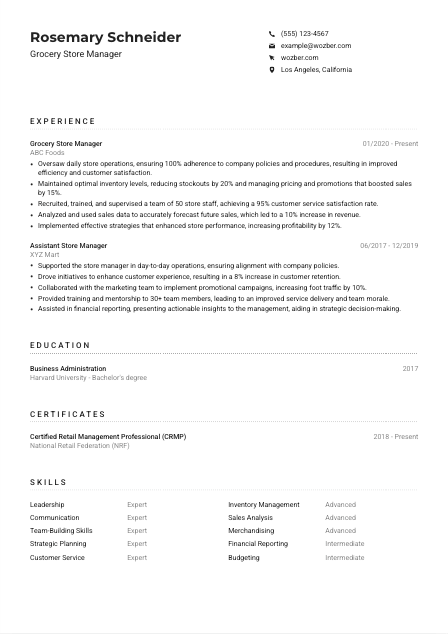
If a job specifically requires local candidates, list your city and state clearly. In the example, "Los Angeles, California" addresses the stated location requirement without adding a full street address. Use this kind of detail when it helps remove a practical hiring question.
Include LinkedIn or another professional profile if it reinforces your background in retail operations, team leadership, merchandising, or multi-department store work. Make sure the dates, titles, and achievements match your resume so your application presents one consistent record.
This section should tell the employer who you are, what role you do, and how to reach you without friction. Clean details at the top keep the focus on your store leadership experience.




For Grocery Store Manager hiring, experience carries most of the weight. Employers look for proof that you have run day-to-day operations, led staff, protected inventory flow, responded to sales trends, and improved how the store performs.
Start by pulling the key responsibilities from the job description and mapping them to your own work. Prioritize bullets about daily operations, inventory control, pricing, promotions, hiring, training, budgeting, and sales analysis. In the sample resume, the strongest bullets mirror those priorities directly, which makes the match easy to see.
List positions in reverse chronological order and focus on roles with direct responsibility for store operations or department performance. For grocery hiring, recent experience managing staff schedules, merchandising execution, vendor orders, or service issues matters more than older, less relevant work.
Replace generic task wording with outcomes. "Managed inventory" is weaker than "reduced stockouts by 20%." "Oversaw operations" says less than "maintained 100% adherence to company procedures." Grocery employers respond to concrete indicators such as sales lift, shrink reduction, service scores, labor efficiency, and revenue growth.
Numbers help employers understand the size of the operation you handled. Include team size, sales improvements, retention gains, inventory improvements, or profit impact where you can. The example does this well by showing a team of 50 staff, a 15% sales boost from pricing and promotions, and a 12% increase in profitability.
Trim experience that does not support your case for running a grocery store. A hiring manager wants to see how you handled floor execution, employee supervision, customer experience, merchandising decisions, and financial reporting. If a bullet does not support one of those areas, cut it or rewrite it.
Your experience section should make your management range obvious, from staffing and inventory to sales and profitability. When the bullets are specific and measured, employers can picture you running the store, not just working in it.
Education usually sits behind experience for this role, but it still matters when the employer prefers formal business training. Keep it concise and make the connection to retail management clear.
If you have a bachelor's degree in Business Administration or a related field, list it clearly. That matters here because the posting names it as a preference, and it supports responsibilities tied to budgeting, sales planning, and staff management.
Include the degree, school, field of study, and graduation year or date. A clean entry is enough for most Grocery Store Manager resumes. Recruiters should be able to find your academic background in seconds.
A degree in Business Administration, retail management, operations, or a related area is worth stating plainly. In the example, the Business Administration degree supports the financial and operational side of store leadership without needing extra explanation.
Relevant coursework, honors, or projects can help if you are earlier in your management career or if the work ties directly to merchandising, finance, supply chain, or leadership. If you already have several years of solid store management experience, keep this section brief.
Additional training in retail operations, loss prevention, food safety, merchandising, or management development can reinforce your progression. Include it when it reflects current knowledge that supports grocery store performance.
Education should confirm that you have the business foundation to support store decisions. Give it enough detail to satisfy the posting, then let your operational track record do the heavier lifting.
Certifications are not always required for Grocery Store Manager roles, but the right one can strengthen your credibility. They are especially useful when they connect to retail operations, customer service standards, compliance, or management development.
Choose credentials that support the work of running a store, such as retail management, food handling, safety, inventory control, or supervisory training. A certification like CRMP works because it aligns with leadership and retail operations rather than adding unrelated credentials.
Only keep certifications that improve your case for grocery management. A short, focused list is more convincing than a longer list with weak relevance. Treat this section as support for your management profile, not a place to archive every course you have completed.
Add the issue date or active period so employers can tell whether the credential is current. This matters most for certifications tied to compliance, safety practices, or current retail management standards.
Grocery operations shift with pricing pressure, customer expectations, inventory systems, and merchandising practices. Ongoing certification or training shows that you keep your management approach current, especially if your market is fast-moving or highly competitive.
Well-chosen certifications add weight when they connect directly to store operations or team leadership. Keep the section focused on credentials that strengthen your case for running a grocery business effectively.
A Grocery Store Manager skills section should look like the real mix of the job. That means operational skills, commercial judgment, and people leadership all need to be visible, because the role sits at the intersection of store execution and business performance.
Review the posting and extract the skills that shape the role. Here, that includes leadership, communication, team-building, knowledge of grocery assortments, financial reporting, sales analysis, and operational oversight. Start with the skills the employer has already told you matter.
Put the most job-relevant skills near the top, especially those tied to managing a team and improving store performance. Inventory management, customer service, merchandising, budgeting, pricing, and sales forecasting are often more persuasive than broad business terms because they connect to daily grocery operations.
Keep the section lean and readable. Grouping a balanced mix of leadership, commercial, and operational skills works well. The sample resume does this effectively by pairing people-management strengths like leadership and communication with execution skills such as inventory management, merchandising, and sales analysis.
Your skills section should sound like someone who can run a store, lead a team, and manage the numbers behind the floor. When the list mirrors the job description and your experience, it supports both ATS optimization and human review.
Language ability matters differently in grocery management than it does in many back-office roles. You are leading staff, handling service issues, and communicating with customers throughout the day, so required language proficiency should be easy to find on the resume.
If the posting requires English fluency, include it directly and label your level accurately. This role depends on clear communication with employees, customers, and company leadership, so do not leave the requirement implied.
Additional languages can be valuable in neighborhoods with diverse customer bases or multilingual teams. In the example, Spanish adds practical value for day-to-day service and staff communication, but include extra languages only when you can use them professionally.
Use honest ratings such as Native, Fluent, Intermediate, or Basic. Grocery managers are often expected to step into customer conversations, coach associates, and handle escalations in real time, so exaggerated language claims can quickly become a problem.
Recognized terms make the section easier to read and easier to compare across candidates. Clear labels also help ATS parsing and prevent confusion about whether you can actually work in that language on the sales floor.
Language skills matter most when they support customer service, staff supervision, or community relevance. If a second language helps you manage a broader team or communicate with shoppers more effectively, it belongs here.
For a Grocery Store Manager, language skills are not just a bonus line. They can reinforce your ability to lead teams and serve the customer base your store actually sees every day.
The summary should give a fast, credible picture of how you operate as a store manager. In a few lines, show your level of experience, the kind of results you drive, and the areas of store performance you manage best.
Start with a direct line such as "Grocery Store Manager with 4+ years of experience" if that reflects your background. This immediately places you in the right lane, especially when employers are filtering between assistant managers, department managers, and full store leaders.
Build the next sentence around the priorities of the role, such as store operations, inventory control, sales growth, team supervision, customer service, or budgeting. Match the emphasis to the posting instead of writing a generic retail summary.
A short summary becomes more convincing when it includes outcomes tied to store performance. The sample summary points to profitability, inventory optimization, and sales growth, which are all strong choices for this kind of position.
Aim for 3 to 5 sentences and avoid repeating full bullet points from your experience section. The summary should work like an executive snapshot of your store leadership style and results, not a condensed job history.
When this section is tailored well, the reader quickly understands your management scope, your operational strengths, and the business results you tend to deliver. That is exactly what a Grocery Store Manager summary should establish before the first experience bullet begins.
A Grocery Store Manager resume works best when it shows command of daily operations, team leadership, inventory discipline, customer service standards, and the numbers behind store performance. Keep every section tied to how you improve execution on the floor and results on the P&L.
Use Wozber's free resume builder to tighten the wording, keep the structure ATS-friendly, and apply ATS resume scanner insights to the language of the job description. The finished resume should make it easy to judge whether you can step in, run the store well, and improve business performance.




