



Use Wozber and land your dream job
Create Resume
No registration required
Commanding bids, but your resume isn't fetching offers? Check out this Auction House Manager resume example, created with Wozber free resume builder. Learn how to align your auctioneering acumen with job requirements, so your career rises to the highest bidder!
Auction house management sits at the intersection of commercial judgment and operational control. Hiring teams want to see that you can drive consignments, price work credibly, manage catalogs and sale-day logistics, and build relationships with collectors, dealers, and institutions without losing sight of revenue.
A tailored resume changes how quickly that commercial range becomes visible. With Wozber's free resume builder, you can align your wording with the posting, keep an ATS-compliant resume structure, and make it easy to connect your background to auction operations, client development, and sales performance from the first scan.
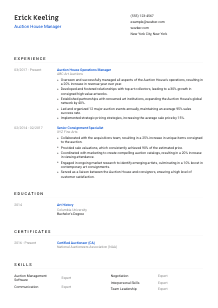
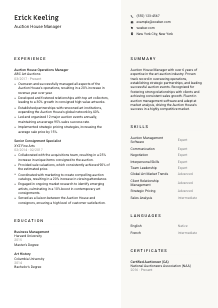
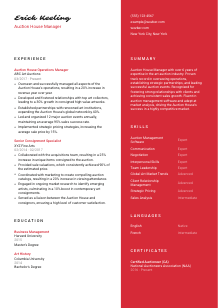
This section is simple, but it still does screening work. For an Auction House Manager opening, your header should immediately show who you are, how to reach you, and whether you meet practical requirements such as location.
Use your full name as the clearest visual element in the header. Keep the formatting clean and professional so the focus stays on your identity, especially in a field where reputation and client trust matter.
Place "Auction House Manager" directly under your name if that matches the role you are pursuing. This helps frame your experience around auction operations, valuations, consignments, and sale leadership before the reader reaches the rest of the resume.
List a reliable phone number and a professional email address. If you include a personal website or portfolio, make sure it supports the role with relevant information such as auction results, catalog work, institutional partnerships, or market-facing experience.
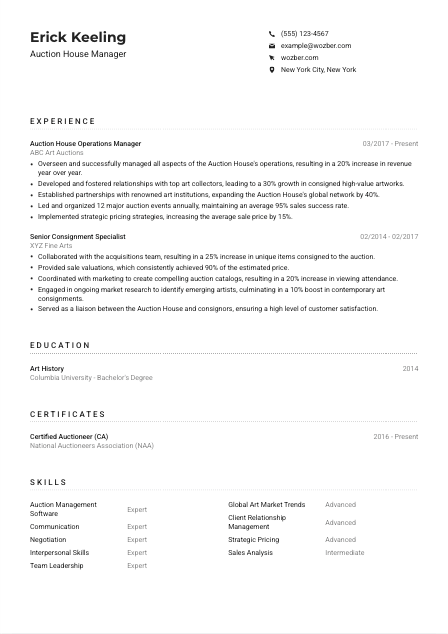
If the employer requires a local candidate, state your city and state clearly. In the example, "New York City, New York" addresses that filter immediately and avoids unnecessary questions about relocation or availability.
A LinkedIn profile can strengthen this section when it reflects the same career story as your resume. For auction leadership roles, that may include consignor relationships, art market exposure, sale highlights, and relevant industry affiliations.
Your personal details should remove friction at the top of the page. When the title, contact information, and location are accurate and aligned with the posting, the reader can move straight to your auction experience.




For this role, experience carries the most weight. Employers want proof that you can manage the business side of an auction house while delivering sale results, strong consignor relationships, and smooth execution from intake through post-sale follow-up.
Start by identifying the work the employer cares about most. Here, that includes overseeing operations, evaluating consignments, building global relationships, leading auction events, and reporting on sales results. Those themes should shape which achievements you highlight and how you phrase them.
List positions in reverse chronological order and make each entry easy to scan with title, company, and dates. Prioritize roles tied to art auctions, consignments, valuations, catalog production, client development, or sale management, since adjacent gallery or luxury-sales experience only helps when you connect it to auction outcomes.
Generic lines like "managed auction operations" are too thin for a leadership role. Show what changed because of your work. The example does this well with results such as a 20% year-over-year revenue increase, 12 major auction events annually, and a 95% sales success rate.
Use the numbers this profession naturally tracks. Revenue growth, average sale price, sell-through rate, growth in high-value consignments, bidder attendance, client retention, and expansion of institutional partnerships all help a hiring team gauge your scale and effectiveness. Metrics like the sample's 30% growth in consigned high-value artworks or 15% lift in average sale price are especially persuasive because they tie market judgment to business results.
At this level, every bullet should reinforce your ability to lead an auction house. Keep the material that shows pricing strategy, market knowledge, relationship management, event leadership, and cross-functional work with consignments, cataloging, and marketing. Cut older or less relevant details that do not strengthen that case.
Your experience section should make it easy to picture you running auctions, guiding consignments, and improving sales performance. When the bullets show scope and results in the language of the art market, your background reads as commercially credible.
Education matters here because it often signals both subject knowledge and commercial grounding. A degree in Art History, Business, or a related field supports the mix of valuation awareness, client credibility, and operational decision-making the role requires.
Start with the degree that best matches the posting. If you hold a Bachelor's in Art History, Business, or a related area, make sure that connection is obvious. In the example, the Art History degree maps directly to the stated requirement.
List the school, degree, field of study, and graduation year. Keep the structure simple so the reader can confirm qualifications quickly without digging through extra text.
When your degree aligns closely with the role, there is no need to over-explain it. A field like Art History signals familiarity with artworks, provenance, and context, while Business-related study can reinforce pricing, operations, and management capability. The sample combines both angles effectively through Art History and Business Management.
Most experienced candidates can keep this section brief. If you are earlier in your career, selected coursework in valuation, art markets, business strategy, finance, or collections management can help connect your academics to auction-house work.
Honors, research projects, or relevant extracurriculars are useful when they add real context. For example, a thesis on global art markets or leadership in an art society may support your positioning, but senior candidates should keep the emphasis on professional results.
This section should confirm that your background supports the commercial and cultural demands of the role. Clear degree information is usually enough, with extra detail only when it strengthens your case for auction leadership.
Certifications are not always mandatory for auction house management, but the right ones can strengthen your profile. They work best when they reinforce sale leadership, auction practice, valuation knowledge, or ongoing involvement in the field.
Some openings focus entirely on experience, while others value industry credentials as added proof of expertise. Even when certification is not required, something relevant such as a recognized auctioneer credential can support your authority with consignors and senior management.
Prioritize certificates that connect directly to the work. A designation like "Certified Auctioneer (CA)" is useful because it speaks to professional standards in sale execution and industry knowledge, whereas unrelated certificates add little to this application.
If a credential has an active period, renewal cycle, or continuing education expectation, list the dates clearly. That helps the employer see that your training is current and still relevant to today's market environment and auction processes.
Auction houses operate in a changing environment shaped by collector behavior, digital bidding tools, and shifts in category demand. Updating your certifications over time shows that you continue to sharpen your commercial judgment and operational practice.
The strongest certificates section adds targeted professional credibility. Choose credentials that support your role in auctions, valuations, sales, or client trust, and leave out anything that does not materially strengthen the application.
This section should read like a practical snapshot of how you operate. For an Auction House Manager, that means combining hard skills tied to auction workflows with people-facing strengths that influence consignments, negotiations, and buyer relationships.
Start with the language the employer already uses. In this posting, that includes auction management software, knowledge of global art market trends, communication, negotiation, and interpersonal strength. Mirroring that wording helps both ATS matching and human review when the skills genuinely reflect your experience.
A credible skills section should show more than general leadership. Include tools and domain knowledge such as auction management software, strategic pricing, sales analysis, valuation awareness, and catalog coordination alongside client relationship management, negotiation, and team leadership. The example strikes that balance well.
Do not turn this section into a catch-all list. Choose the skills you use in auction-house work and that support the target posting. A shorter list of aligned capabilities is more convincing than a long inventory of vague strengths.
Your skills should support the story told in your experience section. When the list reflects auction technology, market knowledge, pricing judgment, and client-facing execution, it reinforces that you can handle both the floor and the business behind it.
Art auctions often involve international buyers, consignors, and institutional contacts, so language skills can carry real business value. This section should show both required fluency and any added language capability that supports cross-border relationships.
If the posting specifies a language requirement, make that visible immediately. Here, English is essential, so list it first and describe your level accurately, such as "Native" or "Fluent," depending on your actual proficiency.
After the required language, list any others that may be useful in collector outreach, international consignments, or institution-facing work. In art-market settings, additional languages can strengthen your profile when they connect to the regions or clients you work with.
Use clear labels like Native, Fluent, Advanced, Intermediate, or Basic. For an auction leadership role, these distinctions matter because client communication, negotiation, and post-sale correspondence require different levels of confidence.
Only claim the level you can support in real interactions. If you can manage relationship-building conversations in French but not complex contractual discussion, "Intermediate" is stronger than overstating your ability and creating doubt later.
Additional languages become more valuable when your work includes overseas consignors, fair attendance, cross-border buyer networks, or global institutional contacts. The sample's French is a helpful secondary asset because it complements the international side of the business without distracting from the required English fluency.
Keep this section accurate and business-focused. It should confirm that you can handle the required communication demands of the role and, where applicable, add reach in an international art market.
Your summary should quickly establish what kind of auction professional you are. For this role, that means combining art-market credibility with revenue-minded leadership, not filling the top of the resume with broad claims about being passionate or hardworking.
Pull together the main themes from the posting before you write. Here, those priorities include auction-house operations, sales performance, consignment evaluation, global relationship management, and comfort with auction technology. Use those themes to decide what belongs in your opening lines.
Open with a direct statement that places you in the field, such as experience level and sector focus. The example's "Auction House Manager with over 6 years of expertise in the art auction industry" works because it immediately establishes seniority and specialization.
Follow your opening with specifics that show why you are credible. That may include revenue growth, successful auction volume, consignor network development, or pricing results. Keep the details aligned with the target role rather than trying to summarize your entire career.
Aim for a short paragraph of about three to five lines. It should be dense with relevant information, easy to scan, and written in the language of the profession. Save deeper detail for the experience section, where results and scale can be expanded properly.
A well-written summary should make the reader expect strong auction results, client credibility, and operational control in the sections that follow. If those themes are clear in the first few lines, the rest of your resume has a stronger foundation.
An effective Auction House Manager resume should show that you can win consignments, guide pricing, run auction operations, and deliver measurable sales results. When each section supports that story, hiring teams can quickly see commercial judgment and market credibility.
Wozber's free resume builder helps you turn that experience into a targeted, ATS-compliant resume, with ATS-friendly resume templates and an ATS resume scanner that keep your language aligned with the posting. The finished resume should make one thing easy to judge: whether you can lead an auction house with confidence and results.




