



Use Wozber and land your dream job
Create Resume
No registration required
Nurturing strategic partnerships, but your resume feels like a single sale? Check out this Key Account Manager resume example, created with Wozber free resume builder. Learn how to show off your account acumen in a way that matches the job description, positioning your career at the forefront of account management excellence.
Key Account Manager hiring usually comes down to commercial judgment you can prove. Teams want to see that you can protect high-value relationships, grow revenue inside existing accounts, and spot risk before it shows up in churn, stalled renewals, or missed targets. Your resume should make that commercial ownership visible, not bury it under broad sales language.
When the resume is tailored well, hiring teams can quickly separate general sales experience from true account ownership. Wozber's free resume builder helps you align your wording with the job description, keep the structure clean for ATS optimization, and bring forward the metrics that matter most in account management, such as retention, expansion, customer satisfaction, and account planning discipline.
For a Key Account Manager, the top of the resume should already feel polished and reliable. This role is built on trust, responsiveness, and professional communication, so your personal details need to look as clean and credible as the way you would handle an executive client conversation.
Use your full name as the most visible text at the top of the page. Keep it simple and easy to read. In a client-facing role where relationships matter, clarity beats style every time.
Place "Key Account Manager" directly under your name when that is the role you are pursuing. This helps recruiters and hiring managers immediately connect your profile to account ownership, growth strategy, and customer relationship management instead of reading you as a broad sales candidate.
List a reliable phone number and a professional email address. Account managers are expected to communicate clearly with clients, internal sales teams, and leadership, so even basic contact information should reflect that standard. A straightforward format such as firstname.lastname@email.com works well.
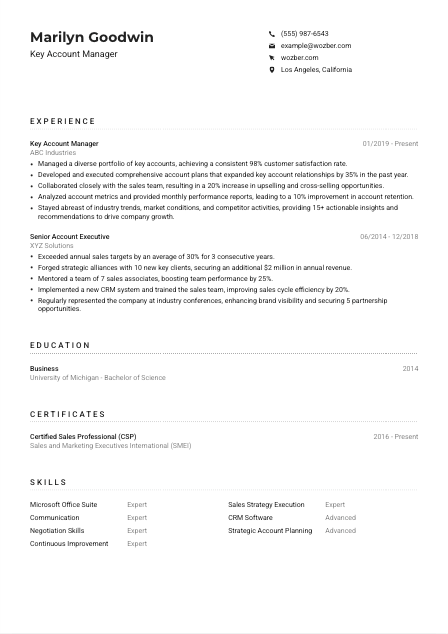
If a posting names a location requirement, show that clearly in your contact section. Here, listing Los Angeles, California directly supports the stated requirement and removes an easy screening objection. For roles without a location filter, city and state are usually enough.
Include LinkedIn or a professional website if it reinforces your account management background with consistent titles, achievements, and industry presence. If your profile highlights portfolio growth, customer retention wins, or sales awards, it gives employers another useful view of your track record.
This section is brief, but it does important work. Clean details, the right target title, and any required location information help your resume start with the same professionalism employers expect when you represent their most valuable accounts.




Experience carries the most weight on a Key Account Manager resume because this role is judged through business results. Hiring teams look for proof that you handled account portfolios, expanded relationships, supported revenue goals, and stayed close enough to client performance to act on trends and risks early.
Read the posting for the work that drives value. For Key Account Manager roles, that usually includes portfolio management, account planning, upselling, cross-selling, retention, reporting, and market insight. Build your bullets around those priorities so the employer sees experience that matches how the role actually operates.
Lead with your most recent position and include job title, company, and dates. This format helps hiring teams quickly trace the scale of your account management experience, your progression from sales into strategic account ownership, and whether you meet a requirement such as 5+ years in account management or related sales roles.
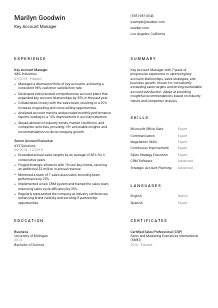
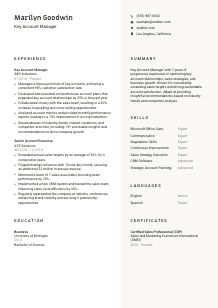
Each bullet should show what you owned and what changed because of your work. Instead of writing that you managed client relationships, show the result. The sample resume does this well with bullets like achieving a 98% customer satisfaction rate and expanding account relationships by 35%, which immediately frames the work in commercial terms rather than task language.
Numbers matter here because account management is measured through retention, revenue, growth, and client performance. Strong examples include renewal improvement, upsell lift, account expansion, satisfaction scores, pipeline growth within named accounts, or the frequency and value of executive business reviews. Monthly reporting that improved retention by 10% is much stronger than saying you "analyzed metrics regularly."
Prioritize achievements that show portfolio ownership, cross-functional coordination, negotiation, and commercial impact. Earlier sales experience can absolutely stay if it supports the story. In the example, the Senior Account Executive role works because exceeding targets, winning key clients, and improving CRM-driven efficiency all strengthen the case for handling major accounts.
Your experience section should show a hiring manager how you influence revenue, retention, and customer satisfaction across important accounts. If each role makes your scope, actions, and outcomes easy to follow, your resume will read like someone who can step into a book of business and move it forward.
Education is rarely the main decision point for an experienced Key Account Manager, but it still matters when the role asks for a bachelor's degree in Business, Marketing, or a related field. Present it clearly so hiring teams can confirm the requirement and move on to the experience that carries more weight.
If the posting asks for a bachelor's degree, make sure that degree is easy to find. A Bachelor of Science in Business, Marketing, or a related discipline aligns naturally with the analytical and commercial side of account planning, customer development, and sales strategy.
List degree, field, school, and graduation year. Keep the layout straightforward so the information is easy to scan. A line like "Bachelor of Science in Business, University of Michigan, 2014" does the job without unnecessary detail.
For this type of role, the field of study adds context. "Business" or "Marketing" connects more directly to account growth, client strategy, forecasting, and market analysis than a degree title alone. If your field is related rather than exact, include it clearly instead of leaving room for guesswork.
Most candidates with several years of account management experience do not need coursework. Use it only when you are early in your career or pivoting from another path and need to support your understanding of sales strategy, market analysis, customer behavior, or business communication.
Academic distinctions can help if they connect to commercial leadership or communication. Honors, case competition results, or leadership in business organizations can add value for earlier-career candidates. If you already have a strong record of account growth and customer retention, keep this section lean.
This section should confirm that you meet the academic requirement and support the business side of your profile. Once that is clear, the rest of the resume can stay focused on portfolio growth, client outcomes, and sales performance.
Certifications are often secondary for Key Account Manager roles, but the right ones can strengthen your profile. They are most useful when they support consultative selling, relationship management, negotiation, CRM fluency, or industry knowledge that helps you manage complex accounts more effectively.
If a job description does not require a specific certification, choose ones that back up the work the role involves. For Key Account Manager positions, that usually means sales training, strategic account management, negotiation, customer success, or relevant industry credentials rather than unrelated general courses.
One respected certification is more useful than a crowded section full of low-value badges. A credential such as Certified Sales Professional fits well because it supports revenue ownership, client communication, and commercial discipline, all of which matter in key account work.
Dates help employers see whether a credential is current or part of your ongoing development. Listing a certification range such as "2016 - Present" can signal active membership or continued standing, which is useful when the credential remains relevant to your field.
Account managers are expected to stay current on market shifts, buying behavior, and new approaches to client growth. Certifications can support that story when they reflect current selling methods, account strategy, or tools used to track and improve account performance.
Certifications should add commercial depth, not filler. When they connect clearly to account growth, client management, or sales execution, they strengthen the overall case that you can handle strategic relationships with confidence.
A Key Account Manager skills section works best when it reflects how the role is actually done. That means a mix of relationship skills, commercial skills, and operating tools. Hiring teams want to see that you can manage conversations, negotiate value, work from account data, and stay organized inside the systems the business already uses.
Start with the language in the posting. Here, that includes interpersonal communication, negotiation, CRM software, and Microsoft Office Suite. Those are not filler terms. They point to real work such as running account reviews, tracking pipeline activity, preparing performance reports, and handling client conversations with credibility.
Show a mix of hard and soft skills that fits account management. CRM software and Microsoft Office support reporting and account tracking. Communication and negotiation support renewals, cross-sell discussions, and issue resolution. Strategic account planning and continuous improvement help position you as someone who can grow an account, not just maintain it.
Choose the skills you can defend with examples from your experience. A focused list is stronger than a generic inventory. The example resume keeps this credible by pairing tools like CRM software with business capabilities such as sales strategy execution and strategic account planning, which match the responsibilities in the job description.
Your skills section should echo the way you manage business, not just the way you describe yourself. When the list reflects account planning, client communication, data review, and revenue growth, it reinforces the rest of the resume.
Language skills matter in account management when they affect how you build trust, run meetings, or support customers across regions and markets. This section should stay factual and useful, especially when a posting explicitly requires strong English communication.
If English is required, list it first with an accurate proficiency level. For a Key Account Manager, strong English communication usually covers presentations, negotiation, email communication, reporting, and relationship management, so make that qualification easy to find.
Any additional language can be valuable if it helps with client relationships, regional accounts, or internal collaboration. Spanish, for example, may strengthen your profile in some markets, but it should be treated as an added asset unless the posting specifically asks for it.
Stick to standard terms such as Native, Fluent, Intermediate, or Basic. Vague descriptions make it harder for employers to judge whether you can handle customer calls, presentations, or negotiation in that language.
Only emphasize this section if language ability affects the role's scope. For account managers handling multilingual clients or broader territories, language skills can support smoother relationship management and stronger customer experience. If the role is entirely domestic and English-only, keep this section short.
This section works best when it directly supports client communication or market reach. Lead with the required English proficiency, then add other languages that genuinely expand the kind of accounts you can manage.
The summary should quickly frame your level, your commercial impact, and the kind of accounts you handle. For Key Account Manager roles, that usually means blending relationship management with revenue growth, retention, and strategic planning in a few precise lines.
Build the summary around the work that defines strong account managers. That can include growing existing accounts, protecting customer satisfaction, improving retention, coordinating with sales teams, or turning market insight into account strategy. Keep it grounded in what you have actually done.
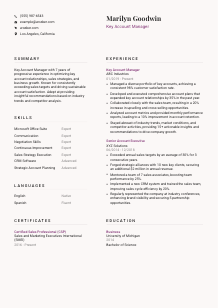
Open with your title and years of experience so the reader can quickly place you. A line like "Key Account Manager with 7 years of experience" works because it immediately establishes seniority and relevance for a posting asking for at least 5 years in account management or sales.
Choose achievements or strengths that match the target role. The example summary works because it highlights exceeding sales targets, driving account satisfaction, and using industry and competitor insight to guide recommendations. That combination speaks directly to growth and account stewardship.
Aim for a short paragraph that is easy to scan and free of generic claims. This is not the place for broad statements about being results-driven. Use role language tied to account planning, customer growth, sales performance, or portfolio management so the first impression is concrete.
A strong summary gives the hiring team a fast read on your level, your account management style, and the business results you tend to produce. If it points clearly to revenue growth, retention, and client stewardship, the rest of the resume has a strong opening.
A Key Account Manager resume should make one thing easy to see: you know how to protect important client relationships while growing the business inside them. When your experience, skills, and summary all point to account planning, customer satisfaction, expansion, and reporting discipline, the hiring case becomes much stronger.
Use Wozber to build an ATS-compliant resume that reflects the language of the role, surfaces the right metrics, and keeps the structure clean. The final document should make it easy for a hiring team to picture you managing a portfolio, strengthening key relationships, and delivering measurable growth.