



Use Wozber and land your dream job
Create Resume
No registration required
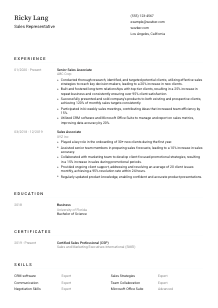
Sealing deals, but your resume isn't quite closing in on success? Follow the path of this Sales Representative resume example, created with Wozber free resume builder. Learn how to match your sales savvy with job expectations, turning your career path into a highway of high conversions and happy customers!
Sales hiring moves quickly when a candidate can already show the numbers behind their pipeline work. For a Sales Representative resume, that means making client acquisition, relationship management, product presentations, forecasting, and quota performance easy to see without forcing the reader to hunt through generic sales language.
A tailored resume changes which parts of your background stand out first, especially when ATS screening is looking for terms like CRM software, sales forecasting, client relationships, and communication. Wozber's free resume builder helps you align your wording with the job description in an ATS-friendly resume format, so hiring teams can quickly understand whether you've sold to the right audiences, managed the right tools, and delivered the kind of revenue outcomes the role depends on.
Sales resumes benefit from a clean, direct opening. Your contact section should confirm who you are, where you are based when location matters, and how a hiring manager can reach you after reviewing your track record.
Use your full name in a larger, professional font so it anchors the page immediately. Sales is a client-facing function, and presentation matters here too. A polished header signals business judgment before the reader gets to your quota, accounts, or forecasting experience.
Place "Sales Representative" directly under your name if that is the role you are pursuing. This keeps your positioning clear, especially if your recent title was something adjacent such as Sales Associate or Senior Sales Associate. In the sample resume, that alignment helps connect prior progression to the target role without making the reader interpret the jump.
If the employer needs someone based in Los Angeles or open to relocation, state that clearly in your personal details. This is a practical filter, not a place for vague wording. When location is a stated requirement, remove doubt early so the conversation stays focused on your sales record rather than logistics.
Include LinkedIn or a professional website only if the content supports your resume. For sales candidates, that usually means a profile that reinforces your industry background, account wins, or client-facing experience. Make sure titles, dates, and achievements match what appears in your resume.
This section should answer the first operational questions right away: who you are, what role you want, how to reach you, and whether you meet a stated location requirement. Once that is clear, the rest of the resume can stay focused on sales performance.




For Sales Representative roles, experience is where credibility is won or lost. Hiring managers look for evidence of prospecting, account growth, product presentation, CRM usage, forecasting, and measurable sales outcomes, not broad claims about being persuasive or driven.
Before rewriting your experience bullets, identify the core motions in the posting. Here, the employer wants someone who can research prospects, reach decision-makers, maintain long-term client relationships, present products in person and virtually, report on sales metrics, and stay current on competitors. Those priorities should shape which bullets you lead with and which keywords you mirror naturally.
List positions in reverse chronological order with title, company, and dates. In sales, progression matters. A path from Sales Associate to Senior Sales Associate, for example, tells a useful story about increased ownership, stronger account handling, or broader target responsibility before a hiring manager even reads the bullets.
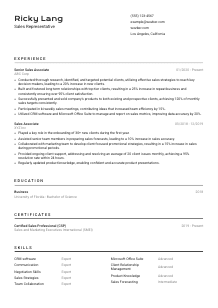
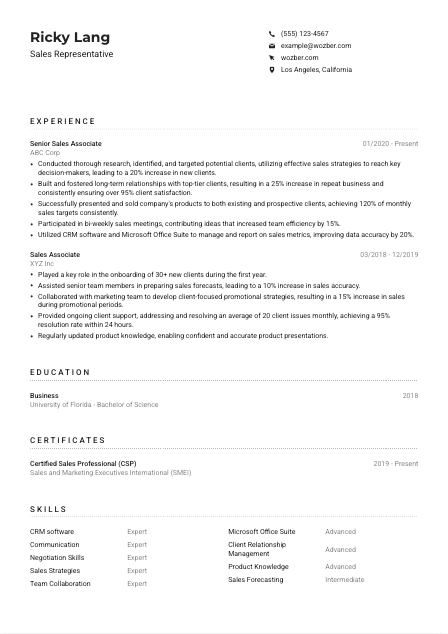
Replace duty-only bullets with results tied to concrete sales work. Strong bullets show what you targeted, how you sold, and what changed. The sample resume does this well with lines about identifying decision-makers, building long-term client relationships, and consistently hitting 120% of monthly sales targets. That kind of framing is far stronger than "responsible for sales" or "managed accounts."
Use numbers that belong naturally in sales reporting: quota attainment, new client growth, repeat business, retention, satisfaction scores, forecast accuracy, pipeline volume, meeting cadence, or revenue contribution. Metrics such as a 20% increase in new clients or a 25% lift in repeat business tell the reader how your work performed in the market, not just what your responsibilities were.
Prioritize bullets that align with the target position, especially if you have sold in the same or a related industry. Even when your past titles vary, the most relevant details are usually universal to sales hiring: prospecting, closing, account development, CRM discipline, and communication with buyers. Lead with those before less relevant tasks such as general admin support or internal coordination.
A sales experience section should read like a record of performance, not a job description. When your bullets show who you sold to, how you managed the pipeline, what tools you used, and what results followed, hiring teams can picture you in front of customers and inside their revenue process.
Education rarely carries a sales resume on its own, but it can strengthen your case when the employer asks for a business-related degree. Keep this section straightforward and make the connection to the role obvious.
If the posting calls for a bachelor's degree in Business, Marketing, or a related field, list that information clearly: degree, field of study, school, and graduation year if appropriate. In the example, a Bachelor of Science in Business directly supports the requirement and removes a basic screening question.
Sales resumes do not need an overloaded education section unless you are early in your career. One clean entry is usually enough for an experienced candidate. If you hold multiple degrees, list the most recent or most relevant first so the section stays quick to review.
A business, marketing, communications, or related academic background can reinforce your understanding of customer behavior, market positioning, and commercial strategy. If your degree lines up neatly with the posting, let that relevance show through clear wording rather than extra explanation.
If you completed coursework in negotiation, consumer behavior, sales management, market research, or data analysis, include it only when it adds value beyond the degree itself. This is especially useful if you are early-career, changing industries, or need to show familiarity with the commercial side of the work.
Honors, leadership roles, or sales-related student activities can help if you have limited professional experience. For candidates with 3+ years in sales, these details should stay brief unless they directly support the role, such as leading a business development club or winning a case competition tied to pitching or market strategy.
For most Sales Representative applications, education is a supporting section. It should confirm that you meet the degree expectation and, when relevant, show preparation in business or marketing without distracting from your sales results.
Certifications are rarely the center of a sales resume, but they can add weight when they reflect formal training in selling, account management, or industry knowledge. Include them when they sharpen your professional credibility.
Relevant credentials can help, especially in competitive fields or industries with structured sales training. A certification such as Certified Sales Professional can support your profile because it connects directly to selling practice, client communication, and professional development rather than general learning.
Do not turn this section into a complete learning archive. Feature credentials that support the role you want now, whether that is sales methodology, negotiation, CRM platform training, or product-domain knowledge relevant to the industry you are targeting.
If a certification is active, recently earned, or part of an ongoing credential, include the date range. That helps the employer understand whether the training reflects current practice, which matters in fast-moving sales environments where tools, buyer expectations, and outreach methods evolve.
Ongoing training matters in sales because top performers keep sharpening prospecting, objection handling, account strategy, and tool usage. A concise, current certification list can reinforce that you invest in your craft, especially when the posting mentions relevant sales certifications as a plus.
Certifications work best when they support the story already established in your experience section. If they reinforce your selling approach, industry fluency, or commitment to staying current, they add useful credibility without taking over the resume.
A Sales Representative skills section should look like it belongs to someone who manages pipelines, handles objections, works inside a CRM, and keeps deals moving. The best lists combine core sales abilities with the tools and communication strengths the role actually requires.
Scan the job description for explicit skills and implied ones. In this case, that includes CRM software, Microsoft Office Suite, communication, negotiation, relationship building, research, forecasting, and awareness of market trends. These should guide your shortlist more than generic traits such as "hardworking" or "people person."
Use the same terminology the employer uses when it accurately describes your experience. If the posting says CRM software, sales metrics, and communication skills, use those phrases naturally in your skills list and your experience bullets. This improves alignment for both human readers and ATS scanning without sounding forced.
Lead with the skills most tied to execution: prospecting, negotiation, client relationship management, product presentation, CRM usage, sales strategy, forecasting, and reporting. The sample resume also includes Microsoft Office Suite and team collaboration, which makes sense because sales roles often involve pipeline reviews, shared forecasting, and coordination with marketing or account teams.
Every skill listed should connect to how you win business, manage accounts, or support sales reporting. If a hiring manager can map your skills directly to pipeline activity, client conversations, and sales targets, the section is doing its job.
Language ability matters in sales when it affects communication with prospects, clients, or regional markets. Present it clearly, especially when the role names a required language or your additional languages could help with relationship building.
If the role requires English, list it first with an accurate proficiency level. That removes a basic screening concern and keeps the section aligned with the posting from the start.
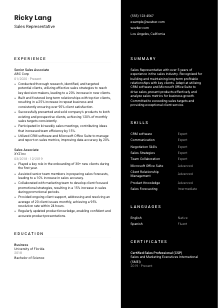
Additional languages can be valuable in sales, particularly in diverse markets, multilingual territories, or customer-facing roles with broad account coverage. In the example, Spanish adds practical relevance because it can widen communication options with prospects and clients, even though it was not listed as a formal requirement.
Be precise about your level, whether native, fluent, intermediate, or basic. Sales conversations rely on nuance, persuasion, and trust, so inflated language claims can quickly become a problem during interviews or client-facing assessments.
If a language helps you serve a target customer base, mention that value elsewhere in the resume if appropriate, such as in your summary or experience bullets. This is especially useful when your language skill supported lead generation, relationship management, or closing conversations across different customer groups.
Languages should strengthen your commercial profile, not just occupy space. In sales, another language can support rapport, reduce friction in communication, and open doors in accounts where trust and responsiveness matter.
Keep this section simple and credible. When your listed languages clearly connect to client communication or market reach, they reinforce your value in a practical, business-facing way.
The summary sits at the top of the resume, so it should establish your sales identity fast. Focus on experience level, market-relevant strengths, and the results or tools that best match the role you are targeting.
Start by identifying the few themes that define the opening. Here, the employer is looking for proven sales experience, relationship building, communication, negotiation, CRM proficiency, and regular reporting on metrics. Those are the ideas your summary should reflect in condensed form.
Lead with a clear description such as Sales Representative with 5+ years of experience or Sales professional with 3+ years in B2B prospecting and account growth. This gives immediate context and helps the reader place your seniority before they move into the details of your pipeline or client results.
After the opening line, include a few targeted strengths supported by outcomes or responsibilities. The example summary works because it mentions long-term client relationships, CRM and Microsoft Office proficiency, product presentation, sales metrics, and a record of exceeding targets. That combination speaks directly to how the work gets done.
Aim for a short paragraph that sounds grounded in real sales work. Skip vague lines about passion or ambition unless they are backed by performance. A hiring manager should finish the summary knowing what you sell well, how you operate, and what kind of commercial contribution you are likely to make.
Your summary should quickly connect experience, selling strengths, and measurable contribution. When it is tailored well, the reader immediately understands your lane, your tools, and the type of results you are used to delivering.
A Sales Representative resume works when it shows commercial judgment from top to bottom: clear positioning, relevant tools, credible client work, and numbers that reflect pipeline and revenue performance. Each section should help a hiring team understand how you prospect, present, negotiate, forecast, and maintain accounts.
Use Wozber's free resume builder to shape that content into an ATS-compliant resume, refine your wording with targeted keywords, and check alignment with an ATS resume scanner before you apply. The final document should make one thing easy to judge: whether you can step into the sales process and produce results.




