



Use Wozber and land your dream job
Create Resume
No registration required
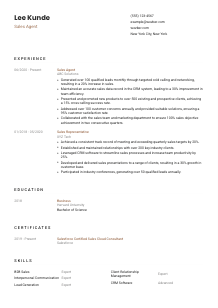
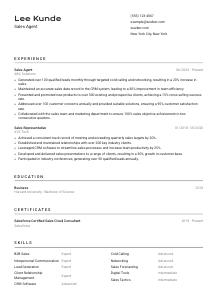
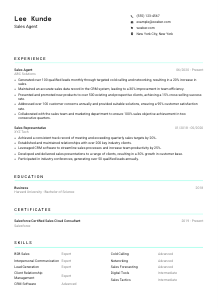
Closing deals, but your resume feels like a cold call? Check out this Sales Agent resume example, created with Wozber free resume builder. Learn how to match your sales accomplishments to job requirements with ease, positioning your career to always ring the cash register!
Sales hiring moves quickly when a resume makes one thing obvious: you know how to turn outreach into revenue. For a Sales Agent, that usually means more than listing communication skills. Hiring teams want to see lead generation activity, sales target performance, client-facing work, and the discipline to keep pipeline and CRM data accurate enough for the rest of the team to rely on.
The first screen often separates candidates who have sold from candidates who can prove how they sell. A tailored resume that reflects the job's language around lead qualification, CRM use, customer concerns, and sales targets gives that proof far faster, especially in an ATS-compliant resume. Wozber's free resume builder helps you match that wording cleanly and structure your experience so a recruiter can quickly see your sales rhythm and business impact.
For sales roles, the top of the resume should feel straightforward and business-ready. Contact details are simple, but they still influence how quickly a recruiter can move you into a phone screen, especially when the role has location or communication requirements.
Use your full name as the most visible text at the top of the page. Keep the formatting clean and professional. In a sales resume, the opening should feel polished and reliable, much like the first impression you would make in a client conversation.
Place "Sales Agent" directly beneath your name when that matches the role you are applying for. This creates immediate alignment with the posting and helps frame the rest of the resume around lead generation, client management, and sales execution rather than a broader or less relevant sales label.
List a working phone number and a professional email address, then add LinkedIn or a relevant professional profile if it supports your candidacy. For client-facing sales positions, sloppy contact information can undercut the credibility you need to project before the first call ever happens.
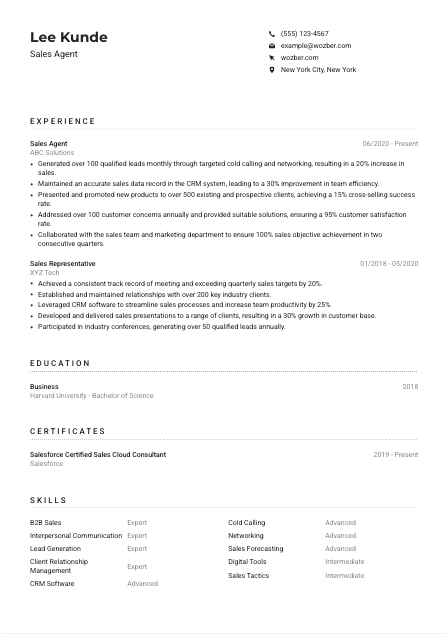
If a job requires candidates to be based in a specific city, include that clearly in your header. Here, listing "New York City, New York" directly addresses a stated requirement and removes an avoidable question during screening. Use location this way when it is relevant to the employer's process, not as filler.
Do not add age, marital status, headshots, or other details unrelated to selling performance, territory coverage, or client communication. Every line at the top should help the employer contact you, place you, or understand your target role faster.
Your header should make it easy to contact you, confirm any location requirement, and understand that you are applying specifically as a Sales Agent. Clean setup here keeps attention on your pipeline results and customer-facing experience.




This section carries the most weight in a Sales Agent resume. Hiring managers want to see how you prospect, how you manage customer conversations, how you use CRM systems, and what commercial results followed from your work.
Start by marking the verbs and operating requirements in the posting. For this role, that includes generating and qualifying leads, presenting products or services, updating CRM records, handling customer concerns, and collaborating across teams. Those actions should appear in your experience section when they reflect work you have actually done.
List positions in reverse chronological order and make each entry easy to scan with company name, title, and dates. For sales hiring, progression matters. A move from Sales Representative to Sales Agent, for example, can show increased ownership over prospecting, account development, or quota responsibility when the bullets support it.
Replace generic statements like "responsible for sales activities" with bullets that show volume, conversion, or customer impact. The sample resume does this well with details such as generating more than 100 qualified leads monthly and presenting products to over 500 clients. That kind of detail tells a hiring team how active your pipeline was and what happened because of your efforts.
Use numbers that match the way sales work is measured: quota attainment, lead volume, conversion rate, revenue growth, cross-sell rate, customer satisfaction, account count, or CRM efficiency gains. Metrics like "exceeded quarterly sales targets by 20%" or "improved team efficiency by 30% through accurate CRM records" are stronger than broad claims about being results-driven.
Prioritize accomplishments that match the employer's setting, especially if the role emphasizes B2B selling, relationship management, digital sales tools, and collaboration with marketing or the wider sales team. If a past role included conference lead generation, cold calling, CRM discipline, and issue resolution, those points deserve more space than unrelated achievements. Relevance helps the reader picture you handling this sales cycle, this customer type, and this reporting rhythm.
Your experience section should show a clear pattern of prospecting activity, customer-facing execution, and measurable sales results. When the bullets connect actions to quota, pipeline growth, or client outcomes, your fit for the role becomes much easier to judge.
Education is usually a supporting section for Sales Agent roles, but it still matters when the employer asks for a specific degree background. Present it clearly and make the match easy to spot.
If the employer asks for a bachelor's degree in Business, Marketing, or a related field, make sure your education section surfaces that information without delay. When your degree aligns directly, as a Business degree does in the sample resume, you remove one more screening question early.
List your degree, field of study, school, and graduation year in a simple structure. Sales resumes rarely benefit from decorative formatting here. A recruiter should be able to confirm your qualification in seconds and move back to your sales history.
When your degree directly supports the role, name it precisely. "Bachelor of Science in Business" speaks more clearly than a shortened or vague label. Exact wording matters because it aligns with both recruiter review and ATS parsing.
If you are early in your career, relevant coursework in marketing, negotiation, consumer behavior, or business communication can help support limited experience. Once you have a solid record of quota attainment, lead generation, and CRM use, coursework becomes far less important.
Honors, leadership roles, or sales-related extracurriculars can help if they show presentation skill, competitive drive, or client-facing initiative. Keep them brief and only include them when they add useful context rather than crowding the section.
Education should confirm that you meet the stated academic baseline and support the business side of your sales profile. Keep it concise, accurate, and easy to verify.
Certifications are not always required for Sales Agent roles, but the right one can strengthen your case, especially when the job mentions CRM software, digital sales tools, or a more structured B2B environment.
When a posting emphasizes CRM use or sales systems, list credentials that connect directly to those tools or workflows. A certification such as "Salesforce Certified Sales Cloud Consultant" is useful here because it supports the technical side of managing opportunities, customer records, and pipeline activity.
A short list of certifications tied to selling, account management, CRM platforms, or customer success is more effective than a long list of unrelated training. The section should reinforce your sales process knowledge, not read like a generic learning archive.
Include the year earned or active date range where appropriate. In sales technology, current knowledge matters. Employers want to know whether your familiarity with systems and practices is recent enough to be useful on day one.
Sales teams continue to rely on new CRM features, automation, reporting dashboards, and digital outreach tools. Updating this section over time shows that your approach to selling evolves with the systems you use to manage prospects and customers.
Use certifications to reinforce practical strengths that matter in sales operations, CRM adoption, or customer management. They work best when they support the day-to-day responsibilities named in the job ad.
A Sales Agent skills section should read like the toolkit behind your results. Focus on the capabilities that support prospecting, conversations, follow-up, pipeline management, and target attainment.
Review the posting for the skills it names or implies. Here, that includes interpersonal communication, CRM software, lead generation, relationship building, digital tools, and B2B sales experience. Those are the terms to prioritize if they match your background.
Lead with the sales capabilities most relevant to the role, such as B2B Sales, Lead Generation, Cold Calling, Client Relationship Management, and CRM Software. The sample resume gets this balance right by mixing selling skills with the operational tools that support them.
Do not overload this section with every skill you have touched. A tighter list is stronger when it reflects the actual sales motion of the role. If the employer is hiring for outbound prospecting and CRM discipline, those skills should stand out more than broad terms with little hiring value.
Your skills list should immediately reflect how you generate opportunities, manage client relationships, and work inside a sales process. Choose the terms that support your experience rather than repeating generic strengths.
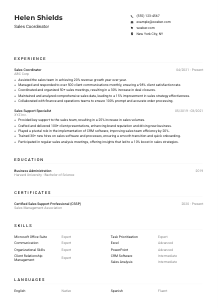
Language ability matters in sales because it affects live conversations, trust, and follow-up quality. Include languages when they strengthen your ability to communicate with prospects and customers or when the posting names a language requirement.
If the employer asks for clear English communication, list English at the top with an honest proficiency level such as Native or Fluent. For a Sales Agent, this supports core work like cold calling, presentations, objection handling, and written follow-up.
Start with the language the role requires, then list additional languages that may help with regional coverage, relationship building, or broader customer reach. This keeps the section aligned with how the job is actually performed.
A second language can be useful in sales, especially in diverse markets or accounts with multilingual stakeholders. In the example resume, Spanish adds practical value without distracting from the required English proficiency.
Use realistic labels such as Native, Fluent, Advanced, or Conversational. Language claims are easy to test in interviews, phone screens, and client-facing scenarios, so accuracy matters.
If the role involves regional territory coverage, international customers, or a multilingual client base, language skills can become a stronger differentiator. If not, keep the section brief and let your sales results remain the main focus.
Use this section to support communication strength where it affects customer conversations and account coverage. Keep it honest, relevant, and proportional to the role.
Your summary should quickly establish what kind of sales professional you are and what results tend to follow your work. It is the fastest place to connect your experience level, sales environment, and measurable strengths to the role you want.
Before writing the summary, identify the few themes the job emphasizes most. In this case, that is B2B experience, lead generation, CRM use, relationship management, and a track record of hitting targets. Your summary should reflect those priorities rather than offering a generic statement about being passionate or hardworking.
Your first line should state who you are professionally and how much experience you bring. The sample summary works because it quickly places the candidate as a Sales Agent with 4+ years across B2B and B2C environments, which gives immediate context for the rest of the resume.
Mention two or three core capabilities tied to the job, such as generating qualified leads, maintaining client relationships, using CRM tools, or consistently surpassing sales targets. This gives the reader a compact view of both your selling style and your operational reliability.
Aim for a short paragraph of three to five lines. Focus on experience, sales scope, and outcomes. A concise summary that points to target attainment, customer management, and CRM fluency is far more persuasive than a long introduction filled with broad personality traits.
By the time someone finishes your summary, they should already understand your sales background, your working style, and the results you are known for. That sets up the rest of the resume to confirm the numbers.
A Sales Agent resume works best when it shows how you build pipeline, manage relationships, and convert activity into measurable business results. Keep the content aligned with the target role, use the employer's language where it matches your real experience, and make your numbers do the talking.
Wozber helps you turn that experience into a sharper application with an ATS-friendly resume format, targeted phrasing, and AI-assisted tailoring that supports stronger ATS optimization. When the final resume is focused and specific, hiring teams can quickly see your ability to prospect, sell, and contribute to revenue from the start.




