




Use Wozber and land your dream job
Create Resume
No registration required
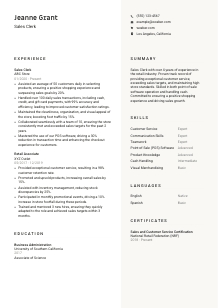
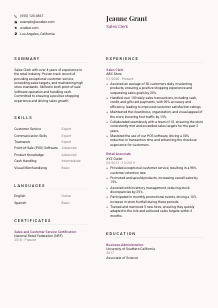
Tending to store shelves, but your resume seems out of stock? Check out this Sales Clerk resume example, made with Wozber free resume builder. Learn how to arrange your sales success to match job demands, ensuring your career never gathers dust on the shelf!
Sales Clerk work is judged in fast, practical moments. Can you greet customers with confidence, guide them to the right product, move the line efficiently at checkout, and still keep shelves, displays, and store standards in order. A resume for this role needs to make that kind of day-to-day reliability easy to see, especially through customer volume, transaction accuracy, sales results, and teamwork on the floor.
A tailored resume changes how quickly a hiring manager can separate general retail experience from performance that fits their store. When your wording reflects the posting's priorities, such as POS use, cash handling, product knowledge, and quota support, Wozber's free resume builder helps shape that into an ATS-friendly resume format that reads clearly in both screening software and human review. The result is a resume that shows you can contribute on the sales floor from day one.
For a Sales Clerk, the personal details section is simple, but it still carries practical information a store can act on quickly. Hiring teams want clear contact details, a relevant job title, and, when the posting asks for it, a location that confirms you can work the role without delay.
Use your full name at the top in a clean, readable font so it stands out immediately. This section does not need design flourishes. It needs clarity, especially when a store manager may be reviewing several retail resumes in one sitting.
Place "Sales Clerk" directly under your name if that matches the role you are targeting. This helps the resume line up with the posting and with ATS searches for retail floor staff, cashiering, and customer-facing sales support.
Include a phone number you answer and a professional email address. Retail hiring often moves fast, with interview calls made soon after review, so accuracy matters here more than style. Check every character before sending.
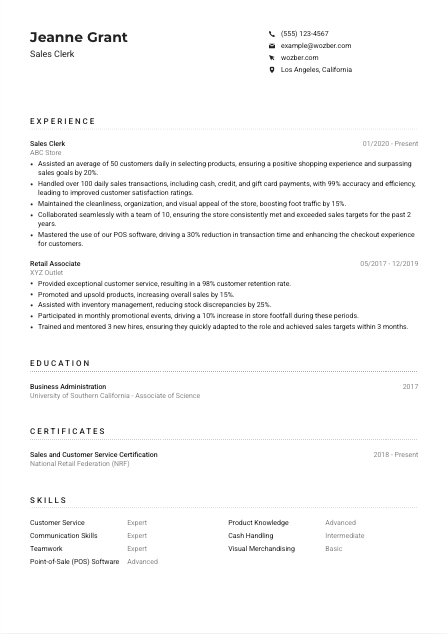
If the employer asks for candidates to be based in a specific city, list your city and state. In the example, "Los Angeles, California" works because the job specifically requires local availability or willingness to relocate. Use location as a tailoring detail, not as a default line in every application.
A LinkedIn profile or personal website is optional for Sales Clerk roles. Include one only if it supports your application with consistent work history, recommendations, or retail achievements. If it is sparse or outdated, leave it off and keep the focus on your store-floor experience.
This section should answer the store's first practical questions right away: who you are, how to reach you, what role you do, and whether you meet any location requirement tied to the opening.




Experience is where Sales Clerk resumes usually win or lose attention. Retail employers look for proof that you can handle customer interactions, process transactions accurately, support merchandising standards, and contribute to store targets without needing extensive ramp-up.
Before writing bullets, mark the operational priorities in the job description. For a Sales Clerk, that often includes customer assistance, POS proficiency, cash handling, product knowledge, store upkeep, and hitting sales goals. Those themes should shape which accomplishments you choose and how you phrase them.
List your most recent role first, then work backward. For each entry, include job title, employer, and dates. In retail, recent experience often carries the most weight because it reflects your current pace with checkout systems, promotions, and customer service expectations.
Do not stop at listing tasks like greeting customers or restocking shelves. Show what happened because of your work. The example does this well by pairing common store responsibilities with outcomes such as assisting 50 customers daily, reducing transaction time by 30%, and surpassing sales goals by 20%. That kind of phrasing tells a manager how you perform in a live retail setting.
The most convincing metrics in this field are customer volume, transaction count, sales growth, upsell results, retention, stock accuracy, foot traffic, and checkout accuracy. Even modest numbers help. "Handled 100+ transactions per shift with 99% accuracy" says far more than "responsible for cashier duties."
Choose bullets that support the target role instead of trying to preserve every past responsibility. For Sales Clerk applications, prioritize customer-facing work, quota support, merchandising, cash management, team coordination, and product knowledge. If you have broader retail experience, trim it to the parts that show you can contribute quickly in a store environment.
A hiring manager should be able to picture you helping customers, closing sales, keeping checkout accurate, and supporting store performance. If your bullets do that with numbers and clear action verbs, this section is doing its job.
Education carries a straightforward role in most Sales Clerk resumes. Many postings ask for a high school diploma or equivalent, and anything beyond that can add context if it relates to business, retail, communication, or customer-facing work.
If the posting asks for a high school diploma or equivalent, make sure that appears clearly on your resume. If you also completed college coursework or earned a degree, list the highest relevant education you have. In the example, an Associate of Science in Business Administration adds useful business context, but it is not a universal requirement for every Sales Clerk role.
List the school, degree or diploma, field of study if applicable, and graduation year. This section should be quick to scan. Retail employers rarely need a long academic description unless you are early in your career and education is one of your stronger credentials.
Coursework or degrees connected to business operations, merchandising, communication, or customer service can strengthen your profile. They suggest familiarity with sales principles and service standards, especially if your work history is still growing.
If you are new to retail, adding a few relevant classes can help fill out the section. Focus on subjects that connect to the role, such as retail management, business basics, communication, or consumer behavior. Once you have solid hands-on experience, coursework usually becomes secondary.
Clubs, awards, or projects can be worth mentioning if they relate to customer service, teamwork, sales events, or leadership. Keep them recent and relevant. A school retail fundraiser or business club project is more useful here than a generic activity with no connection to store work.
This part should confirm that you meet the education baseline and, where relevant, show extra business or customer-service grounding. Keep it concise and connected to the kind of work done on the sales floor.
Certificates are not always required for Sales Clerk roles, but the right one can strengthen your resume by showing recent training in customer service, retail operations, or sales technique. They are most useful when they add skill depth that matches the store's needs.
Some retail roles do not require certifications at all, as in this example. Even so, relevant credentials can still help if they support the employer's priorities. A sales or customer service certificate works because it speaks directly to customer interaction and store performance.
Choose certificates tied to retail sales, customer service, POS systems, visual merchandising, loss prevention, or inventory handling. Leave out unrelated training that does not strengthen your case for customer-facing retail work.
Add the year earned, and if applicable, the validity period. This helps employers see whether the training is current. In fast-moving retail environments, recent learning carries more weight than an old certificate with no ongoing relevance.
If you plan to grow in retail, look for certifications that sharpen the parts of the job stores actually measure: customer satisfaction, conversion, product knowledge, cashier accuracy, merchandising, and team coordination during promotions or peak traffic.
A short, relevant certificates section can add polish to your resume, especially when it supports service quality, sales ability, or day-to-day store operations.
The skills section should read like a quick scan of how you perform in a retail environment. For Sales Clerk roles, that usually means balancing customer-facing strengths with the practical tools and habits needed to keep transactions, shelves, and service standards running smoothly.
Start with the skills the employer names outright, then add closely related ones you genuinely use. In this posting, customer service, communication, POS software, cash handling, teamwork, and sales performance are all central. Those should appear before more general abilities.
List skills that show up elsewhere in your resume through accomplishments or responsibilities. If you claim POS proficiency, your experience should mention transaction volume, checkout speed, or accuracy. If you list product knowledge or upselling, support it with sales or service results.
Avoid long skill blocks filled with vague traits. A tighter list is stronger for this role. Core retail skills such as customer service, communication, POS systems, cash handling, merchandising, inventory support, and teamwork will usually matter more than broad terms with no store-floor relevance.
When this section is tailored well, it quickly tells the employer that you can serve customers, operate the register, support sales goals, and work effectively with the rest of the team.
Language ability matters in retail because every shift depends on clear customer interaction. For a Sales Clerk, the first priority is meeting the posting's required language level, then showing any additional languages that could help with service in a diverse customer base.
If the job requires spoken and written English, include English in this section and state your level plainly. Do not assume it is understood from the rest of the resume. When language is listed as a requirement, make it explicit.
Lead with the language the role depends on most. In this case, English should be at the top because it is a stated requirement and central to customer assistance, cashier communication, and teamwork on the floor.
Additional languages can strengthen a Sales Clerk application, especially in stores with varied walk-in traffic. The example includes basic Spanish, which can be useful in some markets, but treat that as an advantage when relevant rather than a blanket expectation for every retail opening.
Use honest labels such as Native, Fluent, Intermediate, or Basic. Retail communication is practical and immediate, so overstating your ability can create problems during customer interactions or team coordination.
Only include languages that add real value to service, sales conversations, or store operations. For Sales Clerk roles, the point is not to impress with a long list. It is to show which languages help you connect with shoppers and communicate clearly during transactions.
This section should confirm you meet the job's communication requirement and, when applicable, show added range in serving customers across different interactions on the sales floor.
The summary sits at the top of the resume, so it needs to establish your retail profile quickly. For Sales Clerk roles, that means combining experience level with a few concrete strengths such as customer service, sales performance, checkout accuracy, product support, or store presentation.
Read the posting first, then write a summary that reflects its main themes. For this role, that includes customer assistance, POS use, cash handling, teamwork, and hitting sales targets. Your summary should echo those priorities in a natural way, not as a pasted list of keywords.
Start with a direct line that identifies you professionally. The example's opening, "Sales Clerk with over 4 years of experience in the retail industry," works because it immediately gives the reader role alignment and seniority.
Choose highlights that matter for store performance. That might include exceeding sales targets, handling high transaction volume accurately, maintaining product knowledge, or supporting customer satisfaction. Keep the claims specific enough to sound earned.
Aim for a concise paragraph of about 3 to 5 lines. That is enough space to show your value without repeating the experience section. Focus on what makes you useful in a retail setting right now, especially the mix of customer service, sales support, and dependable store execution.
A well-written summary should make the employer expect the right things from the rest of your resume: customer focus, sales contribution, checkout reliability, and practical experience in a retail environment.
Once each section reflects the real work of a Sales Clerk, your resume becomes much easier to review for customer service strength, sales contribution, POS confidence, and day-to-day reliability on the floor.
Wozber's AI resume builder and ATS resume scanner can help you tighten wording, match the posting more closely, and produce an ATS-compliant resume that stays easy to scan. That gives hiring teams a clearer read on whether you can step into the store, support customers, and help hit targets.




