




Use Wozber and land your dream job
Create Resume
No registration required
Orchestrating sales, but your resume hits a flat note? Sync up with this Sales Coordinator resume example, created with Wozber free resume builder. Learn how to score gigs that match your coordination skills, ensuring your career hits all the right sales pitches!
Sales Coordinator work sits at the center of revenue operations. You are the person who keeps client communication moving, sales data current, meetings prepared, and order flow on track when several teams are involved. Resumes for this role need to make that operational support visible, especially where your coordination improved response times, reporting accuracy, lead follow-up, or deal progress.
A tailored Sales Coordinator resume quickly separates general administrative experience from sales-facing support that drives results. Using Wozber's free resume builder to shape an ATS-compliant resume helps you align your wording with the posting's language around CRM use, Excel reporting, client communication, and sales analysis, so hiring teams can immediately see how your background supports revenue activity.
This section is simple, but it still carries screening weight. For Sales Coordinator roles, hiring teams usually check a few basics first: can they reach you easily, does your title line match the function, and do you meet practical requirements such as location. Clean details remove friction before they even reach your experience bullets.
Use your full name in a clear, readable format at the top of the page. Keep it slightly larger than the rest of the text so your header is easy to scan in both a human review and an ATS-friendly resume format.
Place the target title under your name when it reflects the job you are pursuing. If the opening is for a Sales Coordinator and that matches your background, use "Sales Coordinator" rather than a broader label like "Administrative Professional" so your positioning is immediate.
List a reliable phone number and a professional email address, then verify both carefully. Sales support roles depend on prompt communication, so even your contact section should reflect accuracy and professionalism.
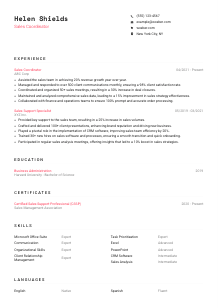
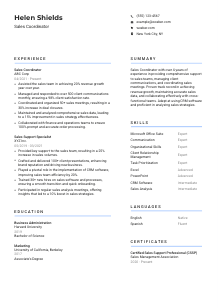
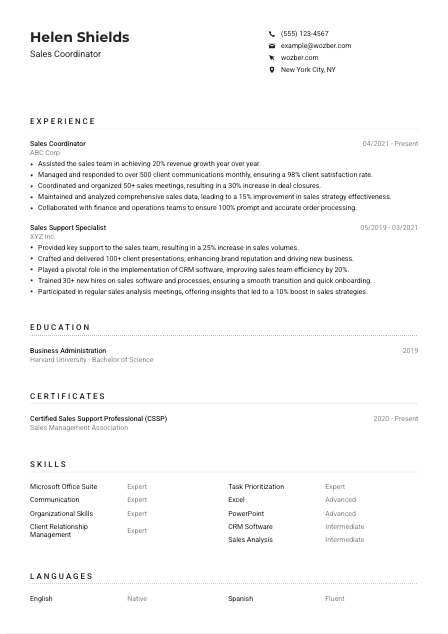
If the employer asks for someone based in New York City or willing to relocate, state that plainly in your header details. The sample resume handles this well by listing New York City, NY, which removes a common screening question right away.
Include a LinkedIn profile or professional website if it supports your candidacy with consistent job titles, results, or sales support experience. Skip personal links that do not strengthen your case for handling client communication, reporting, or coordination work.
Your contact block should answer the practical questions fast: who you are, how to reach you, and whether you meet basic access requirements for the role. That gives the hiring team a clean start before they review your sales support record.




For a Sales Coordinator, experience is less about broad claims and more about how you kept commercial work moving. Hiring managers want to see support tied to sales outcomes, whether that means cleaner reporting, faster follow-up, smoother order processing, stronger client communication, or better meeting preparation for the team.
Start by identifying the actual work named in the posting. Here, the emphasis is on supporting revenue targets, handling client communication, coordinating meetings and presentations, maintaining sales data, following up on leads, and working with internal teams on order processing. Use those responsibilities as a filter for which bullets deserve space.
List your jobs in reverse chronological order with title, company, and dates clearly shown. For each role, make your first few bullets the ones most relevant to sales coordination, especially responsibilities tied to CRM activity, reporting, client contact, meeting support, and cross-functional coordination.
Write bullets that explain how you supported the sales process, not just that you were "responsible for" it. Good examples include managing high volumes of client communication, preparing presentations for the team, tracking pipeline data in Excel or CRM systems, and coordinating with finance or operations to prevent order delays. In the sample resume, collaboration with finance and operations is especially useful because it shows direct support for accurate order processing.
Use numbers that belong to sales support work: revenue growth, client satisfaction, number of meetings coordinated, presentation volume, response volume, reporting accuracy, or efficiency gains from process changes. The sample's "20% revenue growth," "500 client communications monthly," and "30% increase in deal closures" work because they connect coordination work to commercial outcomes.
If a bullet does not help prove your value in a sales environment, remove it or rewrite it. Prioritize achievements that show organization, responsiveness, data handling, and coordination across teams. A hiring manager for this role should be able to picture you supporting account executives, updating reports, and keeping customer-facing activity on schedule.
By the end of this section, your experience should show that you do more than provide general admin support. It should be clear that you help sales teams move faster, communicate better, and operate with cleaner data.
Education is rarely the longest section on a Sales Coordinator resume, but it still matters when the posting asks for a bachelor's degree in business, marketing, or a related field. Present it cleanly so the employer can confirm your academic background without searching for it.
If the employer asks for a bachelor's degree, place your bachelor's entry first and make the field of study easy to spot. For this posting, Business Administration or Marketing lines up well because it connects naturally to sales operations, reporting, and customer-facing work.
Include degree, field of study, school, and graduation year in a consistent structure. Keep it simple so the section is easy to parse in an ATS-friendly resume template and quick to review by a recruiter.
When your major directly supports the role, do not bury it. The example resume does this effectively with a Bachelor of Science in Business Administration, which closely matches the stated requirement and reinforces commercial awareness.
Relevant coursework can be useful if you are early in your career or if it strengthens your connection to sales support work. Courses in marketing, business communication, data analysis, or customer relationship management can add context, but only include them if they sharpen the story.
Honors, leadership roles, or relevant student organizations can stay if they show organization, presentation work, or commercial interest. If you have several years of directly related experience, keep academic extras brief so your sales results remain the main focus.
This section only needs to do a few things well: confirm the degree requirement, support your professional direction, and stay easy to scan. Once that is clear, let your experience carry the heavier weight.
Certifications are not always required for Sales Coordinator jobs, but the right ones can strengthen your profile. They are most useful when they reinforce tools, processes, or communication skills that matter in day-to-day sales support work.
Some roles require a specific credential, while others simply value added training. This job description does not require certification, so include only those that support sales coordination, CRM use, reporting, client service, or process execution.
Choose certificates that connect to the actual responsibilities of the role. Training in sales support, customer relationship management, Excel, business communication, or order processing systems is more useful here than unrelated general credentials.
List the issue date and, if relevant, whether the certificate is current. That helps employers see whether your training reflects current tools and practices rather than something completed years ago and never revisited.
Sales operations change with new CRM workflows, reporting tools, and customer expectations. Ongoing training tells employers you keep your coordination skills current, especially if your recent experience also shows process improvement or systems adoption. The sample's CSSP entry works as a supporting credential because it reinforces the sales support theme without trying to carry the resume.
A certificate should add practical context, not filler. If it helps explain your command of sales workflows, client support, or reporting tools, it belongs here.
This section works best when it mirrors how Sales Coordinators actually support the team. Focus on the mix of tools and working habits that keep leads tracked, presentations prepared, communication organized, and sales reporting accurate.
Read the posting for both explicit and implied skills. Here, that includes Microsoft Office, especially Excel and PowerPoint, CRM familiarity, communication, organization, sales analysis, and coordination across internal teams. Those are the skills hiring teams expect to find quickly.
Use the same language the employer uses when it accurately reflects your background. That supports ATS optimization and makes your resume easier to rank and review. If you have CRM experience, say "CRM software" or name the platform if it is relevant and truthful. If you build reports, include Excel rather than leaving it hidden inside "Microsoft Office Suite."
Do not overload this section with every tool or trait you have ever used. Prioritize the skills that support sales operations and client-facing follow-through. The sample resume does this well by combining technical tools like Excel, PowerPoint, and CRM software with practical capabilities such as task prioritization, communication, and sales analysis.
Your skills list should make it easy to picture you handling the operational side of sales. If the section points clearly to reporting, communication, coordination, and tool proficiency, it is doing its job.
Language ability matters in Sales Coordinator roles because so much of the work depends on clear communication. Whether you are replying to clients, preparing internal updates, or supporting presentations, list languages in a way that reflects how confidently you can use them on the job.
If the posting requires English speaking and comprehension, include English with an accurate proficiency level. This is especially important in roles built around client communication, meeting coordination, and written follow-up.
Additional languages can be valuable when sales teams serve diverse customer bases or work across regions. They are not required for every Sales Coordinator role, but they can strengthen your profile when they support client interaction.
Use clear labels such as "Native," "Fluent," "Intermediate," or "Basic." Avoid vague descriptions. Hiring managers need to know whether you can handle business email, live calls, or only simple conversation.
If the company sells across multiple markets or supports multilingual clients, language skills can become a practical advantage. The sample's Spanish fluency adds range, but it works best as a bonus rather than a substitute for the required English communication strength.
Only list languages you can use at the level stated. In a sales support role, weak language claims can become obvious quickly when the work involves client emails, scheduling, and follow-up.
This section should tell the employer how you communicate in real business settings. Accurate language levels are especially important in a role built on timely responses and professional client contact.
Your summary should quickly explain what kind of Sales Coordinator you are and what results your support work has produced. This is where you connect your years of experience, core tools, and strongest sales-related outcomes in a short opening statement.
Read the posting and decide what matters most in the employer's version of sales coordination. In this case, the thread is support that helps the team hit revenue targets through communication, reporting, meeting coordination, lead follow-up, and accurate order flow.
Start with a direct line that names your role identity and level of experience. For example, a summary can begin by stating that you are a Sales Coordinator with 4+ years of experience supporting sales teams, managing client communications, and maintaining sales data.
Bring in specifics that reflect the posting. That might include revenue support, high client response volume, CRM adoption, presentation preparation, or cross-functional coordination. The sample summary works because it combines broad role coverage with concrete outcomes like revenue growth and effective collaboration.
Aim for three to five lines. Every phrase should help the reader understand your sales support scope, business impact, and tool familiarity. If a detail is better proven in the experience section, leave it there and keep the summary focused.
A hiring manager should reach the end of your summary already knowing that you can support a sales team with organized execution, strong communication, and reliable reporting. That gives the rest of the resume a clear direction.
A Sales Coordinator resume should make one thing easy to see: you help revenue teams stay organized, responsive, and accurate. When your sections consistently point to client communication, sales reporting, CRM familiarity, presentation support, and cross-functional coordination, the role fit becomes much easier to judge.
Use Wozber to tighten that alignment from top to bottom. Wozber's AI resume builder, ATS resume scanner, and ATS-friendly resume templates can help you match the posting's language, surface missing requirements, and present your experience in an ATS-friendly resume format that keeps your sales support value clear. Then apply with a resume that shows how you keep the commercial engine running.




