



Use Wozber and land your dream job
Create Resume
No registration required
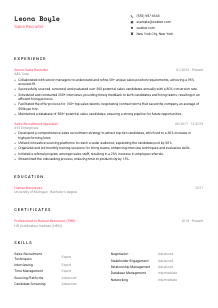
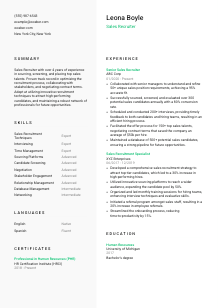
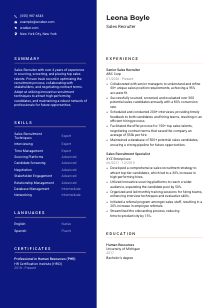
Pitching top talent, but your resume isn't closing deals? Set the tone with this Sales Recruiter resume example, created with Wozber free resume builder. Learn how to adjust your recruitment flair to match job demands, landing your career journey where quotas meet qualifications!
Sales recruiting is judged in numbers long before anyone asks about your process. Hiring teams want to see that you can fill revenue-facing roles with the right mix of pace, judgment, and candidate quality, whether that means stronger interview-to-offer conversion, sharper intake with sales leaders, or a healthier pipeline for future openings. Your resume should make that recruiting performance visible.
When that detail is missing, sales recruiting experience can blur into general talent acquisition. A tailored resume, built in Wozber's free resume builder with an ATS-friendly resume format, helps surface the parts that matter first: sales hiring volume, sourcing reach, stakeholder partnership, and offer-stage wins. That gives hiring teams a faster read on whether you can run a sales desk effectively.
For a Sales Recruiter, the header needs to do one simple job well: confirm who you are, what role you are targeting, and whether basic requirements are covered without making the reader hunt for them. Keep it clean, professional, and aligned with the posting.
Use your full name as the most prominent text in the header. Sales recruiting is a relationship-driven field, so your resume should feel polished and easy to reference from the first line. A readable font and slightly larger size are enough.
Place "Sales Recruiter" under your name when that is the role you are applying for. This helps the resume line up with the job title in ATS searches and tells the reader immediately that your background is framed around sales hiring rather than broad recruiting or HR support.
Add a current phone number and a professional email address, then check them carefully. Recruiters are expected to manage candidate communication cleanly, so small mistakes here can undercut the operational reliability the role requires.
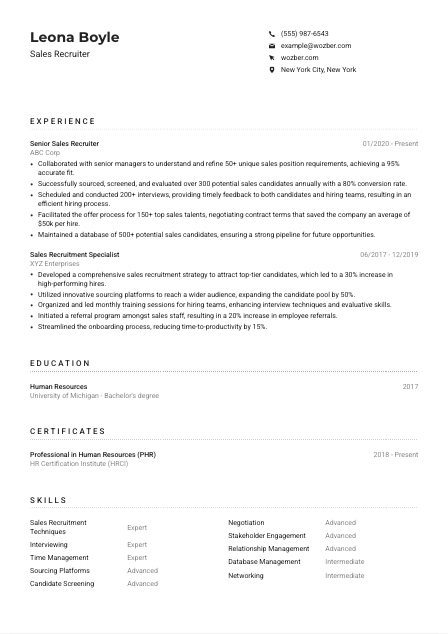
Some openings include a location requirement, as this one does for New York City, New York. Listing the city and state in your header removes uncertainty right away. Use this only when it reflects your actual situation and the employer has made location relevant.
If you have a LinkedIn profile or personal website that reinforces your recruiting work, include it. For a Sales Recruiter, that can support your resume with a fuller career timeline, recommendations, or a clearer view of your network and industry presence.
This section does not need personality flourishes. It should confirm that you are reachable, professionally presented, and aligned with the target role before the hiring team moves into your recruiting track record.




This is the section most likely to decide whether your resume moves forward. For a Sales Recruiter, experience should show how you partner with hiring managers, build pipelines, screen sales talent, manage interview flow, and close hires without losing speed or quality.
Read the posting closely and mark the recurring recruiting actions it emphasizes. Here, that includes collaborating with hiring managers, sourcing and screening sales candidates, running interview coordination, supporting offers, and maintaining a future pipeline. Those are the actions your bullets should reflect, using your own results and scope.
List positions in reverse chronological order and make sure titles, employers, and dates are easy to scan. If you have direct sales recruiting experience, keep that front and center. Roles focused on quota-carrying talent, account executive hiring, SDR recruiting, or sales pipeline building should outweigh less related recruiting work.
A hiring team already knows that recruiters source candidates and schedule interviews. What matters is how well you did it. Compare a generic line like "managed interviews" with a stronger result such as the example's "conducted 200+ interviews" and kept feedback moving efficiently. Show what changed because you owned the process.
Numbers are native to sales recruiting, so use them. Hiring volume, fill rates, conversion rates, offer acceptance, time-to-fill, referral growth, pipeline size, or cost savings all help. The sample resume does this well with figures like 300+ candidates sourced annually, 150+ offers handled, and average savings per hire.
Keep bullets tied to candidate generation, evaluation quality, stakeholder management, negotiation, onboarding, or process improvement. If an accomplishment does not help prove you can recruit for sales teams, trim it. Focus beats breadth in this section.
A Sales Recruiter resume earns attention when the experience section shows pace, volume, and hiring judgment in concrete terms. If your bullets make it easy to see the roles you filled, the scale you handled, and the results you drove, this section is doing its job.
Education is rarely the deciding factor in sales recruiting, but it still matters when the posting names a degree requirement. Present it clearly so the reader can confirm the credential and move back to your hiring results.
If the posting asks for a bachelor's degree in Human Resources, Business, or a related field, make sure your degree is listed in those terms where accurate. The example resume does this directly with a Bachelor's degree in Human Resources, which lines up neatly with the requirement.
List your degree, field of study, school, and graduation year or date in a consistent format. This section should be easy to verify at a glance, especially when hiring teams are reviewing multiple recruiter resumes in one sitting.
Degrees in Human Resources, Business, Psychology, or related areas can support your candidacy because they connect to hiring, organizational behavior, and communication. You do not need to over-explain the degree if the title already makes that relevance clear.
Most experienced Sales Recruiters can keep this section brief. If you are earlier in your career, selected coursework in talent acquisition, HR management, business communication, or sales operations can help bridge limited experience.
Academic honors, leadership roles, or student activities belong here only when they add something credible to your recruiting profile. Keep them concise and relevant rather than turning the section into a full campus history.
Hiring teams usually spend more time on placements, sourcing depth, and stakeholder work than on education details. Give them the degree information they asked for, present it cleanly, and let your recruiting record carry the application.
Certifications are not mandatory for every Sales Recruiter role, but they can strengthen your profile when they reinforce hiring expertise, HR knowledge, or process discipline. List them selectively and make the connection obvious.
Review the posting first, then choose certifications that support the work involved. This job description does not require one, but a credential such as PHR, shown in the example resume, still adds relevant depth because it connects to hiring practices and people operations.
Only include certifications that support sales recruiting, talent acquisition, interviewing, HR compliance, or workforce planning. A short, relevant list is stronger than a long list of unrelated learning badges.
Include the year earned and, if relevant, the active period. This is especially useful for credentials that require renewal because it shows your knowledge is current rather than dated.
Sales hiring changes with labor market conditions, sourcing tools, and interview practices. Updating certifications or adding credible training in recruiting analytics, sourcing strategy, or employment law can show that your approach stays current as the market shifts.
Certificates should reinforce your professional profile, not try to replace experience. When they are relevant and current, they add another layer of confidence around your recruiting judgment and commitment to the field.
A Sales Recruiter skills section should read like the toolkit behind your results. That means a mix of sourcing ability, interview judgment, candidate management, and stakeholder communication, presented in language that matches the role you want.
Look for both explicit and implied skill requirements. In this job description, the obvious ones include sourcing platforms, sales recruitment techniques, interpersonal communication, written communication, screening, interviewing, and networking. Build your list from skills you genuinely use in those areas.
Put the most relevant recruiting capabilities first. For this profession, that usually means sales recruiting, candidate sourcing, screening, interviewing, negotiation, stakeholder engagement, and pipeline management before broader soft skills. The sample resume gets this balance right by leading with core recruiting capabilities.
Avoid turning the section into a keyword dump. Group your strongest, most job-relevant abilities and leave out skills that do not add much hiring value. A concise list makes it easier for both ATS systems and human reviewers to pick up the expertise that matters.
The best skills sections mirror the actual flow of the job, from sourcing and screening through offer negotiation and relationship management. If the list sounds like how you really run a sales search, it will support the rest of the resume well.
Language ability matters in recruiting when it affects communication quality, candidate experience, or market reach. Present languages clearly, especially when the posting names a required level of English.
If the job calls for strong English language skills, list English prominently with an honest proficiency level such as Native or Fluent. That requirement appears directly in this posting, so your resume should answer it plainly.
Start with the language the employer asked for, then add any others that could expand your reach with candidates or internal stakeholders. This keeps the section aligned with the role before highlighting added value.
Extra languages can be useful in markets with diverse talent pools or multilingual sales teams. In the example, Spanish is a practical addition because it suggests broader candidate communication range, though it is an advantage rather than a universal requirement.
Use standard labels such as Native, Fluent, Intermediate, or Basic. Recruiters are expected to communicate clearly and set accurate expectations, so this section should reflect that same precision.
Only include languages you can use meaningfully in conversation, interviewing, or relationship building. If a language helps you source more effectively or engage candidates with less friction, it belongs here.
For a Sales Recruiter, language skills matter when they improve communication and widen access to talent. Keep the section honest and relevant, and it becomes a useful extension of your recruiting toolkit.
The summary sits at the top of the resume, so it should quickly establish your level, focus, and recruiting results. For a Sales Recruiter, that means naming your experience in sales hiring and giving the reader a reason to trust your search execution within a few lines.
Start with the posting, then identify the work you need to echo in your own words. Here, the strongest themes are sourcing, screening, placing sales talent, partnering with hiring managers, and managing the process through offer and onboarding. Those themes should shape your opening lines.
Open with your title and years of experience so the reader immediately understands your level. The example summary does this well with "Sales Recruiter with over 4 years of experience," then moves directly into core recruiting work rather than generic traits.
Use the next sentence to point to your value, such as strong placement results, recruiting process improvement, sourcing depth, or success hiring high-performing sales talent. Keep the claims rooted in the same type of outcomes you prove later in the experience section.
Aim for a compact paragraph, usually three to five lines. You want enough detail to establish your recruiting lane and strengths, without repeating every keyword or rewriting your entire work history at the top.
A clear summary helps the hiring team place you quickly: sales recruiter, proven in candidate generation and selection, able to support hiring managers through to close. If that message is obvious in the first few lines, the rest of the resume has a strong foundation.
A Sales Recruiter resume should make one thing easy to judge: can you find, assess, and close the kind of sales talent that drives revenue? When each section supports that answer with the right mix of metrics, recruiting workflow, and role-specific language, your application reads with much more credibility.
Wozber's free resume builder and ATS resume scanner can help you align that experience with the job description, strengthen ATS optimization, and present it in an ATS-compliant resume format that stays easy to review. The finished resume should make your hiring range, pace, and placement track record clear from the first scan.




