




Use Wozber and land your dream job
Create Resume
No registration required
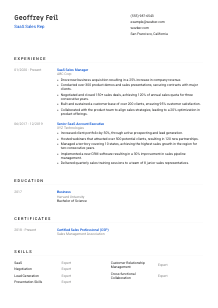
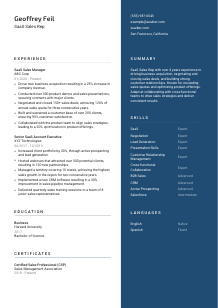
Pitching cloud software, but your resume seems foggy? Check out this SaaS Sales Rep resume example, made with Wozber free resume builder. Learn how to cast your subscription-selling skills in sync with job demands, illuminating your career path like a white-hot server!
SaaS sales resumes are strongest when they show how you move revenue, not just how busy your calendar was. Hiring teams want to see prospecting discipline, demo effectiveness, deal execution, and the ability to keep customer relationships healthy after the signature. If your resume reads like a general sales profile, it will miss the commercial reality of a quota-carrying SaaS role.
The first screen often comes down to whether your background clearly maps to pipeline generation, product-led selling, CRM use, and closed-won results. Wozber's free resume builder helps you line up that language in an ATS-friendly resume format, so your experience is read as relevant SaaS selling work rather than generic account support or broad business development.
This section should make the basics effortless to confirm. For a SaaS Sales Rep, that means clear contact details, the target title, and any location requirement the employer has stated.
Use your full name as the most visible line on the page. Keep the formatting simple and professional so the reader can move quickly to your sales background, quota history, and customer-facing experience without distraction.
Place "SaaS Sales Rep" directly under your name if that is the role you are pursuing. Matching the posted title helps frame the rest of the resume around prospecting, demos, negotiations, and closing work from the start, and it supports ATS alignment as well.
Include a reliable phone number and a professional email address. In sales hiring, speed matters. If a recruiter or sales leader wants to move from resume review to screening call, broken contact details create needless friction.
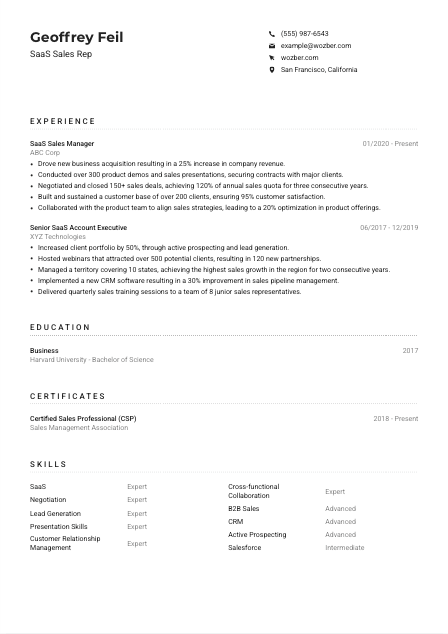
If the posting requires a specific location, show it clearly in your personal details. Here, listing San Francisco, California directly supports the stated requirement. For other roles, only include location when it helps confirm territory coverage, local eligibility, or in-market presence.
A LinkedIn profile or personal site can strengthen this section when it reinforces your sales story. Use it to support what the resume already claims, such as consistent quota attainment, industry focus, or account growth, and make sure the content is current and consistent with your resume.
When this section is accurate and aligned to the posting, the reader can focus on the part that matters most in SaaS sales hiring: your ability to generate pipeline, run effective sales conversations, and close business.




For SaaS sales roles, experience is where credibility is won or lost. Hiring managers are looking for proof that you can prospect, run demos, manage a pipeline, negotiate terms, and hit numbers in a B2B environment.
Pull out the operating priorities in the job description before rewriting your bullets. In this case, the employer emphasizes new business acquisition, lead generation, product demos, negotiations, customer relationships, and cross-functional collaboration. Your experience section should mirror those motions in plain language that matches how SaaS sales teams actually work.
List your most recent and most relevant positions first, especially roles with quota ownership, B2B selling, or SaaS account growth. Titles do not need to match perfectly, but the work should clearly connect to pipeline creation, solution selling, and revenue performance. A title like "SaaS Sales Manager" or "Senior SaaS Account Executive" already points the reader in the right direction when the bullets back it up.
Each bullet should show what you sold, how you sold it, and what happened. Good SaaS sales bullets often cover prospecting volume, demos delivered, deals closed, territory growth, retention, or expansion. The example resume does this well with specifics like conducting 300+ demos and securing contracts, which gives the reader a real picture of selling activity and conversion work.
Quota attainment, revenue growth, closed deals, client count, conversion results, and satisfaction scores all carry weight here. "Achieved 120% of annual sales quota for three consecutive years" says far more than "exceeded expectations." The same applies to metrics like a 25% revenue increase or a 50% client portfolio increase. In SaaS sales, numbers translate effort into business results.
Keep the section focused on work that strengthens your case for this kind of selling environment. General admin tasks, loosely related customer support work, or internal duties with no sales outcome can dilute the message. Prioritize bullets that show pipeline ownership, presentation skill, CRM-driven process, negotiation range, and cross-functional work with product or customer success teams.
A strong experience section should let a sales leader quickly trace how you build pipeline, move opportunities forward, and deliver closed revenue. Wozber's ATS resume scanner can help you check whether those core responsibilities are clearly reflected in the language of your resume.
Education rarely carries a SaaS sales resume, but it can remove questions fast when the employer has listed a degree requirement. Keep it straightforward and relevant.
If the posting asks for a bachelor's degree in Business, Sales, or a related field, present that information clearly and without extra wording. In this example, a Bachelor of Science in Business lines up neatly with the requirement. When your degree is in a related area, let the title stand on its own unless context is needed.
List the degree, school, field of study, and graduation year. That is usually enough for an experienced SaaS sales professional. Dense descriptions are rarely necessary unless you are early in your career or the employer places unusual weight on academic background.
When a job posting names preferred disciplines, do not bury your major. Business, Sales, Marketing, Economics, or another related field can help reinforce commercial training, especially for roles that combine solution selling with business acumen.
Most mid-career sales resumes do not need course lists. Include them only if they sharpen your profile, such as sales management, marketing analytics, negotiation, or business communication coursework that supports your transition into SaaS or B2B selling.
Academic projects, sales competitions, business clubs, or leadership roles can be useful if they connect to presentation skill, persuasion, or commercial thinking. For experienced candidates, keep these brief so they do not crowd out quota performance and client results.
This section should quickly confirm that you meet the posted baseline and then get out of the way. For most SaaS sales roles, the heavier proof sits in your revenue history, customer-facing work, and deal results.
Certifications can help when they reinforce your sales method, industry knowledge, or ongoing professional development. They matter most when they strengthen a profile that already shows real quota-carrying results.
Many SaaS sales roles do not require certification, so treat this section as support rather than filler. If the employer names one, place it prominently. If not, include certifications that still sharpen your case, such as recognized sales training, CRM credentials, or product-led selling programs.
Choose credentials that relate to prospecting, negotiation, account management, SaaS selling, or CRM usage. A certification like Certified Sales Professional can support the profile because it complements the core requirements around presentation, negotiation, and closing.
Include the issue date and, if relevant, the current validity period. In fast-moving sales environments, recent training in sales methodology, CRM platforms, or customer engagement tools can signal that your approach is current and practical.
A short list of relevant certifications usually reads better than a long inventory. Focus on credentials that support the kind of work the resume already shows, especially B2B sales execution, SaaS product selling, and pipeline management.
Certifications should reinforce your ability to prospect, present, negotiate, and manage customer relationships. Wozber's free resume builder can help you place them cleanly in an ATS-compliant resume without letting them crowd out stronger proof from your experience.
The skills section should read like the toolkit of someone who can win business in a SaaS environment. Keep it anchored to how the role is performed, tracked, and measured.
Start with the terms the employer already uses. Here, that includes active prospecting, lead generation, product demos, presentation, negotiation, closing, customer relationship management, and CRM familiarity, with Salesforce named as a preference. Those are the skills most worth surfacing if they reflect your actual background.
SaaS sales hiring usually looks for both process fluency and front-line execution. Include CRM tools, pipeline management, and territory or account planning alongside core sales abilities like discovery, objection handling, demo delivery, negotiation, and closing. The example list works because it combines SaaS, lead generation, CRM, Salesforce, and presentation skill rather than leaning on vague traits alone.
A focused list is more useful than a long one. Keep the skills that map directly to quota-carrying SaaS work and remove items that do not influence how you sell, forecast, manage accounts, or collaborate with product and customer teams. That keeps the section relevant for both ATS screening and human review.
When this section is tailored well, it reinforces the experience section instead of repeating it. Wozber's ATS optimization tools can help you align your skills with the exact language used in the posting while keeping the wording natural and accurate.
Language skills matter in sales when they affect demos, negotiation, account coverage, or relationship-building. Present them clearly and in the order most relevant to the role.
If English is listed as a core requirement, make it explicit. SaaS sales depends on precise communication across discovery calls, presentations, proposals, follow-ups, and contract discussions, so this is more than a basic checkbox.
Use clear labels such as Native, Fluent, Advanced, or Conversational. In the example, listing English as Native immediately supports the communication demands of product demos and client-facing sales conversations.
Additional languages can be valuable when selling into multilingual markets, supporting regional growth, or building rapport with a wider customer base. Spanish, for instance, may be useful in some territories even when it is not required.
Do not overstate proficiency. A hiring team may test language ability in live conversation, especially if the role includes demos, negotiations, or relationship management across different client groups.
If languages are not a major factor in the role, keep this section short. If they are tied to territory, market expansion, or customer coverage, place them in a way that supports your broader commercial profile.
For SaaS sales, language ability matters when it improves communication with prospects and customers. Keep the section honest, concise, and aligned to the markets or accounts you are equipped to handle.
Your summary should give a sales leader a fast read on your commercial value. Focus on scope, results, and the kind of selling work you already know how to handle.
Start with a direct line that places you in the market clearly, such as SaaS Sales Rep or B2B SaaS seller with 4+ years of experience. That immediately frames the rest of the summary around software sales, pipeline ownership, and customer-facing revenue work.
Mention the parts of the sales cycle that matter most for the target role. For this posting, that includes business acquisition, demos, negotiation, closing, and relationship management. The example summary works because it names those activities directly instead of relying on broad claims about being results-driven.
Use concise achievements that signal scale or consistency, such as exceeding quota, growing revenue, or optimizing product positioning with cross-functional teams. You only need enough detail to establish credibility and lead the reader into the experience section.
Aim for a summary that sounds like someone who sells complex products in a structured process. Cut soft filler and keep the emphasis on pipeline generation, closing ability, CRM-backed sales execution, and customer outcomes. Four lines is usually enough.
A well-written summary should quickly tell the reader whether you belong in a SaaS sales pipeline. With Wozber, you can shape this section into an ATS-friendly introduction that highlights the kind of revenue, customer, and closing experience the role calls for.
A SaaS Sales Rep resume should show how you prospect, present, negotiate, close, and maintain customer trust after the deal. When those pieces are specific and measurable, hiring teams can quickly place you in the right part of the funnel.
Use Wozber's free resume builder to tighten your language, organize your experience in an ATS-friendly resume template, and check alignment with the posting through its ATS resume scanner. The finished resume should make one thing easy to judge: whether you can carry pipeline and convert it into revenue.




