



Use Wozber and land your dream job
Create Resume
No registration required
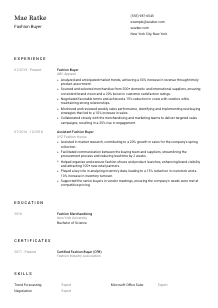
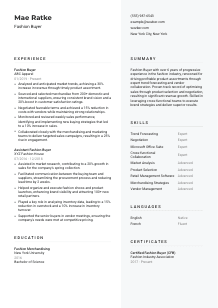
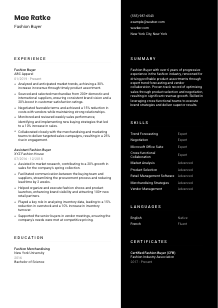
Curating catwalk looks, but your resume doesn't get the front row? Check out this Fashion Buyer resume example, created with Wozber free resume builder. Learn how to blend your trend-savvy selections with job needs, dressing up your profile to always be in vogue with career opportunities!
Fashion buying sits at the intersection of taste and commercial judgment. Hiring teams want to see whether you can turn trend awareness into a product mix that sells, protects margin, and stays true to the brand. Your resume needs to make that commercial lens visible, not just your love of fashion.
When buying experience is described in the same language as the role, it becomes much easier to separate assortment strategy from general merchandising support. Wozber's free resume builder helps you shape that language into an ATS-compliant resume, so trend forecasting, vendor negotiation, inventory decisions, and cross-functional execution are easier to recognize at a glance.
Fashion hiring still starts with practical basics. For a buyer, that means clear identity, easy contact, and any location detail that removes friction for an in-office or market-based role. Keep this section clean and businesslike.
Use your full name in a slightly larger font than the rest of the header so it is easy to spot on the page. Fashion buying is a relationship-driven function involving vendors, merchandisers, and internal stakeholders, so your resume should identify you clearly from the first line.
Place "Fashion Buyer" directly under your name when that is the role you are pursuing. This helps recruiters and ATS filters connect your background to the opening immediately, especially when they are sorting candidates across buying, merchandising, and planning tracks.
Include your phone number, professional email address, and, if relevant, a portfolio or LinkedIn link. Accuracy matters here. If a hiring manager wants to discuss a vendor network, category experience, or buying calendar ownership, they should not have to hunt for a way to reach you.
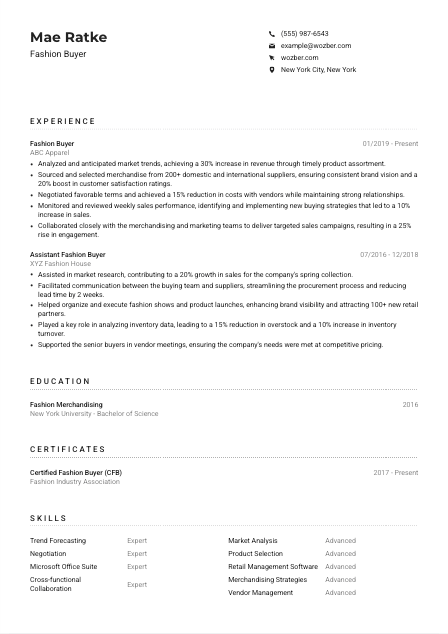
Some fashion roles are tied to a specific market because of showroom visits, vendor meetings, or office collaboration. In the example, listing "New York City, New York" directly addresses the stated location requirement and removes a basic screening question before it comes up.
A polished LinkedIn profile or professional website can support your resume when it reinforces your buying background, brand categories, or industry network. Keep it aligned with the resume. If your online profile says luxury accessories while your resume targets contemporary apparel buying, that mismatch will distract from your application.
Your header should answer the practical questions fast: who you are, what role you do, how to contact you, and whether you meet any location requirement. Then the reader can move straight to your buying experience.




This is the section that carries the most weight for a Fashion Buyer. Employers are looking for proof that you can read demand, build assortments, negotiate terms, and react to sales and inventory data with sound decisions.
Start by marking the responsibilities and requirements that define the role. For this job, the core themes are trend forecasting, market analysis, product selection, vendor negotiation, inventory review, and collaboration with merchandising, marketing, and operations. Those themes should shape which bullets you keep and how you phrase them.
List your most recent role first, then work backward with job title, employer, and dates. In buying, progression matters. A recruiter should be able to see whether you moved from supporting category decisions to owning assortments, supplier relationships, pricing discussions, or weekly sales reviews.
Each bullet should show a commercial action and the result. Instead of describing general responsibilities, show what you selected, analyzed, negotiated, or adjusted. The example does this well with points such as increasing revenue through timely assortments and reducing costs through vendor negotiations. That tells a hiring manager how your judgment affected the business.
Numbers matter when they reflect buying performance. Revenue lift, sell-through improvement, cost reduction, inventory turnover, customer satisfaction, markdown reduction, supplier count, and lead-time improvements are all relevant measures. A line like "sourced merchandise from 200+ suppliers" is stronger because it shows scale, while "15% reduction in costs" shows negotiation impact.
Keep experience that reinforces assortment planning, trend interpretation, vendor management, pricing, margin awareness, or promotional coordination. If an older bullet is mostly administrative and does not show buying contribution, trim it or rewrite it. Every line should help position you as someone who can own profitable product decisions.
By the end of this section, a recruiter should understand your category judgment, your commercial results, and the scale at which you operated. That is what turns buying experience into a credible shortlist.
Education is usually not the deciding factor for an experienced Fashion Buyer, but it still matters because many postings use it as a baseline requirement. Present it clearly and only add extra detail when it strengthens your positioning.
This posting asks for a bachelor's degree in Fashion Merchandising, Business, or a related field. Make sure your degree is easy to find and written in full so the connection is immediate for both recruiters and ATS filters.
Include degree, field of study, school name, and graduation year. Clean formatting helps here. A buyer's resume already carries a lot of commercial detail in the experience section, so the education section should be quick to scan.
If your degree directly aligns with the role, let that relevance work for you. The example lists a Bachelor of Science in Fashion Merchandising, which matches the requirement closely and supports the candidate's career path without needing extra explanation.
Relevant coursework can help if you are earlier in your career or your experience is still developing. Subjects like merchandising, retail math, consumer behavior, sourcing, or fashion marketing can reinforce your foundation in assortment and market analysis. If you already have 5+ years of buying experience, this detail is usually optional.
Honors, scholarships, or leadership in fashion-related student organizations can be useful when they show early commercial interest or industry involvement. Keep them if they add context. Leave them out if they distract from a stronger professional record.
This section should confirm that you meet the educational baseline and, when relevant, show an early foundation in merchandising or retail business. It does not need to compete with your experience section.
Certifications are not required for every Fashion Buyer role, but the right one can strengthen your profile, especially when it points to deeper knowledge in buying, sourcing, or retail operations.
This job does not list a certification requirement, so certificates are a supporting element rather than a gatekeeper. That means you should include them only if they add something relevant to buying, negotiation, supplier management, or market knowledge.
Prioritize credentials that connect directly to the job. A certification like "Certified Fashion Buyer (CFB)" fits because it reinforces professional focus in the same function you are targeting. Avoid unrelated courses that do not support assortment strategy or retail decision-making.
Include issue dates and renewal periods when a certification is current or ongoing. That gives the credential more credibility and shows that your knowledge is maintained rather than dated.
Fashion buying changes with consumer behavior, sourcing conditions, and retail tools. If you have pursued additional training in analytics, inventory planning, retail systems, or sustainable sourcing, those can strengthen your profile when they are directly relevant to the roles you want next.
A focused certificate section can add depth to your buying profile. Keep it tight, relevant, and clearly connected to the commercial side of the job.
A Fashion Buyer skills section should read like the toolset behind profitable assortment decisions. Focus on the capabilities that show how you analyze demand, choose product, manage vendors, and work across commercial teams.
Start with the terms the employer already values. Here, that includes trend forecasting, market analysis, product selection, negotiation, retail management software, Microsoft Office, and fluent English communication. These are the skills most likely to matter in ATS matching and first-pass review.
Do not add a skill just because it appears in the posting. Include it when your experience supports it. In the example, negotiation, trend forecasting, vendor management, and merchandising strategies all fit because the experience section shows cost reductions, assortment gains, supplier sourcing, and sales improvements.
Group your strongest and most relevant skills rather than creating a long keyword dump. A balanced list for a buyer often combines analytical skills, commercial judgment, supplier-facing skills, and operational tools. That mix helps distinguish a true buyer from someone whose background is limited to coordination or showroom support.
The best skill list makes your commercial range clear fast: trend insight, assortment judgment, vendor negotiation, retail systems fluency, and collaboration with the teams that move product.
Many fashion buying roles involve international vendors, cross-border sourcing, or market research across regions. Language skills are useful when they support that work, but they should still be presented with the same precision as any other qualification.
This posting specifically asks for fluent and articulate English communication. Make sure English appears clearly in your languages section if you choose to include one, especially when communication with suppliers, internal teams, and senior stakeholders is central to the job.
Additional languages can be a genuine advantage when you work with international suppliers or global brands. In the example, fluent French adds useful context because it may support sourcing conversations or broader market exposure. Include extra languages when they are relevant, not just decorative.
Terms like "Native," "Fluent," "Intermediate," and "Basic" are enough. Keep the ratings honest. If a language is listed at a high level, employers may assume you can use it in negotiations, supplier calls, or trade-show conversations.
For most Fashion Buyer resumes, languages are a supporting detail rather than a headline qualification. They matter most when the role involves international sourcing, overseas vendor communication, or multilingual customer markets.
If your language skills help you manage suppliers, read markets, or communicate across regions, they strengthen the resume. If not, keep the focus on buying performance.
Your summary should quickly establish what kind of Fashion Buyer you are and what business results you typically drive. In a few lines, connect your years of experience to the categories of work that matter most: assortment planning, supplier negotiations, market reading, and sales performance.
Build the summary around the hiring themes in the posting. For this role, that means profitable assortments, trend forecasting, market analysis, sourcing, negotiation, and collaboration with merchandising and marketing. Choose two or three of those that best match your strongest record.
Lead with a direct description of your background, such as years of experience in fashion buying and the kind of product or retail environment you know best. That immediately tells the reader whether you are operating at the right level for a role asking for at least 5 years of industry experience.
Include one or two outcomes that show the scale or quality of your work. The example summary does this effectively by tying buying expertise to revenue growth and stronger product selection. A short mention of margin improvement, sales growth, cost savings, or inventory optimization can do a lot of work here.
Aim for a short paragraph that sounds grounded in actual buying work. Avoid broad adjectives like "passionate" or "dynamic" unless they are backed by something concrete. Specific phrases such as "driving profitable assortments," "negotiating vendor terms," or "using market analysis to guide product selection" say much more in less space.
A well-written summary gives immediate context for the rest of the resume. It should tell the reader that you understand both fashion and the numbers behind the buy.
A Fashion Buyer resume works when it shows commercial taste backed by measurable results. Your experience should make it easy to see how you read trends, chose product, negotiated with vendors, and adjusted strategy based on sales and inventory movement.
Use Wozber's free resume builder to organize that story in an ATS-friendly resume format, then refine it with the ATS resume scanner so the language reflects the role you want. The finished resume should make one thing clear quickly: you can make buying decisions that support both brand vision and profitable sell-through.




