



Use Wozber and land your dream job
Create Resume
No registration required
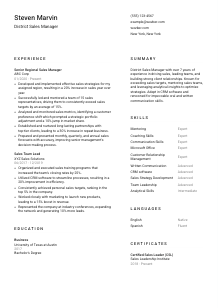
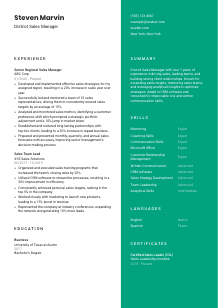
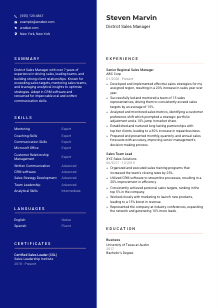
Leading sales teams, but feeling like your resume isn't in its territory? Check out this District Sales Manager resume example, created with Wozber free resume builder. Learn how to highlight your sales leadership skills to match company districts, making your career path as expansive as your sales territories!
District Sales Manager resumes are strongest when they show how you turn territory goals into a repeatable sales plan. Hiring teams want to see leadership that travels beyond personal quota attainment, including coaching reps, reading market demand, adjusting account strategy, and reporting performance in a way senior management can use.
When the resume mirrors how the employer talks about district planning, team coaching, CRM use, and forecasting, it is easier to surface in ATS screening and easier to read as a management hire rather than an individual contributor. Wozber's free resume builder helps you align that language in an ATS-friendly resume format so your application quickly shows district-level ownership, not just sales activity.
For a District Sales Manager, the header should do one practical job well. It should confirm who you are, how to reach you, and whether you meet any location or market requirement that could affect territory ownership, travel expectations, or start timing.
Use your full name in a clean, readable font that stands out from the rest of the page. Sales leadership roles involve external presence and internal credibility, so your header should feel polished and direct rather than overly styled.
Place "District Sales Manager" directly under your name when that is the role you are pursuing. This immediately frames your background around district-level leadership, sales strategy, and team management instead of leaving the reader to infer your level.
Include your phone number and a professional email address you check regularly. If you add a LinkedIn profile or website, make sure it reflects the same leadership scope, sales results, and career dates shown on the resume.
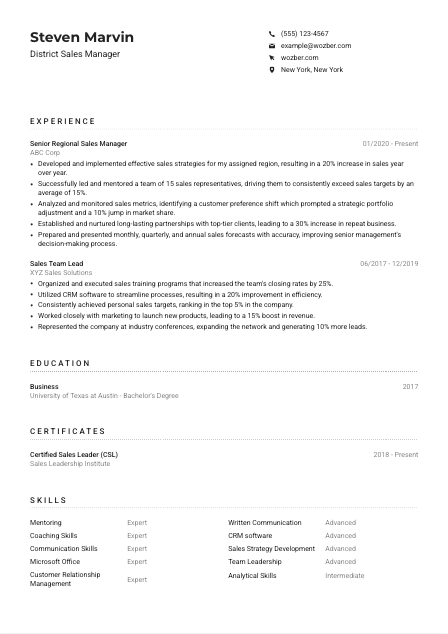
If the posting requires a candidate to be based in a specific market, include your city and state in the header. In the example, listing "New York, New York" directly answers a stated requirement and removes questions about relocation for a district-based sales role.
A LinkedIn page, portfolio site, or professional bio can strengthen your application if it supports your sales leadership story. Keep those profiles current with team size, territory scope, revenue growth, CRM experience, and customer relationship wins so they reinforce the resume instead of creating gaps.
Your personal details should remove friction, not add it. If the header quickly confirms your role focus, contact path, and any market requirement, the reader can move straight to your sales leadership record.




This section carries the most weight for a District Sales Manager. Employers are looking for signs that you can set strategy across a territory, coach a team against quota, manage customer relationships at scale, and use sales data to improve performance over time.
Start with the responsibilities and requirements that define the role. Here, that means district sales strategy, coaching and mentoring representatives, analyzing sales metrics, managing customer relationships, and preparing monthly, quarterly, and annual forecasts. Build bullets that map to those functions using language you can honestly support from your own work.
List roles in reverse chronological order and make the rise in responsibility easy to follow. Hiring teams want to see how you moved from selling to leading, whether that meant taking on rep coaching, owning a territory, managing key accounts, or presenting performance reports to senior leadership.
Numbers matter in sales leadership because they show whether your decisions changed performance. Include metrics tied to sales growth, quota attainment, repeat business, closing rates, market share, forecast accuracy, team size, or process efficiency. The sample resume does this well with results like 20% year-over-year sales growth, a team of 15 representatives exceeding targets by 15%, and a 10% jump in market share after responding to customer preference shifts.
Prioritize bullet points that show leadership over a book of business, a team, or a region. Personal sales awards can still help, especially if they establish credibility, but they should not crowd out proof of coaching, strategic planning, inventory awareness, account retention, and reporting cadence.
Each bullet should show what you led, what you changed, and what happened as a result. For this profession, that often means linking a sales strategy, training initiative, CRM improvement, or client partnership effort to measurable gains in revenue, retention, productivity, or forecasting quality.
A District Sales Manager resume should make it easy to see scale, leadership, and business results. If your bullets show how you guided teams, shaped territory strategy, and reported performance with discipline, the experience section will do its job.
Education matters here because many employers use it as a baseline qualification before they look deeper at your sales record. Keep this section straightforward, and make sure it clearly supports the business, sales, or related-field requirement in the posting.
If the job asks for a bachelor's degree in Business, Sales, or a related field, list that qualification clearly. In the example, a Bachelor's Degree in Business aligns directly with the requirement and needs no extra explanation.
Include the degree, field of study, school name, and graduation year or date. This section is usually reviewed quickly, so clarity matters more than elaborate formatting.
When your degree supports the role directly, make that visible through the field of study. Business, sales, marketing, management, or similar disciplines can reinforce your foundation in forecasting, customer strategy, and commercial decision-making.
If you are earlier in your career, selected coursework in sales management, market analysis, business communication, or finance can help show relevant preparation. For experienced sales leaders, that space is usually better used for results in the experience section unless the academic detail is unusually relevant.
Professional development can support this section if it deepens your sales leadership profile. Training in sales operations, negotiation, forecasting, CRM adoption, or leadership development is especially useful when it connects to how you run a district or coach a team.
This section does not need much space, but it should answer the degree requirement cleanly. Once that is in place, your experience and certifications can carry the heavier proof of sales leadership.
Certifications are not always required for District Sales Manager roles, but the right ones can sharpen your positioning. They work best when they reinforce how you lead sales teams, improve execution, or manage customer and revenue performance.
Lead with certifications that support coaching, account growth, forecasting, negotiation, or sales management. A credential such as "Certified Sales Leader" fits because it adds context to your ability to mentor reps and guide district performance.
A short list of well-chosen certifications is more convincing than a long list of loosely connected courses. Keep the focus on programs that strengthen your candidacy for territory leadership, team development, and commercial planning.
Show the issue date and any active period if applicable. This helps the employer see whether your training is current, which matters in areas like CRM workflows, modern sales methodology, and management development.
Sales environments change with customer behavior, reporting expectations, and tool adoption. Recent learning in leadership, analytics, pipeline management, or strategic selling can signal that you keep your approach current instead of relying only on past success.
Use this section to reinforce how you lead and how you operate. When the certificates support coaching, strategy, or sales execution, they add credibility without distracting from your track record.
A District Sales Manager skills section should read like the toolkit behind your results. The most useful lists combine leadership abilities with the operational and analytical skills that drive sales execution across a territory.
Start with the language already used in the posting. In this case, that includes mentoring and coaching, oral and written communication, CRM software, Microsoft Office, sales strategy development, and analytical work tied to sales metrics and customer preferences.
Choose skills that reflect how the role is performed day to day. For this profession, that usually means sales strategy, team leadership, forecasting, pipeline review, CRM proficiency, customer relationship management, performance analysis, reporting, and communication with both clients and senior management.
A useful mix shows that you can motivate people and run the numbers. The sample resume handles this well by combining mentoring and coaching with CRM software, Microsoft Office, sales strategy development, and analytical skills. Keep the list tight enough that every skill supports the role you are targeting.
The best skills sections feel specific to the way district sales management works. If your list reflects coaching, forecasting, CRM usage, and customer growth, it will support the experience section rather than repeat it.
Language ability matters when the role involves diverse customers, cross-regional teams, or a posting that explicitly calls out communication in a specific language. For District Sales Manager roles, this section is usually a supporting asset rather than a deciding factor, unless the employer says otherwise.
If the employer mentions English proficiency, list it clearly with an honest level such as Native or Fluent. In the provided role, English is a stated asset, so it should appear first.
List the languages most useful to the role first, usually beginning with the required or preferred one. This makes it easy for the reader to understand how your communication strengths could support client relationships, internal meetings, and field leadership.
Additional languages can help in districts with varied customer bases or multicultural teams. For example, Spanish can be a meaningful advantage in many sales environments if it helps with relationship building, service, or rep support.
Use clear labels such as Native, Fluent, Advanced, or Conversational. District managers are expected to communicate accurately in presentations, coaching sessions, and customer discussions, so inflated language claims can create problems later.
Include languages that genuinely broaden your usefulness, but do not overstate their importance if they are not central to the role. This section should support your candidacy, not distract from your sales leadership record.
When language ability helps you communicate with customers or guide a diverse team, it adds practical value. Keep the section honest and relevant, and let it complement the stronger proof in your experience.
The summary needs to establish your level quickly. For a District Sales Manager, that means showing management experience, sales results, and the specific strengths that make you effective across a territory, not just in one account or one quarter.
Focus on the few themes that define the job you want. Here, that includes district strategy, team leadership, customer relationship management, sales analysis, and forecasting for senior management.
Start with your professional identity and a realistic measure of experience, such as "District Sales Manager with 7+ years of sales leadership experience." This sets your level immediately and helps frame everything that follows.
Choose strengths that matter in district sales management and connect them to outcomes. Strong options include exceeding revenue targets, coaching teams to higher quota attainment, improving forecast quality, or growing repeat business through long-term customer partnerships.
Aim for a short paragraph that can be read in seconds but still sounds grounded in actual work. The sample summary is effective because it combines years of experience with measurable strengths in team leadership, target achievement, client relationships, and CRM use without drifting into generic claims.
A good summary tells the reader what level you operate at and why your background fits the opening. When it quickly communicates sales leadership, team impact, and district-level judgment, the rest of the resume lands more clearly.
A District Sales Manager resume should show how you lead people, grow revenue, and manage a territory with discipline. When each section supports that story, hiring teams can quickly connect your background to strategy execution, team coaching, customer retention, and forecast reporting.
Use Wozber's free resume builder and ATS resume scanner to align your wording with the posting, surface missing requirements, and strengthen ATS optimization without losing the specifics of your own sales record. The finished resume should make one thing easy to judge: you can run a district and deliver the numbers.




