



Use Wozber and land your dream job
Create Resume
No registration required
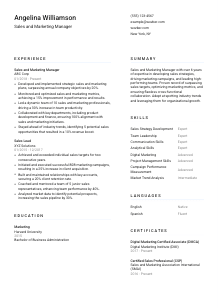
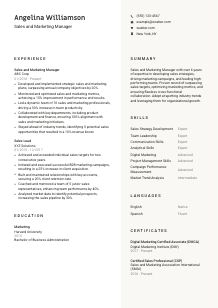
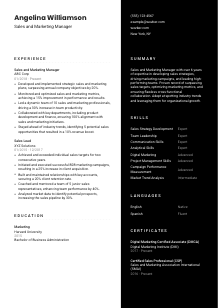
Driving sales and marketing campaigns, but your resume isn't getting any ROI? Check out this Sales and Marketing Manager resume example, created with Wozber free resume builder. Learn how to pitch your leadership and strategy in line with job goals, ensuring your career trajectory is as impressive as your conversion rates!
Sales and Marketing Managers are expected to connect strategy to commercial results. Hiring teams want to see how you turned market insight into campaigns, pipeline growth, stronger conversion, and clearer direction for the people executing the plan. Your resume should make that operating range visible quickly, especially where you have owned targets, performance reporting, and cross-functional coordination.
A tailored resume changes how your background is read in a crowded stack. When your wording reflects the job's priorities, from sales targets to campaign analysis to team coaching, Wozber's free resume builder helps you shape that experience into an ATS-compliant resume that surfaces the right metrics and responsibilities early. That makes it much easier for the employer to see whether you can lead both revenue generation and marketing execution.
This section is brief, but it still does important work for a Sales and Marketing Manager application. Clear contact details, the right title, and any location detail the employer asked for remove friction before they get to your sales results, campaign metrics, and leadership scope.
Use your full name exactly as you present yourself professionally across email, LinkedIn, and any portfolio or website. Keep it easy to read and slightly more prominent than the rest of the header so the resume feels polished and business-ready from the first line.
Place "Sales and Marketing Manager" directly under your name when that reflects the role you are pursuing. This immediately frames your background around commercial planning, campaign ownership, and team leadership instead of leaving the reader to infer your direction from past titles alone.
Add a reliable phone number and a professional email address. For a role built on communication, client interaction, and internal coordination, even small details like an overly casual email address can work against the executive presence you want to project.
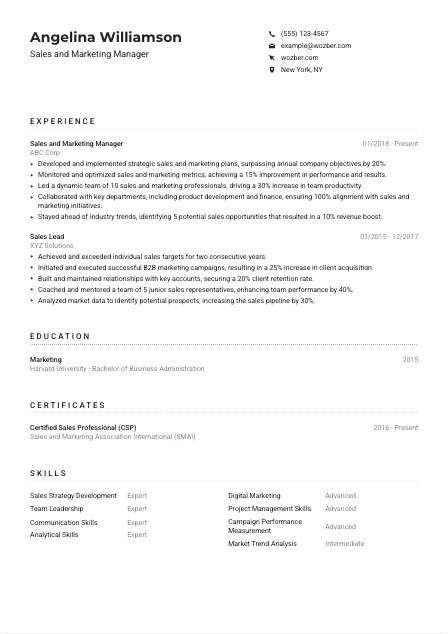
If the employer specifies a city, include it. Here, listing "New York, NY" directly addresses a stated requirement and avoids unnecessary questions about relocation or local availability. Use this only when location is relevant to the posting, not as a default rule for every application.
Include LinkedIn or a professional website if they strengthen your candidacy. For this kind of role, those profiles can reinforce your industry focus, leadership track, campaign work, or thought leadership. Make sure the titles, dates, and achievements match your resume exactly.
Keep this section clean, consistent, and aligned with the role. It should confirm who you are, how to reach you, and any logistical detail that matters before the employer reviews your revenue impact and leadership record.




For Sales and Marketing Managers, the experience section carries the most weight. This is where you show ownership of targets, campaign performance, market analysis, and team output. Generic duty lists fall flat here. Employers want to see how your decisions affected revenue, lead flow, productivity, customer acquisition, retention, or market expansion.
Read the posting closely and mark the recurring themes. In this case, the emphasis is on strategic planning, hitting sales goals, analyzing performance metrics, leading a team, and working across departments. Use those themes to decide which achievements deserve space and which older or less relevant details can be cut.
List roles in reverse chronological order with title, company, and dates. For management-track roles, progression matters. A move from an individual contributor sales role into broader leadership or integrated sales and marketing ownership tells a stronger story than isolated accomplishments with no career arc.
Open each role with outcomes that reflect the commercial scope of the job. Strong bullets often show that you built a plan, launched an initiative, and improved a measurable result. The example resume does this well by tying strategic planning to exceeding annual objectives by 20%, which directly answers the employer's need for a proven track record.
Use numbers that mean something in sales and marketing work: quota attainment, revenue growth, pipeline growth, lead conversion, campaign ROI, client acquisition, retention, productivity gains, or market share improvements. Metrics such as a 15% performance lift, a 30% increase in team productivity, or a 10% revenue boost give hiring teams a faster read on your scale and effectiveness.
Choose bullet points that support the target role's mix of strategic planning, analytics, and leadership. A Sales and Marketing Manager resume does not need every task you handled. It needs the right evidence: team management, campaign execution, market analysis, target ownership, and collaboration with functions like finance, operations, or product. Every line should strengthen that picture.
Your experience section should leave little guesswork about your level. When it clearly connects strategy, execution, and measurable commercial results, employers can quickly see whether you are ready to lead their sales and marketing function.
Education usually sits behind experience for a management hire, but it still matters when the posting calls for a specific degree background. For a Sales and Marketing Manager, this section should confirm that you have the formal grounding to support strategic planning, market analysis, and business decision-making.
If the employer asks for a bachelor's degree in Marketing, Business, or a related field, make sure that information is easy to find. In the example, a Bachelor of Business Administration in Marketing aligns well with the requirement and should be presented without extra clutter.
List your degree, field of study, school, and graduation year in a straightforward format. Hiring teams do not need a paragraph here. They need a quick confirmation that your academic background supports the commercial and analytical demands of the role.
Use the official degree title rather than rewriting it for effect. Accuracy matters, especially in mid-level and senior hiring. If your degree is adjacent rather than exact, the field of study or related coursework can help connect it to the role's sales and marketing focus.
Most candidates with 5+ years of experience will not need coursework, but it can help if you are moving into broader marketing leadership or want to highlight strengths in market research, consumer behavior, digital marketing, or business analytics. Include it only when it adds real context.
Honors, leadership roles, or relevant projects can stay if they support your commercial profile and do not distract from stronger professional achievements. For experienced candidates, keep this brief and relevant to business, marketing, leadership, or data-driven decision-making.
Keep this section concise and accurate. Once the degree requirement is clearly covered, the rest of the resume should carry the heavier proof of sales performance, campaign leadership, and managerial scope.
Certifications are useful when they sharpen your positioning in sales leadership, digital marketing, analytics, or related commercial disciplines. They are rarely the deciding factor on their own, but they can strengthen the picture of a manager who keeps current with tools, channels, and selling methods.
If the posting does not require certifications, choose ones that still deepen your fit. For a Sales and Marketing Manager, certifications in sales performance, digital marketing, CRM platforms, campaign measurement, or leadership development tend to carry the most relevance.
List certifications that support the kind of work you want to lead. In the example, a sales credential and a digital marketing credential work well together because they reflect the blended nature of the role. A shorter, focused list is usually stronger than a long inventory of loosely related courses.
Add earned dates or active periods where appropriate. Sales and marketing methods shift quickly across channels, analytics practices, and buyer behavior, so recent certification activity can signal that your knowledge has kept pace with the market.
Ongoing learning matters in a field shaped by changing platforms, competition, and customer expectations. Certifications can show that you invest in sharpening the skills behind revenue growth, campaign optimization, and modern go-to-market execution.
Choose credentials that add depth to your commercial leadership profile. The right ones support your experience with current marketing practice, sales discipline, and the ability to guide a team through changing market conditions.
The skills section should read like a compact summary of how you operate. For this role, that means balancing revenue-focused planning, campaign execution, analysis, communication, and leadership. Avoid broad filler. Use skills that match the way Sales and Marketing Managers are actually evaluated.
Scan the posting for both stated and implied capabilities. Here, the employer is asking for strategic planning, analytics, organization, project management, communication, and team leadership. Those should guide the list more than generic strengths that could belong on any resume.
Choose skills that support your strongest and most relevant evidence. Good options for this role include sales strategy development, campaign performance measurement, market trend analysis, team leadership, project management, and stakeholder communication. The example resume uses this approach well by mixing leadership, analytical, and execution-focused skills.
Place the most important capabilities first, especially those tied to target ownership, campaign results, and team management. If the role leans heavily on reporting and optimization, analytical skills and performance measurement deserve a higher position than broader secondary abilities.
A focused skills section helps reinforce the rest of the resume. When it mirrors the language of the job and reflects the tools of the role, it supports both ATS optimization and a stronger human read.
Language ability matters most when it affects how you lead teams, work with clients, or operate across markets. For Sales and Marketing Managers, communication quality is already central to the job, so this section should be accurate and useful rather than decorative.
When a posting specifies a language requirement, list it clearly and near the top. Here, English proficiency is a critical requirement, so it should appear first with an honest rating that reflects how you operate in meetings, presentations, reporting, and negotiation.
Order languages based on the role's communication needs and your actual proficiency. If you work with multilingual markets, regional accounts, or diverse internal teams, additional languages can add practical value beyond the requirement itself.
A second language can strengthen your profile when it expands client coverage, improves relationship building, or supports regional marketing work. In the example, Spanish adds useful breadth without overshadowing the required English proficiency.
Stick to familiar descriptors such as Native, Fluent, Advanced, Intermediate, or Basic. Sales and marketing roles often depend on precise communication, so inflated language ratings can create problems later in interviews or on the job.
If the company sells internationally or serves a multilingual customer base, language skills can become more than a nice-to-have. Emphasize them when they genuinely support account growth, customer communication, or cross-border collaboration.
For this role, language skills should clarify communication capability, not fill space. Keep the section honest and relevant to the markets, teams, or customers you can serve effectively.
Your summary should quickly establish the kind of Sales and Marketing Manager you are. In a few lines, it needs to show your level of experience, the commercial outcomes you drive, and the leadership scope you bring. This is where generic claims hurt most, so keep it specific.
Before writing, identify the two or three themes the employer cares about most. In this posting, those are strategic sales and marketing planning, performance analysis, and team leadership. Let those themes shape the opening instead of writing a broad career statement.
Start with your title and years of relevant experience, then anchor that experience in work the employer needs. A line such as "Sales and Marketing Manager with 6+ years leading revenue-focused strategy and campaign execution" is stronger than a vague statement about being driven or results-oriented.
Mention a few concrete strengths backed by real outcomes, such as surpassing targets, improving campaign performance, growing productivity, or identifying new market opportunities. The example summary works because it links strategic planning, metrics optimization, and cross-functional collaboration to organizational growth.
Aim for three to five lines with no filler. Every sentence should earn space by clarifying your commercial impact, leadership range, or analytical value. The summary should make the reader expect strong detail in the experience section, not repeat it word for word.
A good summary tells the employer, early and plainly, that you understand how to grow revenue, run effective marketing activity, and lead people toward clear performance goals.
A Sales and Marketing Manager resume works best when every section supports the same message: you can build strategy, execute campaigns, lead teams, and improve commercial performance. Keep the language close to the job description, use metrics that matter in sales and marketing, and cut anything that does not strengthen that case.
Wozber's free resume builder can help you turn that experience into an ATS-friendly resume format, and its ATS resume scanner can highlight missing keywords and requirements before you apply. The finished resume should make one thing clear fast: you know how to translate market insight and team leadership into measurable growth.




