



Use Wozber and land your dream job
Create Resume
No registration required
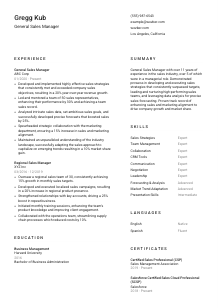
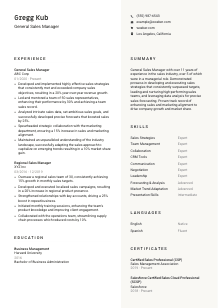
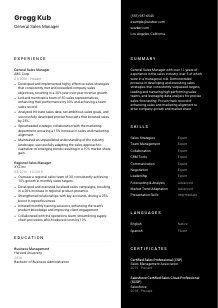
Closing deals, but your resume feels like a tough sell? Check out this General Sales Manager resume example, built with Wozber free resume builder. It shows how to align your sales strategy with the job requirements while highlighting leadership and market growth, positioning yourself for a standing ovation and a sales target surpassed!
General Sales Manager hiring usually turns on one question fast: have you led a sales organization to consistent growth, or have you mainly supported it from the sidelines? This role carries revenue responsibility, forecasting pressure, and team accountability, so the resume needs to show how you set direction, coached managers or reps, and moved numbers such as quota attainment, growth rate, retention, or market share.
A targeted resume also helps hiring teams separate broad sales experience from true sales leadership. When your language mirrors the posting's priorities, from strategy and forecasting to marketing alignment, Wozber's free resume builder helps you shape that experience into an ATS-compliant resume that makes your management scope and commercial results easier to read. That distinction matters when companies are choosing who can actually run the sales engine.
For sales leadership roles, the header does more than identify you. It tells the employer whether you are positioned for the exact opening, available in the right market, and easy to contact for a fast-moving interview process. Keep this section clean, direct, and aligned with the role requirements.
Your name should be the most visible text on the page, set in a clear font and easy to scan. Senior sales hiring often starts with a quick top-down review, so make the header instantly readable and professional. Save visual flair for your results, not your formatting.
Place the role title directly beneath your name when it matches the job you are pursuing. If the opening is for a "General Sales Manager," using that exact title helps frame the rest of the resume around sales leadership, revenue ownership, and team direction from the first line.
List a phone number you answer, a professional email address, and any relevant website or LinkedIn profile. Check every detail carefully. For leadership roles, small errors can undercut the credibility you are trying to establish around pipeline discipline, forecasting accuracy, and team management.
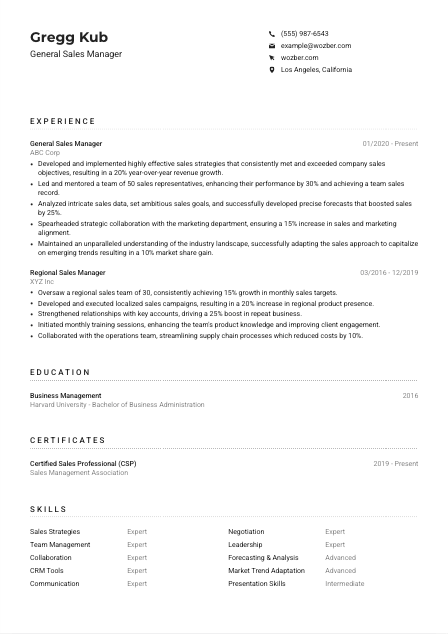
If the employer names a location requirement, handle it in the header instead of leaving it ambiguous. Here, Los Angeles, California is part of the screening criteria, so showing Los Angeles in the example resume removes a practical objection immediately. If you are relocating, state that plainly.
A polished LinkedIn profile or personal site can reinforce career progression, major wins, and industry credibility. For a General Sales Manager, that profile should support the same story told on the resume, such as team size led, regions owned, revenue growth delivered, or sales systems used.
This section should confirm who you are, what role you are targeting, and whether you meet any practical requirements tied to the opening. For a sales leadership resume, that clarity helps the reader move quickly to your revenue record and management scope.




Experience is where a General Sales Manager resume either becomes persuasive or stays generic. Hiring teams want to see how you drove revenue, improved team output, forecasted demand, and adjusted strategy when markets shifted. Your bullets should read like business results tied to leadership decisions, not a list of routine duties.
Start by marking the responsibilities that define success in the role. In this case, the employer is asking for sales strategy development, team leadership, forecasting, collaboration with marketing, and awareness of the competitive landscape. Those themes should guide which achievements you surface first and which older bullets you cut.
List roles in reverse chronological order and include job title, company, and dates without clutter. For sales management candidates, progression matters. Moving from a role like Regional Sales Manager into General Sales Manager helps show growth in team size, territory scope, and decision-making authority.
A hiring manager already knows a General Sales Manager leads teams and sets targets. What they need to know is what changed because you did. Strong bullets connect leadership action to measurable results, such as improving rep productivity, raising close rates, increasing recurring revenue, or beating annual sales objectives. The example resume does this well with achievements like 20% year-over-year revenue growth and a 10% market share gain.
Sales leadership is measured in numbers, so your bullets should reflect that reality. Include metrics that naturally belong in the role, such as quota performance, year-over-year growth, forecast accuracy, account expansion, win rate, retention, pipeline conversion, or team size. "Led a team of 50 sales representatives and improved performance by 30%" gives a much clearer picture than "managed the sales team."
Remove accomplishments that do not strengthen your case for this level of sales management. Prioritize bullets that show strategy execution, coaching, cross-functional work, and market response. Even when you include collaboration with operations or marketing, tie it back to revenue impact, cost efficiency, campaign performance, or customer growth so the commercial thread stays clear.
Your experience section should leave no doubt about the size of the teams, targets, and revenue outcomes you have handled. When each bullet connects strategy to measurable sales performance, the resume reads like a General Sales Manager application instead of a broad sales history.
Education will not outweigh proven sales performance at this level, but it still matters when the job posting specifies a degree. Present it clearly so the employer can confirm that requirement and move on to the leadership and revenue evidence elsewhere on the page.
If the job requires a bachelor's degree in Business, Marketing, or a related field, make that information easy to find. A Bachelor of Business Administration or a marketing-focused degree lines up naturally with the strategic, analytical, and customer-facing demands of senior sales management.
List your degree, field of study, school, and graduation year in a clean format. There is no need to over-design this section. Hiring teams reviewing senior sales candidates want quick confirmation of the credential, not a long academic narrative.
When your degree aligns closely with the opening, let that alignment be visible. In the example, "Bachelor of Business Administration" in business management directly supports a role focused on sales strategy, forecasting, and leadership. If your degree is in a related field, that is usually sufficient as long as the relevance is clear.
Most experienced General Sales Managers do not need to list classes. Still, if you are earlier in your management career or your program included standout work in marketing analytics, negotiation, finance, or organizational leadership, a brief mention can help connect your education to the role.
Academic honors, leadership roles, or sales-related extracurriculars can add context when they support your professional story. Use them sparingly. At this career stage, they matter most when they reinforce leadership potential, business acumen, or industry interest rather than filling space.
Keep this section concise and accurate. Once the degree requirement is clear, the rest of the resume can do the heavier work of showing sales execution, leadership range, and commercial judgment.
Relevant certifications can support your credibility, especially when the posting mentions them directly. For a General Sales Manager, the best credentials reinforce sales methodology, CRM fluency, account strategy, or leadership development rather than adding unrelated badges.
This posting asks for relevant sales certifications or licenses, which means they deserve space if you have them. They may not decide the hire on their own, but they can strengthen your case by showing continued development in sales management practices and tools.
Prioritize certifications tied to the actual demands of the role. That can include sales leadership programs, consultative selling credentials, CRM platform certifications, or industry-specific licenses. In the example, CSP and Salesforce Sales Cloud certification both reinforce capabilities that matter in pipeline management and team execution.
Add the year earned and, when relevant, the validity period. For systems, platforms, or methodologies that change over time, dates help show that your knowledge is current. This is especially useful when the role involves process design, forecasting discipline, or CRM-driven reporting.
Sales leadership changes with buyer behavior, tooling, reporting expectations, and go-to-market models. Ongoing certification work can support your resume when it reflects real developments in enablement, CRM workflows, analytics, or management training. List only credentials that still strengthen your positioning for the role you want.
Well-chosen certifications add depth to your leadership profile and show that your sales methods are current. They work best when they back up the bigger story already established in your experience section.
The skills section should reflect how you run a sales organization, not just what you have been exposed to. Employers hiring General Sales Managers look for a mix of strategic, analytical, and people-management capabilities tied to revenue performance and cross-functional execution.
Review the posting for both direct requirements and implied capabilities. Here, the obvious ones include sales strategy, team management, forecasting, collaboration, and knowledge of market trends. Those are not filler terms. They point to the day-to-day demands of planning targets, coaching teams, and adjusting to competitive shifts.
Only include skills you can support with examples elsewhere in the resume. If you list CRM tools, negotiation, forecasting and analysis, or leadership, the experience section should show where you used them to improve conversion, guide a team, or hit revenue goals. That connection is what makes the list believable.
Keep the section focused on the skills most relevant to leading sales performance. A concise list of high-value capabilities is stronger than a long catalog of generic traits. For this kind of opening, strategy development, coaching, CRM usage, pipeline analysis, collaboration with marketing, and communication carry more weight than broad descriptors without business context.
This section should reinforce the operating strengths behind your results. When your skill list mirrors the language of the role and matches the evidence in your work history, it supports both recruiter review and ATS optimization without sounding forced.
Language ability can matter in sales leadership because communication sits at the center of coaching, negotiation, account growth, and cross-functional work. Even when multilingual ability is not essential, listing languages accurately can broaden your appeal in diverse markets and customer bases.
If the posting names a language requirement, list it clearly. Here, English competency is mandatory, so it should appear in the languages section with an honest proficiency level such as Native or Fluent. Do not leave a stated requirement for the employer to infer.
Extra languages can be useful when they support customer relationships, regional coverage, or internal team communication. Spanish, for example, can be valuable in many sales environments, including large metropolitan markets. Mention it when you can use it confidently in business settings.
Use clear levels such as Native, Fluent, Advanced, or Intermediate. Accuracy matters. A General Sales Manager may need to handle client conversations, coaching sessions, or presentations, so overstating proficiency can quickly become visible in an interview or on the job.
If a second language has helped you build accounts, manage regional teams, or communicate with a broader customer base, it becomes more than a nice extra. That is especially true in businesses with multilingual sales teams or diverse client segments.
Do not turn languages into a personality statement. Include what is useful for the job and present it plainly. For senior sales roles, the value of language skills comes from better communication, stronger relationships, and wider coverage, not from decoration.
A clear languages section can support your candidacy when communication range matters. For a General Sales Manager, it should tell the employer exactly how you can operate with teams, customers, and stakeholders across the market.
The summary sits at the top of the resume, so it needs to establish your level quickly. For a General Sales Manager, that means years of experience, leadership depth, and the kind of commercial outcomes you are known for, all in a few tightly written lines.
Before writing, identify the few themes that define the opening. In this case, strategy development, team leadership, forecasting, and sales-marketing alignment are central. Build your summary around those points instead of vague claims about being driven or results-oriented.
Your first line should establish who you are and at what level you operate. A phrase like "General Sales Manager with 11+ years in sales and 5+ years leading teams" immediately gives the reader professional context and aligns with the requirement for both sales and managerial experience.
Follow with capabilities that matter most for the role, such as building sales strategies, coaching high-performing teams, improving forecast accuracy, or partnering with marketing on go-to-market execution. The example summary works because it highlights strategy, team leadership, data analysis, and alignment with marketing without sounding bloated.
Aim for three to five lines that read smoothly and point toward measurable business impact. You do not need to repeat every metric from the experience section, but the summary should still imply scale and performance. Leave the detail for the bullets below.
A well-written summary tells the reader, in seconds, that you can lead teams, shape sales strategy, and deliver against targets. Once that framing is in place, the rest of the resume can deepen it with numbers, scope, and execution detail.
A strong General Sales Manager resume should show how you drive revenue, lead teams, forecast performance, and adjust strategy when the market shifts. Each section should support that story, from a clear location match and degree requirement to quantified wins in team output, growth, and sales-marketing coordination.
Wozber's free resume builder can help you organize that story in an ATS-friendly resume format, and its ATS resume scanner can help you map job requirements to the sections where your experience proves them. The final result should make one thing easy to judge: you have already led the kind of sales performance this role is hiring for.




