



Use Wozber and land your dream job
Create Resume
No registration required
Driving sales targets, but your resume seems off-route? Navigate this Distribution Sales Manager resume example, created with Wozber free resume builder. Learn how to align your sales strategy with job coordinates, making your career trajectory as successful as your delivery routes!
Distribution sales leadership is measured in channel growth, forecast accuracy, partner retention, and the ability to keep revenue moving across a network of distributors, agents, and resellers. A resume for this role needs to make those commercial results visible fast. Hiring teams want to see how you built territory plans, managed channel relationships, and worked with operations or logistics when delivery and after-sales support affected revenue.
When the resume mirrors the language of the target opening, it is easier to separate broad sales experience from true distribution leadership. Wozber's free resume builder helps shape that wording into an ATS-compliant resume, so terms like sales forecasting, CRM usage, channel partnerships, and market analysis are easy to read by both the ATS and the hiring team. That clarity matters when they are deciding who can actually run a distribution pipeline and hit target.
This section is brief, but it still does real work. For a Distribution Sales Manager, it should immediately confirm who you are, what role you are targeting, and whether any practical requirement, such as location, is already covered.
Use your full name in a clean, readable format so it stands above the rest of the page. This is basic resume structure, but it matters when hiring teams are reviewing multiple candidates for revenue-driving roles and need to scan quickly.
Place "Distribution Sales Manager" directly under your name if that is the role you are pursuing. It aligns your resume with the opening from the first line and helps frame the experience below around channel sales, forecasting, and partner management rather than general sales work.
Include a reliable phone number and a professional email address. Distribution sales hiring often moves quickly once a candidate shows the right channel experience and track record, so make it easy for recruiters or sales leaders to reach you without friction.
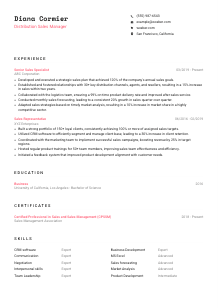
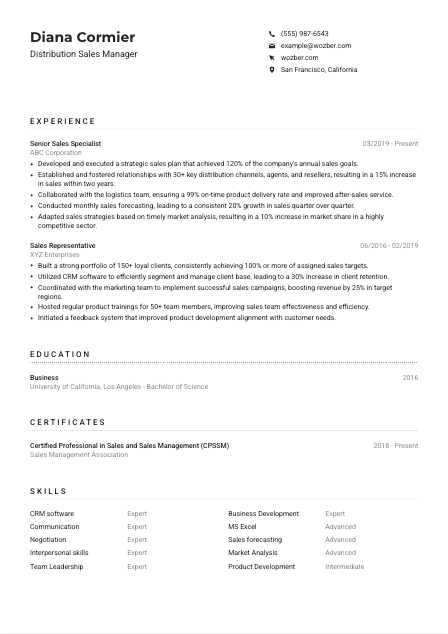
If a role specifies a city or relocation expectation, show that clearly in your personal details. In the example, listing San Francisco, California directly answers the employer's stated location requirement. Use that approach when geography affects eligibility, but do not overstate it when location is not a deciding factor.
A LinkedIn profile or professional site can support your resume when it reinforces your background in channel development, account growth, or leadership. Check that the title, dates, and achievements match your resume, especially if you mention sales targets, regions, or partner programs.
This section should confirm the basics in seconds: your identity, your target role, how to reach you, and any practical requirement that affects consideration. For distribution sales positions, that early clarity keeps attention on your commercial track record.




This is the section that carries the most weight for a Distribution Sales Manager. Employers are looking for signs that you can build channel strategy, manage partner relationships, forecast accurately, and translate sales activity into measurable growth.
Read the posting closely and mark the responsibilities that define success in the role. For this kind of position, that usually includes sales planning, distribution channel management, reseller relationships, forecasting, performance reporting, and cross-functional coordination. Those priorities should shape which achievements you emphasize and which language you use.
List roles in reverse chronological order with title, company, and dates. Distribution Sales Manager hiring often favors candidates who have moved from direct sales or account management into broader channel ownership, so make that progression easy to follow.
Each bullet should show what you changed, improved, grew, or protected. The example does this well by pairing actions with outcomes, such as building relationships with 30+ channel partners and driving a 15% sales increase. That is far stronger than simply stating responsibility for distributor relationships.
Percent-to-target, revenue growth, market share gains, client retention, forecast improvement, delivery performance, and partner expansion all carry weight here. Metrics like 120% of annual sales goals, 99% on-time delivery, or 20% quarterly growth help a hiring manager picture your operating range and commercial impact.
Keep the focus on experience that strengthens your case for managing distribution performance. Prioritize achievements tied to sales plans, reseller networks, account growth, forecasting, internal coordination, and competitive response. If a point does not support those themes, it is taking space from stronger proof.
Your experience section should show a pattern of hitting targets, strengthening distribution channels, and working across teams to keep customers served and revenue growing. If that pattern is easy to spot, you are giving the hiring team what they need most.
For this role, education is usually a qualification check rather than the main selling point. Still, it should confirm that you meet the degree requirement and support the business side of your sales leadership background.
If the posting asks for a bachelor's degree in Business, Sales, or a related field, present your degree in a way that makes the match obvious. In the example, "Bachelor of Science" with a Business field does exactly that and removes uncertainty early.
List the degree, field of study, school, and graduation year. Hiring teams do not need extra formatting here. They need to confirm quickly that you meet the educational baseline and move back to your revenue history, forecasting ability, and channel experience.
If your degree aligns well with the role, make sure the field is visible rather than buried. A Business degree supports responsibilities like strategic sales planning, profitability management, reporting, and partner negotiations, so do not leave that context implied.
Most experienced distribution sales professionals will not need course lists. Still, if your degree title is broad, a few relevant courses in sales management, business analytics, supply chain, or marketing can clarify your preparation. Use this selectively.
Honors, leadership roles, or standout projects can help if they connect to commercial thinking, presentation skills, or market analysis. For a candidate with 5+ years of experience, keep these brief so the section stays supportive rather than dominant.
This section should quickly confirm that you meet the stated degree requirement and have a business foundation that supports sales planning and channel management. Then let your experience carry the argument.
Certifications are not always required for distribution sales roles, but they can strengthen your profile when they point to formal training in sales management, leadership, or channel strategy. They are especially useful when an employer lists preferred credentials.
When an employer mentions certifications such as CPSSM or CSL, list those prominently if you have them. In this example, including both directly answers a preferred qualification and shows commitment to professional development in sales leadership.
Focus on certifications tied to sales management, negotiation, channel development, customer strategy, or leadership. Generic training courses carry less weight than recognized credentials that relate to target setting, team performance, or distributor management.
Add the year earned or the active period when that helps show currency. This is useful for credentials that require renewal or signal ongoing professional standing, especially in roles where employers value up-to-date sales practices and management discipline.
Distribution sales changes with channel models, reporting expectations, and market pressure. Updating your certifications over time shows that you keep refining how you lead sales teams, manage partners, and respond to competitive shifts.
Relevant certifications strengthen your case when they align with the role's preferred qualifications and your actual sales leadership record. They work best as added proof around an already solid history of channel performance.
A Distribution Sales Manager skills section should look operational, not generic. The best version balances commercial tools, planning ability, and people-facing strengths that matter in partner-driven sales environments.
Start with the skills the employer has already named. Here that includes CRM software, MS Excel, communication, negotiation, and interpersonal skills. Then add adjacent strengths that naturally support the work, such as sales forecasting, market analysis, channel management, or business development, if you can back them up elsewhere on the resume.
Lead with the capabilities most connected to distribution sales results. For this profession, that usually means CRM-driven pipeline management, forecasting, partner relationship management, negotiation, reporting, and cross-functional coordination. The example skills list works because it stays close to the commercial realities of the job.
A shorter list of clearly relevant skills is stronger than a long inventory of buzzwords. Choose skills that connect to actual responsibilities and achievements in your experience section, so the hiring manager can see the link between what you claim and what you have delivered.
If the skills you list are the same ones your experience demonstrates through forecasts, partner growth, CRM usage, and target achievement, this section becomes a quick confirmation of how you operate in the role.
Language fluency can matter in distribution sales when you work across regions, support diverse channel partners, or communicate with internal and external stakeholders in different markets. This section should reflect the communication demands of the role, not just add extra detail.
If the posting calls for high-level English communication, list English first with an honest proficiency level. That requirement is directly tied to negotiation, reporting, presentations, partner communication, and internal coordination, so it deserves clear placement.
Additional languages can be valuable when your territory, distributor base, or customer mix crosses regions. The example includes Spanish, which can be a practical advantage in many sales environments, though it should be presented as an added strength rather than a universal requirement.
Terms like "Native," "Fluent," "Intermediate," and "Basic" are enough. They give hiring teams a realistic view of how confidently you can manage calls, presentations, negotiations, or account discussions in each language.
If the role involves international distributors, multilingual clients, or regional resellers, language skills can support trust, training, and smoother issue resolution. Include them when they genuinely improve your ability to sell, support, or manage partner performance.
If you are studying another language, include it when it connects to the markets you serve or plan to serve. For sales roles, the most useful language detail is always the one that helps you build stronger commercial relationships.
Language skills matter most when they help you communicate clearly with partners, customers, and internal teams. Present them in a way that shows where they support your sales coverage and relationship management.
For a Distribution Sales Manager, the summary should read like an executive snapshot of your sales record. In a few lines, it should establish your level, your channel or distribution experience, and the kinds of results you are known for delivering.
Use the job description to decide what belongs in these opening lines. For this profession, that often means years of experience, target performance, channel development, sales planning, forecasting, and relationship management. Keep the focus on the responsibilities that define success in the role you are applying for.
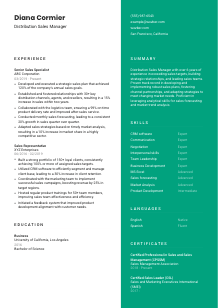
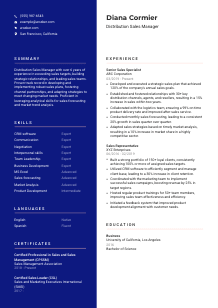
Start with a direct line that tells the reader who you are professionally. The example, "Distribution Sales Manager with over 6 years of experience," works because it sets seniority quickly and positions the rest of the summary around relevant leadership rather than general sales exposure.
Choose points that connect to revenue and execution. Exceeding sales targets, building distributor relationships, leading strategic sales plans, improving forecasts, or adapting to market shifts are all stronger than broad claims about being driven or results-oriented. Use wording that matches your actual record.
Aim for 3 to 5 lines with no filler. This section should encourage the reader to move into your experience with a clear expectation of what they will find there: sales leadership, distribution expertise, and measurable performance.
A good summary tells the hiring team, in a few seconds, whether you have the background to lead channels, hit targets, and manage the commercial rhythm of the role. When it is tailored well, the rest of the resume lands faster.
A Distribution Sales Manager resume should leave little doubt about three things: you can grow revenue, manage channel relationships, and make sound decisions from forecasts and market data. Every section should support that commercial story, from your title and location details to the metrics in your experience bullets.
Use Wozber's free resume builder to tighten the structure, align your wording with the job description, and produce an ATS-friendly resume format that reflects real distribution sales experience. A final pass with Wozber's ATS resume scanner can help surface missing terms, strengthen ATS optimization, and make your readiness for the role easier to judge.




