



Use Wozber and land your dream job
Create Resume
No registration required
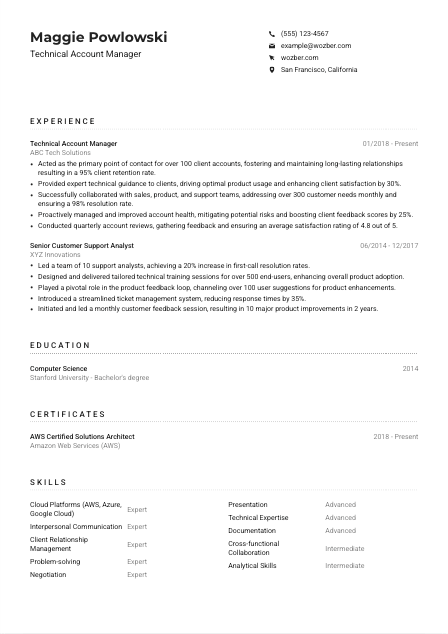
Juggling tech, but your resume feels off the grid? Explore this Technical Account Manager resume example, created with Wozber free resume builder. Learn how to sync your technical talents with account mastery, making your career profile as seamless as a well-integrated system!
Technical Account Managers sit at the intersection of product depth and customer trust. Hiring teams want to see whether you can keep strategic accounts healthy, explain technical issues in business terms, and move cross-functional teams when adoption, escalations, or renewal risk starts to surface. Your resume needs to make that operating range visible quickly.
A tailored resume changes how that range comes across in screening. When your experience, cloud platform knowledge, and account outcomes are phrased in the language used by the job description, an ATS-compliant resume is far more likely to surface you as someone who can manage customer success after the sale, not just support tickets. Wozber's free resume builder helps structure that alignment clearly, so the hiring team can read your account ownership and technical credibility without digging for it.
For a Technical Account Manager, the top of the resume should already feel organized, credible, and client-facing. This section is simple, but it still carries practical screening value, especially when the employer is hiring for a customer-facing role with a stated location and communication requirement.
Place your name at the top in a clear, readable format. For a role built on trust, presentations, and account ownership, a clean header sets the right tone immediately.
Use the exact title "Technical Account Manager" beneath your name when that is the role you are pursuing. This removes ambiguity, especially if your background includes adjacent titles such as Customer Success Manager, Solutions Consultant, or Support Lead.
List a reliable phone number and a professional email address. Since this role involves client communication, executive updates, and internal coordination with sales, product, and support, even basic contact details should reflect polish and consistency.
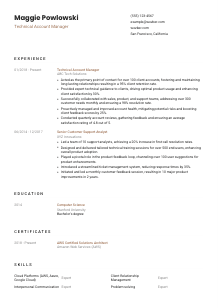
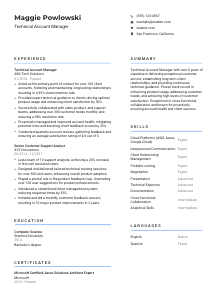
If the job requires candidates to be based in a specific place, include your city and state. In the example, "San Francisco, California" directly supports a stated requirement and helps remove an avoidable screening question early.
Link to LinkedIn or another professional profile if it strengthens your application. Make sure the titles, dates, certifications, and cloud platform experience there match your resume, especially if your profile expands on customer-facing achievements or technical specialization.
Your header should answer the basic access questions right away: who you are, what role you do, how to reach you, and whether you meet any stated location requirement. For a Technical Account Manager, that clarity supports the professional credibility the rest of the resume needs to build on.




This is the section most likely to decide whether you move forward. Technical Account Manager hiring usually turns on proof that you have handled live customer relationships, translated technical issues into action, and improved account health through coordination, guidance, and follow-through.
Read the posting for the operating responsibilities behind the title. Here, the important themes are owning client relationships, providing technical guidance, working across sales, product, and support, tracking account health, and leading regular reviews. Those should shape the bullets you choose and the language you use.
Start with your current or most recent role and work backward. For customer-facing roles, this format helps employers see your present level of account responsibility, the types of clients you support, and whether your work has moved closer to strategic account management over time.
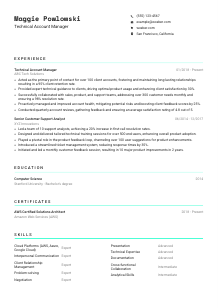
Do not stop at listing responsibilities such as "managed accounts" or "supported clients." Show what happened because of your work. The sample resume does this well with points like serving as the main contact for more than 100 accounts and maintaining a 95% retention rate. That tells the reader far more than a generic ownership statement.
Quantify results with measures that make sense for account management and customer success: retention, product adoption, satisfaction scores, resolution rates, response improvements, review cadence, or volume of accounts supported. Metrics such as a 4.8 out of 5 satisfaction score or a 98% resolution rate help hiring teams understand your scale and consistency.
Every bullet should reinforce your ability to manage technical customer relationships. Prioritize experience with cloud environments, client reviews, issue resolution, enablement, escalation management, and cross-functional execution. If a bullet does not help explain why you can own an account portfolio successfully, it probably does not need the space.
Your experience section should make it easy to picture you running an account book, guiding customers through technical questions, and protecting retention. Lead with outcomes, keep the scope visible, and use metrics that reflect real customer-facing performance.
Education matters here because the role sits close to technical architecture, product usage, and cloud conversations with customers. You do not need an academic section loaded with detail, but your degree should clearly support your ability to handle technical discussions with confidence.
If the role asks for a Bachelor's degree in Computer Science, Information Technology, or a related field, make that easy to find. A directly relevant degree strengthens your technical foundation before the reader even reaches certifications or skills.
List the degree, school, field of study, and graduation year in a straightforward format. Technical Account Manager resumes benefit from clear structure throughout, and the education section is no exception.
When your degree directly lines up with the requirement, do not bury the field of study. In the example, a Bachelor's degree in Computer Science from Stanford immediately supports the posting's educational preference and the technical nature of the role.
If you are early in your career, you can include coursework, projects, or research tied to cloud systems, infrastructure, networking, enterprise software, or client-facing implementation work. If you already have solid TAM experience, keep this section tighter and let your work history carry more weight.
Additional training, workshops, or continuing education can reinforce that you stay current in cloud platforms and customer-facing technology work. Use this selectively, especially when it strengthens your story around architecture knowledge, platform adoption, or technical advisory work.
Education should confirm that your technical base is real and relevant. For a Technical Account Manager, that foundation matters most when it supports stronger account conversations, better client guidance, and more credibility with internal technical teams.
Certifications carry real weight in Technical Account Manager hiring when they connect to the platforms your customers use. They help show that your advice is grounded in current technical knowledge, especially in cloud-focused environments.
Place the most relevant credentials first, especially when the job description names them. For this posting, cloud certifications such as AWS Certified Solutions Architect, Microsoft Certified: Azure Solutions Architect Expert, or Google Cloud Professional Cloud Architect directly support the stated preference.
A shorter list of certifications tied to cloud architecture, platform implementation, or technical advisory work is usually stronger than a long list of loosely related credentials. Keep the section focused on what helps you advise customers and work credibly with technical stakeholders.
Show when each certification was earned, and note active status when applicable. In cloud and platform work, recency matters because product ecosystems, service offerings, and best practices change quickly.
If your target roles consistently ask for AWS, Azure, or Google Cloud exposure, keep your certifications aligned with that demand. The example resume pairs AWS and Azure credentials well, which strengthens the candidate's fit for cloud-oriented account management without overloading the section.
Use certifications to back up the technical side of your profile with recognizable credentials. For Technical Account Manager roles, the strongest ones make it easier to trust your platform guidance, especially in cloud-heavy customer environments.
A Technical Account Manager skills section should read like a practical operating toolkit. Employers are looking for a mix of platform fluency, customer communication, account judgment, and cross-functional execution, not a generic list of soft skills.
Start with the language the employer is already using. In this case, cloud platform proficiency, communication, presentation, customer relationship management, and cross-functional collaboration are central. Mirroring that wording supports ATS optimization and makes your resume easier to match to the role.
Feature the capabilities you would actually use in the job: AWS, Azure, Google Cloud, technical troubleshooting, account health management, client presentations, stakeholder communication, renewal support, and issue resolution. The sample skills list works because it balances platform knowledge with relationship and documentation strengths.
Choose skills you can support elsewhere in the resume through bullets, certifications, or summary language. A concise list of relevant technical and customer-facing skills is far more convincing than an oversized inventory with little proof behind it.
Your skills section should quickly tell a hiring team that you can speak with customers, understand technical environments, and coordinate action across internal teams. Keep it aligned with the role and supported by the experience section.
Language ability matters in Technical Account Manager roles because the job depends on clear communication with customers, internal teams, and sometimes distributed stakeholders. Even when only one language is required, this section can still reinforce your client-facing strengths.
If the posting specifies language proficiency, list it clearly. Here, strong English skills are explicitly required, so English should appear prominently with an honest proficiency level.
Use a standard label such as Native, Fluent, or Professional. For customer calls, account reviews, and technical presentations, the reader should not have to infer whether you can communicate at the level the job demands.
Extra languages can strengthen your profile when accounts span regions or global teams. In the example, Spanish adds useful range, especially for customer communication and relationship-building across broader client bases.
Avoid vague descriptions. Use clear terms like Native, Fluent, Intermediate, or Basic so hiring teams can gauge whether the language is usable in client meetings, written follow-up, or technical training contexts.
Even when a posting only names English, multilingual ability can still be relevant if the company serves international accounts or diverse user groups. Include additional languages when they add credible value to the customer-facing side of your background.
Language skills should support the communication demands of the role. For a Technical Account Manager, they can reinforce your ability to lead reviews, explain product behavior clearly, and build trust across a wider set of customers.
The summary is where you frame your profile in a few lines before the reader reaches the details. For Technical Account Manager roles, that means combining technical credibility with customer ownership, account results, and the kind of communication needed to guide adoption and retention.
Start with your role identity and years of relevant experience. Keep it specific to technical account work, customer success, or another close customer-facing technical function, so the employer immediately knows the level and direction of your background.
A simple opening such as "Technical Account Manager with 6+ years of experience supporting enterprise clients and driving product adoption" works well because it gives role, tenure, and scope in one line. The sample summary uses this approach effectively.
Mention the capabilities most central to the job: cloud platform knowledge, technical guidance, account relationship management, and cross-functional collaboration. Keep these tied to actual work, not abstract traits.
Aim for three to five lines that combine your experience, technical focus, and a few concrete results such as retention, satisfaction, or adoption gains. This section should read like a concise professional overview, not a list of claims.
Your summary should quickly position you as someone who can manage customer relationships with technical depth and commercial awareness. When it is aligned with the target role, the rest of the resume has a much clearer story to support.
A Technical Account Manager resume works best when each section points back to the same core strengths: account ownership, technical guidance, cloud fluency, and measurable customer outcomes. Keep the language close to the job description, especially around platform expertise, customer reviews, collaboration, and retention.
Wozber's AI resume builder can help you tighten that alignment, improve ATS optimization, and present your background in an ATS-friendly resume format that keeps the focus on relevant experience. When the tailoring is done well, your resume makes it much easier to judge whether you can lead customer relationships with both technical credibility and steady account judgment.




