



Use Wozber and land your dream job
Create Resume
No registration required
Resolving inquiries like a pro, but your resume feels on hold? Check out this Customer Support Executive resume example, created with Wozber free resume builder. Learn how to align your service mastery with job needs, so your career trajectory is always set to "success!"
Customer support work is judged in real time. You are expected to calm frustrated customers, resolve issues across phone, email, and live chat, and keep accurate records that the rest of the team can act on. A Customer Support Executive resume needs to show that you can handle volume without losing empathy, write clearly under pressure, and follow through until a case is resolved.
When that experience is tailored to the posting, hiring teams can quickly separate general service backgrounds from candidates who already work in structured support environments with ticketing tools, response targets, and documented follow-up. Wozber's free resume builder helps you shape that experience into an ATS-compliant resume with the right terminology and structure, so your customer handling, resolution rates, and support workflow stand out early.
Customer support hiring moves quickly when the basics are clear. Your contact section should confirm that you are reachable, professional in written communication, and aligned with any practical requirement the employer has listed.
Use your full name at the top in a clean, readable format. This section does not need design flair. In support roles, a simple layout already reflects the professionalism and clarity employers expect in customer-facing communication.
Place "Customer Support Executive" directly under your name when that is the role you are applying for. Matching the title helps frame your background correctly, especially when your previous titles vary between support associate, service representative, or client care roles.
Hiring teams often move from resume review to a phone screen fast, so accuracy matters. Include:
If a role specifies a city or state, list it plainly. Here, "New York City, New York" directly addresses a stated requirement and removes questions about availability or relocation. For other applications, follow the location wording that fits that employer's request.
Include LinkedIn or a professional website if it supports your application with consistent work history, recommendations, or customer service achievements. For a support role, this matters less for branding than for reinforcing credibility and timeline accuracy.
Do not add age, marital status, photo, or other details unrelated to support performance. The better use of space is information tied to accessibility, professionalism, and role alignment.
Your personal details should confirm three things immediately: who you are, how to reach you, and whether you meet any practical requirement such as location. Keep it clean, factual, and aligned with the posting.




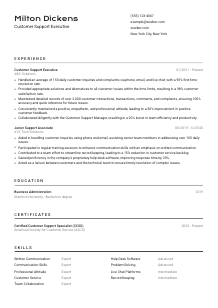
This is the section hiring managers read most closely for support roles. They want to see how you handled customer volume, which channels you worked in, how you documented issues, and whether your work improved resolution speed, satisfaction, or team efficiency.
Start by identifying the operational language in the job description. For this role, that includes customer inquiries, complaints, phone, email, live chat, solutions within time limits, follow-up, record keeping, and working with a Customer Support Manager. Use those terms where they truthfully match your background so both the hiring team and ATS can connect your experience to the role.
List your jobs in reverse chronological order and label them clearly. Include:
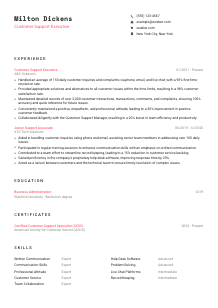
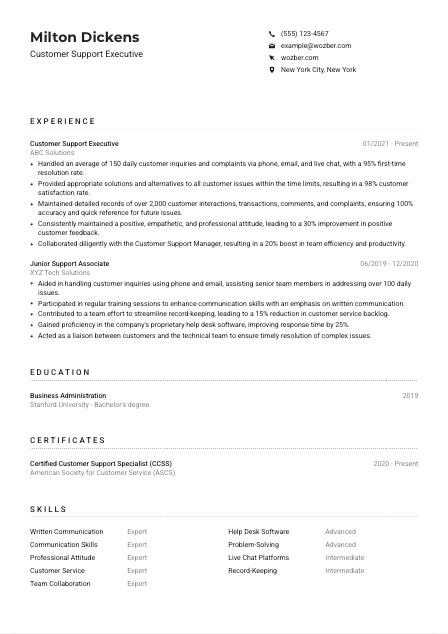
Customer support resumes are stronger when bullets show service quality, not just task lists. Instead of saying you answered inquiries, show scope and results. The sample resume does this well with details such as handling 150 daily inquiries and reaching a 95% first-time resolution rate. Metrics like CSAT, response time, backlog reduction, escalation reduction, and case volume are all useful when they reflect your actual work.
Choose metrics that hiring teams in service environments recognize immediately. That can include average tickets handled, satisfaction scores, turnaround time, documentation accuracy, or improvements in team workflow. In the example, maintaining records for more than 2,000 interactions and contributing to a 20% efficiency increase gives a much clearer picture than general claims about being helpful or organized.
Prioritize accomplishments that show how you received issues, solved them, documented them, and followed through. If you worked with managers, technical teams, or escalations, include that collaboration where it improved outcomes. Cut bullets that do not support your case as a customer-facing problem solver.
A well-built experience section should make your support style visible in concrete terms: channel coverage, issue resolution, service quality, documentation habits, and team coordination. When those elements are backed by real metrics, your resume reads like someone already operating at the level the role demands.
Education usually plays a supporting role in customer support hiring, but it still matters when the posting names a degree requirement. Present it clearly and let it confirm that you meet the baseline without distracting from your service performance and results.
If the employer asks for a Bachelor's degree in Business, Communications, or a related field, list your degree in a way that makes that connection obvious. In the example, a Bachelor's degree in Business Administration aligns well because it supports communication, process awareness, and customer-facing work.
Keep the entry easy to read and include:
Most experienced support professionals do not need course lists. Include relevant coursework only if you are early in your career and it adds practical value, such as business communication, conflict resolution, customer behavior, or information systems.
Academic honors can stay if they add useful context, especially for recent graduates. Once you have solid support experience with metrics, honors become secondary unless they are especially relevant or prestigious.
For most Customer Support Executive applications, education should be concise. If you already have more than 2 years of support work, your degree confirms eligibility while your experience section carries the stronger proof of performance.
Your education section should answer the requirement quickly and cleanly. Once that is established, let the rest of the resume show how you apply communication, organization, and customer service skills in a live support environment.
Certifications are rarely the main reason someone is hired into customer support, but they can strengthen your profile when they relate to service standards, communication, product support, or platform knowledge. They are especially useful when a posting mentions certification as preferred or welcomed.
Focus on certifications that reinforce customer service, customer success, communication, help desk operations, or product support. If the employer says "relevant industry certifications," they are usually looking for signs that you take service quality and professional development seriously.
One well-chosen certification helps more than several unrelated ones. The example includes a Certified Customer Support Specialist credential, which fits the role directly. That kind of alignment is stronger than listing generic training that does not connect to customer interaction or service delivery.
List the issue date and, if applicable, the validity period. This is particularly useful for current certifications or ongoing credentials because it shows your knowledge is recent and maintained.
Support teams value people who keep improving their communication, systems knowledge, and service approach. If you are still building your career, a current certification can reinforce that you are investing in better case handling, customer communication, or support process discipline.
Certifications work best as supporting proof. They add weight when they connect clearly to customer interactions, support workflows, or service quality, and they are most effective when paired with strong experience metrics.
A customer support skills section should read like the toolkit behind your daily performance. The most useful mix combines service communication, problem resolution, record accuracy, and the systems you use to manage customer issues across channels.
Review the posting for both explicit and implied requirements. Here, help desk software, live chat platforms, verbal communication, written communication, professionalism, and teamwork all appear directly in the role description. Add only the skills you can back up elsewhere in the resume.
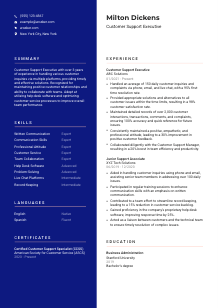
Support hiring depends on both people skills and execution. Pair interpersonal abilities such as empathy, complaint handling, and clear writing with operational skills such as ticketing systems, live chat tools, case documentation, and issue triage. The example resume gets this balance right by combining communication and professional attitude with help desk software and record-keeping.
Do not stuff the section with every soft skill you have ever used. Prioritize the abilities that matter in day-to-day support performance and that match the posting language. A shorter list with real relevance is easier for recruiters and ATS screening to process than a broad catalog.
This section should quickly confirm that you can handle customer conversations, work inside support systems, and keep service quality steady under pressure. Every listed skill should connect back to work you have already demonstrated elsewhere on the resume.
Language ability matters in support roles because every call, email, and live chat depends on clear communication. Even when only one language is required, listing proficiency accurately helps employers understand how you will handle customer interactions.
If the posting specifies English communication skills, place English first and label your proficiency honestly. Since this role requires effective oral and written English, that should be immediately visible.
Lead with the language that directly meets the job requirement, then add others that could help in customer-facing work. This is especially useful in high-volume service environments where multilingual support can improve accessibility and customer satisfaction.
A second language is worth listing when it could help with a broader customer base, even if it is not required. In the example, Spanish adds practical value because it suggests the candidate may serve more customers without needing translation support.
Terms such as Native, Fluent, Advanced, and Intermediate are usually enough. Keep the labels realistic. If you may need to handle live complaints or write customer-facing emails in that language, avoid overstating your level.
Not every Customer Support Executive role needs multilingual ability, but some industries and regions benefit from it more than others. If language skills are part of how you reduce friction in customer communication, they deserve a place on the resume.
Language details should help the employer picture how you will communicate with customers clearly and reliably. Keep this section honest and practical, and let it support the service context of the role.
Your summary needs to establish, in a few lines, what kind of support professional you are. For this role, that usually means years of experience, channel coverage, service quality, and the tools or habits that make your customer handling dependable.
Pull the main themes from the role before you write. In this case, the employer wants experience in customer support, strong communication, help desk and live chat familiarity, and the ability to resolve issues professionally within time limits.
Start with your title or core profession and your years of relevant experience. That gives the reader immediate context, such as whether you already meet the requirement for 2+ years in customer support or a similar role.
Include one or two concrete strengths or achievements that match how support performance is measured. The sample summary points to multi-channel support experience, timely solutions, relationship management, and help desk software use. You can strengthen yours further with specifics such as first-contact resolution, CSAT, ticket volume, or workflow improvements if space allows.
Aim for a short paragraph that can be read in seconds. Three to five lines is usually enough to show your support background, your strongest value to customers, and your operational competence without repeating the experience section.
By the end of the summary, the employer should already understand your support environment, your communication standard, and the kind of results you bring to customer interactions. That gives the rest of the resume a clear frame.
You now have a clear structure for presenting customer support experience in a way that matches how the role is actually reviewed. Wozber's free resume builder can help you organize that content into an ATS-friendly resume format that highlights service metrics, support tools, and customer-facing strengths without clutter.
Before you apply, run the finished version through an ATS resume scanner and check that the language matches the posting naturally across your summary, skills, and experience bullets. When your resume is tailored well, hiring teams can quickly see that you know how to resolve issues, document interactions, and represent the support function with professionalism.