



Use Wozber and land your dream job
Create Resume
No registration required
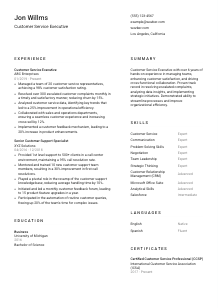
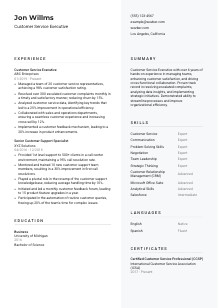
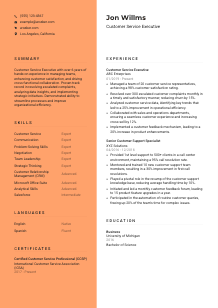
Delighting clients, but your resume is on hold? Ring up this Customer Service Executive resume example, made with Wozber free resume builder. Learn how to present your frontline strengths to match job specifics, ensuring your service-centered career is always in a "ready to assist" mode!
Customer Service Executives sit where customer expectations, team performance, and operational follow-through meet. Hiring teams want to see whether you can lead representatives, steady difficult escalations, and turn service data into better processes, not just whether you have spent time in support. Your resume should make that operating range visible from the first few lines.
A tailored resume changes how quickly that leadership picture comes through, especially when an ATS first scans titles, CRM terms, reporting language, and service metrics. Wozber's free resume builder helps structure that information in an ATS-friendly resume format so your experience reads clearly as executive-level customer service work, not general support experience.
Customer service leaders are expected to communicate clearly and remove friction. Your Personal Details section should do the same by presenting the basics cleanly, with no missing contact information, no distractions, and no ambiguity about the role you are targeting.
Use your full name in a slightly larger font than the rest of the header so it anchors the page immediately. For a Customer Service Executive resume, the top of the document should feel organized and dependable, much like the service operation you would be expected to oversee.
Place "Customer Service Executive" beneath your name if that is the position you are pursuing. Matching the posted title helps both recruiters and ATS tools connect your resume to leadership-level customer service work instead of individual contributor support roles.
List a phone number you answer reliably and a professional email address, ideally in a clean format such as firstname.lastname@email.com. Accuracy matters here. If a hiring manager wants to discuss complaint handling, team leadership, or service reporting experience, they should be able to reach you without friction.
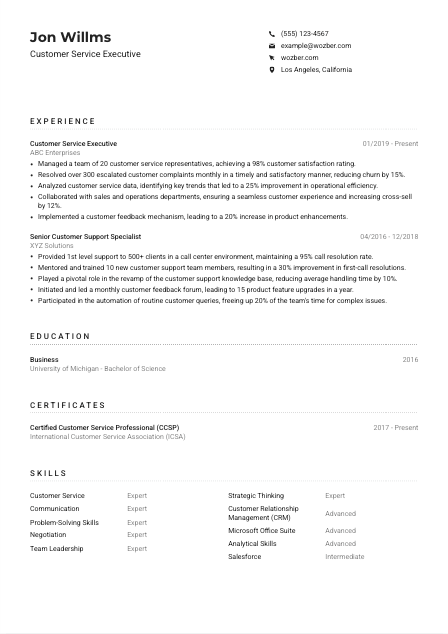
If the employer requires local presence, include your city and state. Here, listing "Los Angeles, California" directly addresses the stated location requirement and removes a basic screening question early in the process.
Include LinkedIn or a professional website if it strengthens your application and matches the resume. For this kind of role, a profile that reinforces team leadership, CRM experience, service improvement work, or cross-functional collaboration can add useful context.
Do not include age, marital status, photo, or other private information unless required by local practice. Keep the header focused on the details that support contact, role alignment, and straightforward review.
This section should confirm that you are reachable, professionally presented, and already aligned with the basics of the opening. When the top of the resume is clean, the reader can move straight into your service leadership record.




In customer service leadership hiring, experience carries the most weight when it shows ownership of outcomes. Recruiters and hiring managers look for team scope, complaint resolution, customer satisfaction performance, reporting habits, and signs that your work improved the customer journey across departments.
Start by identifying what the employer needs most and reflect that in your experience bullets. For a Customer Service Executive, that usually includes leading representatives, handling escalations, tracking customer satisfaction, analyzing service trends, and coordinating with teams such as sales, operations, or product.
List positions in reverse chronological order and make the progression easy to follow. If you moved from frontline support into senior support and then into team leadership, let that arc show. For each role, include the essentials recruiters scan first:
Focus bullets on what you led, improved, resolved, or implemented. Good Customer Service Executive bullets often cover escalated complaint handling, coaching teams, reducing churn, improving first-contact resolution, tightening workflows, or introducing feedback loops. The example resume does this well by pairing actions such as managing a 20-person team and implementing a customer feedback mechanism with clear business outcomes.
Customer service leadership is measured. Use numbers that naturally belong to the work, such as customer satisfaction scores, complaint volume, retention, average handling time, efficiency gains, first-call resolution, or cross-sell lift. The sample's 98% customer satisfaction rating, 300+ monthly escalations resolved, and 25% operational efficiency improvement are strong examples of the kind of proof that makes leadership credible.
Prioritize experience that shows judgment, people leadership, process ownership, and customer outcomes. Older or less relevant bullets can stay brief unless they show transferable value, such as training staff, maintaining resolution quality in high-volume environments, or improving knowledge-base workflows. Keep the emphasis on the work that best supports an executive customer service brief.
This section should make it easy to understand the size of the team or customer base you supported, the problems you handled, and the service results you improved. If those points are visible, your experience will read at the right level.
For customer service leadership roles, education usually serves as a baseline qualification rather than the centerpiece of the resume. Still, it should clearly confirm that you meet the degree requirement and support the business judgment expected in roles tied to customer operations, reporting, and cross-functional coordination.
Read the education requirement carefully and match it where you can. Here, the employer asks for a bachelor's degree in Business, Marketing, or a related field, so a degree tied to business operations, customer behavior, communication, or management should be easy to recognize on the page.
Keep this section clean and easy to scan. Hiring teams usually want to confirm the degree, field, and institution quickly rather than read a detailed academic history.
If your degree closely supports the role, make that connection visible. Business, marketing, communications, and related studies can all reinforce readiness for customer analysis, team coordination, and service improvement work. In the example, a Bachelor of Science in Business aligns neatly with the employer's stated preference.
Experienced candidates usually do not need course lists unless the content is unusually relevant, such as customer analytics, service operations, or consumer behavior projects. This is more useful early in your career or when you need to bridge into a more strategic customer-facing role.
Academic honors, leadership roles, or additional study can help if they support the story of management potential, communication strength, or business understanding. Keep them only if they add something the rest of the resume does not already show.
Education should confirm that you meet the posted baseline and support the business side of your customer service background. Once that is clear, let your experience and results carry the heavier weight.
Certifications can strengthen a Customer Service Executive resume when they show current training in service standards, customer communication, support operations, or related management practices. They are rarely the deciding factor on their own, but they can support your credibility, especially when a posting mentions them directly.
List certifications that align with the role's stated preferences or your most relevant strengths. For customer service leadership, that may include customer service credentials, CRM-related training, complaint resolution programs, or management-focused learning tied to service delivery.
Do not overload this section with general or outdated certificates that do not strengthen your case. A focused list is better. In the example, the Certified Customer Service Professional credential works because it supports the leadership and service-quality emphasis of the role.
Show when a certificate was earned and, if applicable, whether it remains active. This helps employers distinguish between long-past training and qualifications that still reflect your current practice.
If you are aiming for senior customer service roles, ongoing certification can be useful in areas such as customer experience, service operations, leadership, or platform-specific workflows. Add new credentials when they reflect where your responsibilities are heading, not just where they have been.
A concise certification section can strengthen your profile when it points to current customer service knowledge and professional discipline. Keep it relevant to service delivery, team leadership, or customer experience improvement.
The skills section should quickly confirm that you can run a customer service function, not simply answer customer queries. That means balancing people leadership and communication skills with the operational tools and analysis abilities used to improve satisfaction, resolution quality, and reporting.
Review the posting for both explicit and implied requirements. In this case, that includes CRM systems, Microsoft Office Suite, communication, interpersonal strength, problem-solving, and team leadership. Also watch for implied executive-level skills such as reporting, complaint escalation management, and cross-functional coordination.
Customer Service Executives need both operational and interpersonal range. Combine hard skills such as CRM use, data analysis, Excel reporting, or service dashboard tracking with soft skills such as coaching, de-escalation, stakeholder communication, and conflict resolution. The sample's mix of CRM, Microsoft Office Suite, communication, team leadership, and analytical skills is a solid model.
Keep the list focused on abilities that matter at this level. It is better to show a tight set of relevant competencies than a long catalog of loosely related skills. Choose the skills that help a hiring manager picture you leading a team, resolving complex customer issues, and reporting service performance to management.
When selected well, your skills section reinforces the kind of customer service work you are ready to lead. It should point toward service operations, escalation handling, coaching, and customer satisfaction outcomes, not just general helpfulness.
Language skills matter in customer service when they affect comprehension, customer access, and escalation handling. For leadership roles, they also shape how well you can coach teams, read complex written material, and communicate clearly across a diverse customer base.
Check the posting for explicit language expectations and list those first. Here, the employer asks for the ability to read complex texts in English, so your English proficiency should be clearly stated and easy to find.
Present each language with a clear proficiency level. Start with the languages most relevant to the role so the employer can quickly gauge whether you can communicate with customers, read documentation, and handle escalations confidently.
Additional languages can strengthen a customer service application when they help with customer communication in multilingual markets. For example, Spanish can be a practical asset in many service environments, including Los Angeles, though it is an advantage rather than a universal requirement unless the posting says so.
Choose standard levels that hiring teams can interpret quickly. Avoid vague wording and keep the scale consistent across all listed languages.
Only include languages you could actually use in customer conversations, written communication, or internal coordination. For customer service leadership, credibility matters more than ambition, especially if you may be handling sensitive escalations or reviewing detailed customer correspondence.
Language skills are worth including when they support customer communication, documentation, or team leadership in your target market. Keep the section accurate and practical so it adds substance rather than decoration.
Your summary should establish your level quickly. For this role, that usually means years of experience, leadership scope, service strengths, and one or two measurable outcomes that show you can improve customer satisfaction while managing people and processes.
Before writing the summary, identify the top demands of the role. Here, those include leading a customer service team, handling escalated complaints, analyzing service data, collaborating across departments, and reporting satisfaction metrics to management. Those themes should guide the wording of your opening lines.
Open with your title or closest equivalent, your years of experience, and the area where you have built strength. A good summary for this role might position you as a customer service leader with 5+ years in team management, escalation handling, and customer satisfaction improvement.
Mention the abilities most relevant to the job and tie them to outcomes when possible. The example summary works because it combines team management, customer satisfaction, cross-functional collaboration, and process improvement into a short profile supported by the detailed metrics later in the resume.
Aim for a brief paragraph that sounds grounded in actual service operations. Skip broad claims about being passionate or people-oriented unless the resume also shows how that translated into retention, faster resolution, stronger satisfaction scores, or better team performance.
A well-written summary should quickly tell the reader that you can lead service teams, manage complex customer issues, and improve operational results. That sets the right expectation for everything that follows.
You now have the framework for a Customer Service Executive resume that reflects leadership, escalation management, customer satisfaction performance, and cross-functional service improvement. Use Wozber's free resume builder to organize that experience into a clear ATS-compliant resume that matches the language of the role.
If you want to tighten alignment further, review your draft with an ATS resume scanner, refine the wording around CRM systems, reporting, team leadership, and service metrics, and make sure each section supports the level of responsibility you are targeting. The finished resume should make it easy to judge your ability to lead customer service operations with confidence.




