




Use Wozber and land your dream job
Create Resume
No registration required
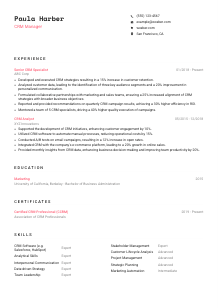
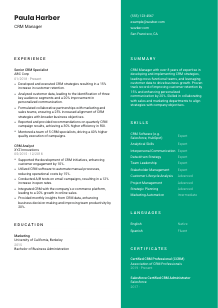
Juggling client data, but your resume feels lost? Explore this CRM Manager resume example, created with Wozber free resume builder. It shows how to capture your relational prowess to align with job dots, steering your career in sync with customer loyalty!
CRM work sits at the point where customer data, campaign execution, and revenue goals meet. Hiring teams want to see whether you can turn lifecycle insights into better retention, sharper segmentation, and more relevant communication, while also keeping cross-functional work with marketing and sales moving in the same direction.
A tailored resume changes how quickly that story comes through. With Wozber's free resume builder and an ATS-friendly resume format, you can mirror the language of the role, surface platform expertise and customer lifecycle analysis, and make it easy to recognize that your experience maps to real CRM ownership rather than general marketing support.
For a CRM Manager, the top of the resume should feel clean, credible, and aligned with the opening right away. This section will not win the job on its own, but it can remove friction immediately by confirming who you are, where you are based, and how to reach you for a role that often involves close coordination across teams.
Use your full name as the most visible text on the page. Keep the styling professional and easy to scan. In a role built on communication, reporting, and stakeholder trust, even this first line should feel organized rather than decorative.
Place "CRM Manager" directly under your name when that reflects the role you are pursuing. It helps frame the rest of the resume around lifecycle strategy, segmentation, campaign performance, and team leadership instead of leaving the reader to infer your level from past titles alone.
Include a reliable phone number and a professional email address, then check both carefully. If you add LinkedIn or a personal website, make sure the content supports the same story as your resume, whether that is marketing automation work, CRM program ownership, or customer engagement results.
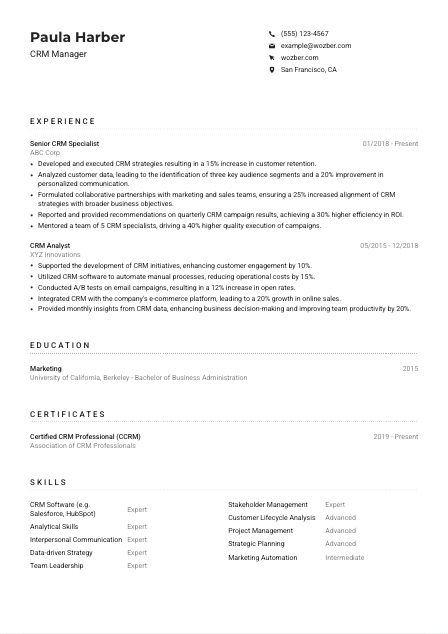
Some CRM roles are flexible, but others require a specific location because the work depends on close partnership with local sales, marketing, or leadership teams. Here, the San Francisco, CA requirement should appear in your personal details if it applies to you, as the sample resume does. That removes an avoidable question early.
A website is useful when it adds something concrete, such as campaign case studies, dashboard examples, or a professional profile that supports your CRM and marketing background. If it does not strengthen your application, leave it off and keep the section tight.
Keep the header simple, accurate, and aligned with the role. For CRM hiring, that usually means clear contact information, the right title, and any required location detail handled without distraction.




This is the section where CRM candidates separate themselves. Employers are looking for more than channel execution. They want to see who owned strategy, who improved customer retention, who built segments from data, who reported on campaign performance, and who could lead specialists while keeping commercial goals in view.
Before rewriting your bullets, mark the themes that matter most in the posting: CRM strategy, customer experience, lifecycle analysis, segmentation, personalization, performance reporting, cross-functional alignment, and team management. Those are the areas your experience should echo in real language, using the same terminology where it matches your background.
List roles in reverse chronological order and include job title, company, and dates for each. That format helps the reader quickly trace your progression from analyst or specialist work into broader ownership, which is especially important in CRM roles where scope often expands from execution to strategy and team leadership.
Your strongest bullets should show what changed because of your work. The sample does this well with lines such as increasing customer retention by 15% and improving personalized communication by 20% through audience segmentation. That kind of wording tells a hiring team you did more than send campaigns. You improved the customer program.
CRM performance is measured. Use metrics that fit the work, such as retention lift, engagement growth, open rate improvement, conversion gains, ROI efficiency, audience segment performance, cost reduction through automation, or team size managed. Numbers help the reader understand the scale and commercial value of your decisions.
Prioritize achievements tied to customer lifecycle management, campaign optimization, reporting cadence, automation, sales and marketing alignment, and leadership. If a bullet does not help prove you can run CRM programs and improve results, it is taking up space that could be used for stronger evidence.
Your experience section should make it easy to connect your past work to the demands of CRM leadership. Show strategy, measurable customer impact, platform fluency, and collaboration with revenue-facing teams in a way that feels proven, not implied.
For an experienced CRM Manager, education is rarely the main selling point, but it still matters. It confirms the academic base behind your work in marketing, business, analytics, and customer strategy, and it helps satisfy degree requirements that may be screened early in the process.
When a posting asks for a bachelor's degree in Marketing, Business, or a related field, make that match obvious. A degree such as the sample's Bachelor of Business Administration in Marketing covers the requirement clearly and supports the commercial and customer-focused side of CRM work.
List degree, field of study, school, and graduation year in a clean order. This section does not need extra styling. It needs to be readable by both people and systems that may be checking for a required academic credential.
If your degree title is broad, the field of study can do useful work. Marketing, business, analytics, communications, or similar studies all help frame your background for CRM roles that blend customer insight, campaign planning, and business performance.
Early-career candidates can include relevant coursework, capstone work, or student projects involving segmentation, database marketing, consumer behavior, or campaign analysis. If you already have several years of CRM results, that detail is usually less important than your professional track record.
If you completed additional CRM, analytics, or marketing automation coursework after graduation, mention it if it supports the role. Ongoing learning is valuable in a field where platforms, personalization methods, and reporting expectations keep evolving.
Keep education concise and relevant. For most CRM Manager applications, the key is to make the required degree easy to find and clearly connected to the business and marketing side of the work.
Certifications can strengthen a CRM resume when they back up the tools and methods you actually use. They are especially useful in roles that depend on platform administration, campaign execution standards, automation workflows, or deeper knowledge of customer data practices.
Prioritize credentials that relate directly to CRM platforms, customer engagement programs, lifecycle marketing, or marketing operations. In the example, Certified CRM Professional and Salesforce certification both support the candidate's credibility in managing CRM systems and strategy.
Focus on certifications that add value for the role instead of listing every course or badge you have earned. A shorter list of relevant credentials usually works better for CRM hiring than a long list with weak links to retention, segmentation, or automation work.
Add issue dates or active periods so the reader can see whether your training is current. That matters in CRM because platforms, compliance expectations, reporting tools, and automation capabilities change quickly.
Recent certification activity can signal that you keep your technical and strategic knowledge current, whether that is in Salesforce, HubSpot, lifecycle marketing, analytics, or campaign operations. It helps round out a resume that already shows measurable results.
Relevant certifications can reinforce your hands-on credibility with the systems and practices behind CRM performance. Keep the list focused on credentials that support the type of customer program ownership the role requires.
CRM Manager skill lists work best when they balance platform knowledge with commercial thinking. The role usually sits between customer data, campaign delivery, reporting, and cross-functional planning, so your skills section should reflect that mix instead of reading like a generic marketing checklist.
Start with the hard and soft skills named in the job description, then add closely related strengths you genuinely use. For this role, that includes CRM software, customer lifecycle analysis, analytical ability, project management, organization, and cross-functional collaboration.
If you have worked in Salesforce, HubSpot, marketing automation platforms, segmentation analysis, A/B testing, or campaign reporting, name those skills directly. The sample resume does this well by pairing platform experience with data-driven strategy, stakeholder management, and team leadership.
Order your list around what the employer is most likely to care about first. For a CRM Manager, that usually means platform fluency, retention and engagement strategy, audience segmentation, analytics, reporting, and leadership before broader or less central abilities.
Your skills section should read like the toolkit of someone who can run CRM programs, interpret customer behavior, and work across teams to improve business results. Keep it focused, specific, and consistent with the experience section.
Language requirements are usually straightforward, but they still matter in CRM. Clear communication affects campaign quality, reporting, stakeholder alignment, and sometimes customer reach, especially in organizations serving multiple markets or diverse customer groups.
If the posting requires English, list it clearly and use an honest proficiency level. That handles a stated requirement quickly and avoids unnecessary ambiguity for a role that depends on communication across teams and customer touchpoints.
Additional languages can be valuable when CRM programs touch multilingual audiences, regional campaigns, or international customer segments. The sample's Spanish fluency is a good example of an extra capability that could matter in the right company context.
Use clear levels such as Native, Fluent, Advanced, or Conversational. Inflated language claims can create problems quickly in roles where written communication, stakeholder meetings, and customer-facing content are part of the job.
If the employer serves customers across markets, language ability can strengthen your value beyond communication alone. It may support localization, audience understanding, or coordination with regional teams, all of which can be relevant in CRM work.
Do not overbuild this section unless languages are central to the position. For many CRM Manager roles, English proficiency is the requirement and any additional language is a useful bonus rather than a deciding factor.
State required language ability clearly, then add other languages only when they contribute to the scope of the CRM work. Keep the emphasis on communication that supports campaigns, reporting, and customer engagement.
The summary needs to establish your level fast. For a CRM Manager, that means showing enough experience, the kind of CRM ownership you have handled, and the results you have influenced, all in a few lines that make the rest of the resume feel worth reading closely.
Center the summary on the work that defines CRM management: developing strategy, analyzing customer behavior, improving retention and engagement, partnering with sales and marketing, and leading execution. Build from those realities instead of writing a broad marketing introduction.
Lead with your years of experience and your core area of expertise. A line like the sample's "CRM Manager with over 8 years of expertise" works because it immediately places the candidate in the right level band before moving into strategy and leadership.
Follow your opening with strengths that map directly to the target job, such as lifecycle strategy, segmentation, cross-functional alignment, or team leadership. Then anchor them with one or two outcomes, like retention improvement or stronger personalized communication, so the summary feels grounded in performance.
Aim for a concise paragraph, not a full career history. Four lines are often enough to show the scope of your CRM work, your strongest measurable wins, and the type of value you bring to customer growth and experience.
By the end of the summary, the reader should already understand your level, your CRM focus, and the results you are known for. That gives the rest of the resume a clear frame and sets up your experience section well.
A well-tailored CRM Manager resume should show how you use customer data, segmentation, campaign performance, and team leadership to improve retention and business growth. Keep each section aligned with that story, from the headline through the final bullet.
Use Wozber's free resume builder to organize that story in an ATS-compliant resume, then refine it with ATS optimization tools such as the ATS resume scanner to match the language of the job description. The result should make your CRM ownership, analytical depth, and leadership range easy to recognize.




