



Use Wozber and land your dream job
Create Resume
No registration required
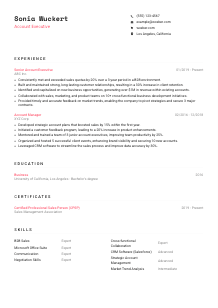
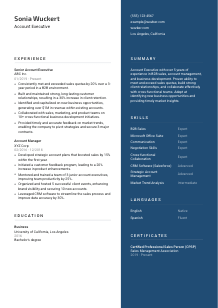
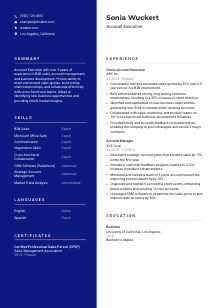
Sealing deals, but feeling account-abandoned on your resume? Check out this Account Executive resume example, created with Wozber free resume builder. Learn how to present your strategic sales talent to match the job, and launch a career trajectory as impressive as your client roster!
Account Executive hiring usually turns on one question fast: can you grow revenue while keeping customers engaged enough to expand, renew, and trust you with bigger business. A resume for this role needs to show more than activity. It needs to make your sales performance, account ownership, relationship management, and commercial judgment visible in a few lines.
When that story is tailored well, the first pass becomes much sharper. Wozber's free resume builder helps you line up your wording with the posting, keep an ATS-friendly resume format, and surface the parts of your background that matter most for account growth, quota delivery, and customer-facing credibility. That makes it easier for a hiring team to see whether you can step into a book of business and move it forward.
For an Account Executive, the header should read like a clean business card. Hiring teams want immediate access to your name, location, and professional title without digging, especially when the role involves client contact, territory coverage, or a stated local requirement.
Use your full name in the largest text on the page so it is easy to spot at a glance. Keep it simple and professional. This role is built on clarity in meetings, emails, proposals, and negotiations, and your resume should reflect that standard from the first line.
Place "Account Executive" directly under your name if that is the role you are pursuing. Matching the posted title helps with ATS alignment and immediately frames your background around quota-carrying sales, account growth, and client management rather than broader sales support work.
Include a reliable phone number and a professional email address you check often. Client-facing roles depend on responsiveness, so avoid casual handles or outdated accounts. If you include a website or LinkedIn profile, make sure it reflects your sales experience, industries served, and current achievements.
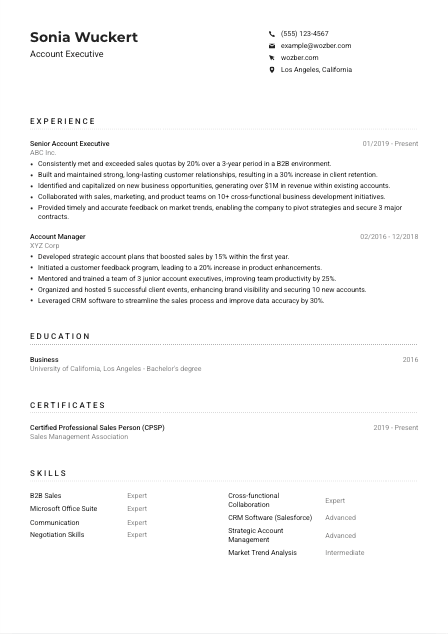
If the employer specifies a location requirement, mirror it clearly in your contact details. In this example, listing "Los Angeles, California" helps remove uncertainty about local availability. Use this only when it is true and relevant, especially for roles tied to a region, territory, or in-person client coverage.
A polished LinkedIn profile can reinforce your resume with account portfolio context, client industries, recommendations, or sales awards. Keep the dates, titles, and performance claims consistent. If you have a personal site, use it only when it adds real value such as case studies, speaking appearances, or thought leadership tied to sales or customer growth.
Your header should answer the basics immediately: who you are, what role you do, how to reach you, and whether any stated location requirement is already covered. That keeps the focus on your sales record instead of avoidable questions.




This is the section hiring teams study most closely for Account Executive roles. They want to see how you handled accounts, what commercial goals you owned, how you worked across teams, and what came from your efforts in revenue, retention, expansion, or pipeline progression.
Start by identifying the work the employer cares about most, then map your experience to it. For an Account Executive, that usually includes hitting quota, growing existing accounts, building long-term customer relationships, using CRM tools, and sharing market feedback with leadership. Use those priorities to choose which bullets stay, which get rewritten, and which should be cut.
List your positions in reverse chronological order and make the progression easy to follow. Hiring teams want to see whether you moved from account support or account management into fuller revenue ownership. Titles such as Account Manager and Senior Account Executive work well when the bullets make clear how your responsibilities expanded across deal size, account scope, or business development activity.
Replace generic duties with outcomes tied to selling and account growth. Good Account Executive bullets show what you changed, improved, won, retained, or expanded. The sample resume does this well with points like exceeding sales quotas by 20 percent, increasing client retention by 30 percent, and generating more than $1M within existing accounts. Those are the kinds of results that carry weight in sales hiring.
Use numbers that belong naturally to the role: quota attainment, revenue growth, retention rate, account expansion, renewal value, deal volume, pipeline growth, average contract value, or conversion improvement. Metrics make your scope easier to understand. A line about "supporting client relationships" is forgettable. A line about securing 10 new accounts or lifting sales 15 percent gives a hiring manager something concrete to compare.
Prioritize experience that reflects the employer's business model and workflow. In this description, B2B sales, CRM use, cross-functional work with marketing and product, and reporting on market trends all matter. If you have that experience, name it directly in your bullets. Mentioning that you collaborated on business development initiatives or used Salesforce to improve data accuracy is much stronger than leaving those details implied.
Your work history should make one thing obvious: you have managed customer relationships with commercial intent and delivered measurable sales outcomes. If a reader can quickly see quota performance, account growth, and collaboration across the revenue team, this section is doing its job.
Education matters most here as a qualification check. Once experience proves you can sell, the degree section should confirm that you meet the baseline requirement without taking attention away from your performance history.
If a posting asks for a bachelor's degree in Business, Marketing, or a related field, list your degree in clear terms. That direct match helps both ATS parsing and recruiter review. In the example, a Bachelor's degree in Business lines up neatly with the stated requirement.
Include the degree, field of study, school name, and graduation year if appropriate. Keep the formatting straightforward so the information is easy to scan. This section should confirm qualifications quickly, especially when recruiters are reviewing several quota-carrying candidates in one sitting.
If your degree relates directly to sales, marketing, business, communications, or another commercial discipline, state the field clearly. That matters more than decorative details. The closer the academic background is to customer-facing business work, the less explanation a hiring manager needs.
Early-career candidates can include relevant coursework, sales projects, case competitions, or leadership roles if professional experience is still limited. For experienced Account Executives, these details usually matter less unless they connect directly to a target industry, channel strategy, or business development focus.
Honors, scholarships, or notable business-related projects can strengthen the section when they show leadership, analysis, or communication skill. Keep them concise. Once you have several years of B2B sales experience, education should support the story, not compete with your revenue results.
This section should quickly confirm that you meet the posted degree requirement and have a credible academic foundation for client-facing business work. Then it should get out of the way and let your sales record lead.
Certifications are not mandatory for every Account Executive role, but the right one can reinforce expertise in selling, account strategy, or the tools used to manage a pipeline. They work best when they support your actual day-to-day sales practice.
If the posting does not require a certification, treat this section as a strategic extra. Prioritize credentials tied to sales methodology, CRM platforms, customer success, negotiation, or account management. The CPSP listed in the example adds useful sales credibility because it supports the role's consultative and performance-driven nature.
Do not crowd the section with unrelated short courses. A small number of relevant certifications is more persuasive than a long list with weak connection to revenue work. Each item should strengthen your case for managing accounts, advancing deals, or communicating with customers more effectively.
List the award or active dates so employers can see whether the credential is current. This matters most for certifications tied to evolving sales tools, CRM systems, or professional training frameworks. Recent dates also show continued engagement with the craft of selling.
Sales environments shift with product changes, buying behavior, and market pressure. Ongoing training in negotiation, pipeline management, account planning, or platforms like Salesforce can help show that you keep your methods current and practical, not static.
A focused certification section can strengthen your profile when it supports the way you sell, manage accounts, or use revenue tools. Keep it relevant, current, and clearly connected to the work you want.
The skills section should mirror how Account Executives are actually evaluated. That means showing a mix of sales capability, account management strength, communication range, and tool proficiency, not filling the page with generic workplace traits.
Pull out the skills the employer emphasized, then include the ones you genuinely use. In this case, that includes B2B sales, CRM software, negotiation, communication, account planning, relationship management, and cross-functional collaboration. Matching this language helps ATS performance and keeps your resume relevant to the role.
Lead with capabilities that shape how you win and grow accounts. For Account Executives, that often means strategic account management, business development, forecasting, CRM hygiene, proposal coordination, and stakeholder communication. Keep the list readable and avoid padding it with broad terms that do not tell a hiring manager how you operate.
Show both the systems you work in and the interpersonal skills that drive deals forward. A strong mix might include Salesforce or another CRM, Microsoft Office Suite, pipeline management, market analysis, negotiation, and presentation skills. The sample resume handles this well by combining CRM software and market trend analysis with communication and collaboration strengths.
This section should quickly show that you can manage the sales process, communicate well with customers and internal teams, and work inside the tools that keep revenue operations running. Relevance matters more than length.
Language skills matter in Account Executive roles when they affect customer coverage, relationship building, or internal communication. Even when only one language is required, being precise here helps remove doubt about your ability to work with clients and stakeholders smoothly.
If the job calls for high English proficiency, list English clearly with an honest proficiency level. This is a direct requirement in the example posting, so it deserves a visible place. For client-facing sales work, language ability affects calls, presentations, follow-up emails, and negotiation accuracy.
After the required language, list any others that could support the territory, customer base, or market. For some Account Executive roles, an additional language can help with relationship-building in multilingual regions or international accounts. Put the most commercially relevant language first rather than listing them randomly.
Use clear labels such as Native, Fluent, Advanced, or Conversational. Avoid overstating your ability. In sales, weak language claims become obvious quickly during discovery calls, demos, or account reviews, so accuracy protects your credibility.
If you speak more than one language well, include it when it could expand account coverage or strengthen customer rapport. The sample resume's English and Spanish combination could be useful in many client-facing markets, but only include additional languages when they are real assets, not resume decoration.
The value of multilingual ability depends on the customers, region, and product. For local or national B2B roles, English may be enough. For accounts with broader geographic reach, another language can support relationship depth and business development. Present it as a business advantage when that connection is real.
This section should answer a simple question quickly: can you communicate with the customers and teams this role involves. If additional languages strengthen your coverage, make that benefit easy to see.
An Account Executive summary should read like the opening of a strong sales conversation. In a few lines, it needs to establish your level, the kind of accounts or sales environment you know, and the outcomes you consistently deliver.
Before writing, identify what the employer needs from the hire right away. Here, that includes B2B account management, quota performance, account growth, relationship building, and collaboration with sales, marketing, and product teams. Your summary should echo that commercial reality, not just restate your title.
Begin with a concise line that places you in the market clearly, such as your years in B2B sales or account management and the type of work you handle. This helps readers understand whether you are coming from quota-carrying account executive work, account management, or a broader sales background.
Choose achievements or strengths that match the target role most closely. Quota attainment, retention gains, expansion revenue, strategic account planning, or CRM-led sales discipline all work well here. The sample summary is effective because it pairs years of experience with outcomes like exceeding sales quotas and identifying new business opportunities.
Aim for a short paragraph with no wasted lines. Skip vague descriptors and focus on what you sell, how you manage accounts, and what results tend to follow. A hiring manager should finish the summary with a clear sense of your sales range and customer-facing credibility.
By the end of the summary, a reader should already understand your sales environment, your account management strength, and the kind of revenue impact you are likely to bring. That gives the rest of the resume a clear commercial frame.
A polished Account Executive resume should show where you have owned growth, how you have managed customer relationships, and what business results followed. When those points are tailored to the posting, the document reads less like a general sales profile and more like a candidate ready to handle the employer's accounts, targets, and market realities.
Use Wozber's free resume builder to shape that story in an ATS-compliant resume, refine your wording with role-specific terminology, and present it in an ATS-friendly resume template that keeps your sales record easy to scan. The finished resume should make one conclusion easy to reach: you can build revenue and manage accounts with confidence.




