




Use Wozber and land your dream job
Create Resume
No registration required
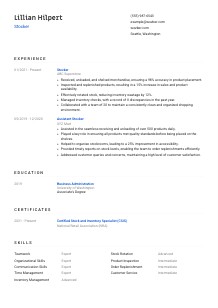
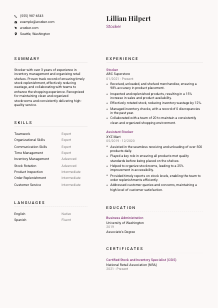
Restocking the shelves, but your resume looks empty? Fill it up with this Stocker resume example, created with Wozber free resume builder. It shows how to stack up your stocking skills to match job requirements, making your career profile just as robust as the inventory you manage!
Stocking work looks simple on paper, but stores depend on it to keep shelves full, back rooms usable, and product rotation under control. A stocker resume needs to show that you can handle the physical pace of the job while staying organized enough to receive freight, shelve items correctly, and catch inventory issues before they become lost sales or waste.
When that information is tailored well, hiring teams can quickly separate general retail help from someone who already understands replenishment, stock checks, and floor readiness. Wozber's free resume builder helps you build an ATS-compliant resume that mirrors the language of the posting without sounding forced, so your background reads clearly for both screening systems and store managers reviewing whether you can keep product moving accurately.
This section is brief, but it still does real work. For stocking jobs, the header should immediately confirm who you are, how to reach you, and whether you meet practical requirements such as location and professional communication.
Place your name at the top in a clean, readable format. Store managers often scan resumes quickly, so your header should be easy to identify at a glance without decorative styling or clutter.
Add "Stocker" beneath your name when that is the role you are pursuing. This helps frame the rest of the resume around stocking, replenishment, and inventory support rather than broader retail work.
Include a reliable phone number and a professional email address. For retail hiring, quick callbacks matter, and basic details that are hard to read or look unprofessional can create unnecessary friction.
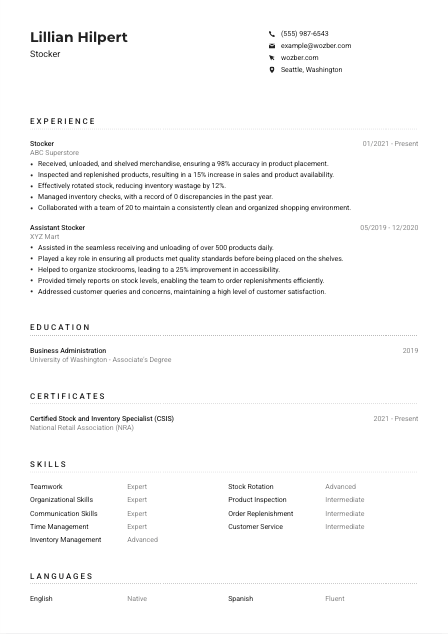
If the posting requires you to be in a certain area, show that plainly in your location line. Here, listing "Seattle, Washington" immediately answers a practical requirement from the job description and removes doubt about availability.
A LinkedIn profile or personal website is optional, but include it if it supports your retail background and matches the resume. Only add links that reinforce your work history, reliability, or related experience.
Your personal details should remove basic questions right away. Clear contact information and a matching location let the reader move straight to your stocking experience, availability, and fit for the store environment.




For a stocker, experience is where hiring managers look for proof of pace, accuracy, and consistency. They want to see that you have handled freight, kept shelves replenished, supported inventory counts, and worked well with the rest of the store team during busy shifts.
Start by identifying the work the store needs done every day. In this posting, that includes receiving and shelving merchandise, replenishing the sales floor, rotating stock for freshness, helping with stock checks, and maintaining an orderly shopping environment. Those duties should shape which bullets you lead with.
Begin with your most recent role and include the job title, employer, and dates for each position. That format helps the reader follow your progression from related support work, such as assistant stocking, into full responsibility for shelf organization, stock movement, and inventory tasks.
Focus each bullet on a stocking task and the result it produced. A line such as "Received, unloaded, and shelved merchandise, ensuring a 98% accuracy in product placement" works because it ties a routine responsibility to a measurable standard stores actually care about.
Quantify your work where the numbers are meaningful. Product placement accuracy, daily item volume, sales-floor availability, waste reduction, discrepancy rates, and stockroom accessibility all make sense in this field. The sample resume does this well with metrics such as a 15% increase in availability-driven sales and 0 inventory discrepancies over a year.
If you have retail experience that is not all stocking-focused, put the most relevant duties first. Shelf replenishment, FIFO rotation, unloading deliveries, stock checks, and teamwork on store upkeep should take priority over more general customer-facing tasks.
Your experience section should make daily store execution easy to picture. By the end of it, the reader should understand that you can move product efficiently, keep shelves in order, and support accurate inventory handling without constant supervision.
Most stocker roles are hired more heavily on reliability, work ethic, and relevant retail experience than on formal education. Still, the education section can add useful context, especially if your coursework, degree, or training supports organization, operations, or business basics.
If the job posting does not require a specific degree, include the education that strengthens your overall profile without overselling it. An Associate's Degree in Business Administration, for example, can support your understanding of retail operations, inventory flow, and store processes, even though it is not the main hiring factor.
List your degree, field of study, school, and graduation year in a straightforward way. Hiring teams should be able to scan this section quickly and return to the parts of the resume that show stocking performance.
If you completed a diploma, certificate, or degree, name it clearly. For entry-level candidates, this can help show consistency and follow-through, especially when direct stocking experience is still limited.
Relevant classes can be useful early in your career, particularly if they relate to logistics, business operations, supply chain basics, or inventory control. Skip course lists if you already have enough hands-on retail experience to carry the resume.
Include honors, leadership roles, or extracurricular activities only if they reinforce traits that matter in store work, such as dependability, teamwork, or sustained responsibility. Keep this section concise so it supports rather than competes with your experience.
Education can strengthen your profile, but for a stocker resume it should stay secondary to proof of shelf work, inventory handling, and dependable execution on the floor.
Certifications are not required for every stocking role, yet they can add useful depth when they relate to inventory control, warehouse processes, safety, or retail operations. They are most helpful when they reinforce the kind of work the employer already asked for.
Review the job description for clues about specialized knowledge. Here, familiarity with inventory management systems is listed as a plus, so a certification tied to stock or inventory work can strengthen that part of your profile.
Lead with certifications that connect directly to receiving, stock control, inventory procedures, or retail operations. A credential such as Certified Stock and Inventory Specialist fits naturally because it supports the day-to-day tasks of stock rotation, discrepancy reporting, and organized replenishment.
Add the issue date or active date range when it helps show that your training is current. Recent certification can be especially useful if you are trying to show up-to-date knowledge of inventory practices or store systems.
Retail environments change with new systems, processes, and safety expectations. Updating your certifications over time shows that you are keeping pace with inventory tools and store operations, which can matter if you want to move into lead stock, inventory, or back-room coordination roles.
Certifications carry weight when they connect to the job's real demands. On a stocker resume, the best ones support organized receiving, accurate inventory handling, and steady execution on the sales floor.
The best stocker skills sections feel close to the actual shift. That means emphasizing organization, speed, physical reliability, inventory awareness, and teamwork rather than filling the section with broad retail buzzwords.
Start with the abilities the employer named or clearly implied. In this description, that includes organization, time management, communication, teamwork, inventory familiarity, English proficiency, and the physical ability to lift heavy items and stay on your feet for long periods.
Select skills that you can support elsewhere in the resume. Teamwork and organizational skills make sense when your experience shows collaboration on store cleanliness, product placement accuracy, or stockroom order. Inventory management and stock rotation become stronger when paired with bullets about discrepancy control or reduced waste.
Put the most job-specific skills near the top. For a stocker, that usually means stock replenishment, inventory management, organization, time management, product inspection, and teamwork before more general skills. The section should read like a quick summary of how you handle stock movement and floor maintenance.
Every skill listed should connect to a visible task or result somewhere else on the page. That connection makes your stocking profile feel credible, practical, and ready for the demands of the role.
Language ability matters in retail because stockers still communicate with supervisors, teammates, delivery staff, and sometimes customers. If the posting mentions English proficiency, your languages section should address that requirement clearly and without overcomplication.
When a job calls for good English proficiency, list English first and state your level clearly. That removes uncertainty about whether you can follow instructions, report stock issues, and coordinate with the team during receiving or replenishment tasks.
Order languages by relevance to the job. For this role, English belongs at the top because it is explicitly required and central to day-to-day communication in the store.
If you speak other languages, add them. In retail settings, another language can help with team coordination or brief customer interactions, even when the role is primarily focused on stocking and inventory support.
Use honest levels such as Native, Fluent, Advanced, or Intermediate. Clear language ratings help the employer understand how comfortably you can communicate in a fast-moving retail environment.
Treat language skills as an operational advantage, not decoration. In a diverse store environment, being able to communicate with more coworkers or customers can support smoother shifts and faster issue resolution, but it should remain secondary to your stocking ability.
Your languages section should confirm that you can communicate effectively in the store and, where relevant, add extra value in a multilingual team or customer setting.
The summary is often the first substantial section a hiring manager reads. For a stocker, it should quickly establish your experience level, your reliability in fast-paced retail work, and the specific results you have delivered in stocking, replenishment, and inventory support.
Open with your professional identity and level of experience. Terms such as stocker, retail stock associate, or inventory support associate work well when they accurately reflect your background and set up the rest of the summary.
State how long you have worked in stocking or similar retail roles, then point to the kind of work you handle well. Receiving merchandise, maintaining shelf availability, organizing stockrooms, and supporting inventory accuracy are stronger than vague claims about being hardworking.
Add one or two achievements or strengths that line up with the posting. The sample summary does this effectively by highlighting timely stock replenishment, reduced wastage, and team collaboration to improve the shopping environment.
Aim for a short paragraph that a manager can read in seconds. Cut generic enthusiasm and focus on the parts of your background that show you can keep product organized, available, and correctly handled throughout the shift.
A hiring manager should finish your summary with a clear picture of your experience, your reliability around stock handling, and your ability to support a well-run sales floor from day one.
A tailored stocker resume should show more than willingness to work hard. It should show that you can receive freight, replenish shelves, rotate stock correctly, support inventory checks, and keep the store floor and back room organized under daily pressure.
Wozber's free resume builder can help you shape that experience into an ATS-friendly resume template, align your wording with the posting, and use ATS optimization tools to surface missing requirements before you apply. When the final resume reads clearly, both the scanner and the hiring manager can quickly see that you are ready to keep product moving accurately and efficiently.




