




Use Wozber and land your dream job
Create Resume
No registration required
Closing deals, but your resume isn't signing leases? Browse this Real Estate Salesperson resume example, created with Wozber free resume builder. Learn how to match your property-pushing prowess with job expectations, guiding your career to top-market success!
Real estate sales resumes are read through a practical lens. Hiring teams want to see whether you can win listings, move buyers through showings and offers, and keep a pipeline active with steady follow-up. Broad claims about being a "people person" are easy to ignore. Specific proof such as transaction volume, offer acceptance rates, referral growth, or faster close timelines carries much more weight.
The first pass often depends on how quickly your resume connects your background to the brokerage's market, client mix, and workflow. Wozber's free resume builder helps you tailor that language into an ATS-compliant resume, so terms like property showings, CRM follow-up, listing marketing, and negotiation appear where screening systems and hiring managers expect them. That makes it easier to see whether you can step into active client work without a long ramp-up.
This section does more than identify you. In real estate hiring, it quickly confirms whether you are licensed, reachable, and local enough to work the market the role serves. Keep it clean, direct, and aligned with the practical filters in the job ad.
Use your full name in a slightly larger font so it is easy to spot at the top of the page. In a client-facing field built on reputation and referrals, your name should read clearly and professionally from the first glance.
Place "Real Estate Salesperson" directly under your name if that matches the role you are pursuing. This helps connect your resume to the posting immediately, especially when the employer is screening for licensed sales professionals rather than adjacent titles such as leasing agent or property manager.
List a reliable phone number and a professional email address. If you have a website, LinkedIn profile, or portfolio with listings sold, neighborhoods served, testimonials, or market activity, include it only if it strengthens your case and is current.
When a posting specifies a market, reflect that clearly in your location line. Here, Los Angeles, California matters because the employer asked for candidates based there. You usually do not need a full street address. City and state are enough to show local presence.
A digital presence can help in real estate when it shows real business activity, such as listing promotion, client reviews, or local market knowledge. Skip personal profiles or anything that does not support your ability to attract clients, market properties, or manage transactions.
Your header should answer the basic operational questions right away: who you are, how to reach you, what role you do, and whether you match the location requirement. Once those details are settled, the rest of the resume can focus on your sales record.




This is the section most likely to drive an interview in real estate sales. Employers look for proof that you can build relationships, market listings, run showings, negotiate offers, and keep momentum from lead to close. Write your experience like a record of business performance, not a task list.
Start by marking the experience requirements and repeated responsibilities in the posting. For this role, that includes at least 2 years in residential or commercial real estate sales, strong negotiation and communication, client relationship building, CRM use, and market awareness. Those points should shape which jobs and bullet examples you lead with.
Show your most recent role first, then work backward. Include your title, brokerage or company name, and employment dates. That layout helps hiring teams quickly understand your progression from agent-level work to a fuller sales book, and it also supports ATS parsing without confusion.
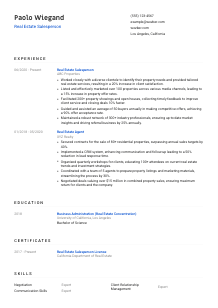
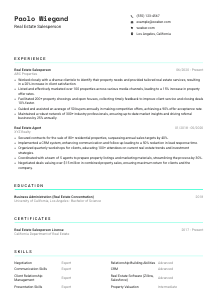
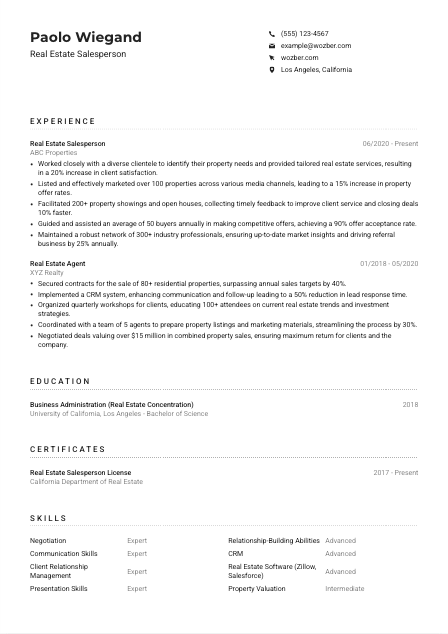
Each bullet should connect an action to an outcome. Instead of saying you "worked with buyers and sellers," show what that produced. The sample resume does this well by tying client needs analysis to a 20% increase in satisfaction, property marketing to a 15% increase in offer rates, and buyer guidance to a 90% offer acceptance rate. Those numbers tell a brokerage how you operate in the field.
Quantify with numbers that matter in this profession: properties listed, annual buyers served, showings hosted, close rate, offer acceptance rate, sales volume, referral growth, lead response time, or speed to close. The example's 200+ showings, $15 million in negotiated sales, and 50% reduction in lead response time are strong because they reflect actual sales workflow and client management performance.
Keep the emphasis on work that proves you can generate and convert business. If you have broad sales or service experience, keep only the parts that map to prospecting, client advising, negotiations, market knowledge, listing promotion, or transaction support. Every bullet should strengthen your case for handling active real estate clients and deals.
After reading your experience section, a brokerage should understand your market exposure, how you manage buyers and sellers, and what kind of results you produce. If those points are clear, your resume is doing the heavy lifting it needs to do.
Education usually plays a supporting role in real estate sales hiring, but it still adds context. It can show business grounding, local market familiarity, or relevant training in finance, marketing, contracts, or real estate operations. Present it simply and let it reinforce the story told by your sales experience.
If you have a degree connected to business, real estate, finance, marketing, or communications, list it clearly. In the example, a Business Administration degree with a real estate concentration adds useful context because it supports work in property sales, client strategy, and market analysis.
Include degree, field of study, school, and graduation year. That is usually all you need. A straightforward format makes it easy for recruiters and ATS tools to read without distracting from your transaction history and sales metrics.
Most Real Estate Salesperson openings will care more about licensing and sales record than about academic detail. Still, if your education supports the type of properties or clients you serve, keep that connection visible. For example, coursework in real estate, business law, or marketing can strengthen your positioning, especially earlier in your career.
Relevant coursework is most helpful when you have limited field experience or you are moving into a different segment, such as from leasing into residential or commercial sales. In that case, classes in property valuation, contracts, real estate finance, or digital marketing can add useful context.
Honors, student organizations, or academic projects can stay if they directly support your real estate story. Otherwise, keep this section compact. Once you have several years of production, hiring teams will care far more about listings, deals, and client outcomes than campus involvement.
Your education section should support your professionalism without competing with your sales record. Keep it brief, relevant, and easy to scan.
Credentials carry real weight in this field because they affect whether you can legally work the role and how quickly you can start producing. The right license should be easy to find, current, and written exactly enough to match the posting.
When a job asks for a valid Real Estate Salesperson license, place that credential prominently in this section. For the example role, the California license is essential, not optional. If you are licensed in more than one state, list the one tied to the target market first.
After the required license, include only certifications that strengthen your work as a salesperson. Training in negotiation, real estate marketing, luxury sales, fair housing, contracts, or CRM-driven lead management can all help if they are relevant to the jobs you are targeting.
Include the issuer and date, and make the status clear if the credential is active. Real estate is regulated work, so employers want to know your license is current and usable. The example's "2017 - Present" format does that cleanly.
Continuing education matters because market regulations, disclosure requirements, digital marketing practices, and transaction tools change over time. Updating this section shows that you stay current with the business side of selling property, not just the relationship side.
A brokerage should be able to confirm your legal qualification and your commitment to staying current in the industry within a few seconds. Put the required license first and keep the rest tightly relevant.
The best skills sections in real estate are specific enough to support the rest of the resume. They should reflect how you win business, manage clients, market listings, and keep transactions moving, not just repeat generic traits that could apply to any sales role.
Review the job ad for patterns. Here, negotiation, written and verbal communication, relationship building, CRM use, and real estate software proficiency are all explicit priorities. Those are the skills to mirror if they match your actual background.
Lead with the capabilities that affect production and client management. For this role, that likely means negotiation, client relationship management, communication, property marketing, CRM workflows, and local market knowledge before broader traits. The sample also includes property valuation and marketing strategy, which strengthen the profile because they connect to listing quality and pricing conversations.
Group skills in a way that makes sense, such as sales skills, client-facing skills, and tools. Avoid padding the section with every soft skill you can name. A concise list that matches your experience bullets is far more convincing than a long one full of unsupported claims.
Your skills section should echo the abilities already proven in your work history. If someone reads both sections together, they should see a clear match between what you claim and what you have actually done in the market.
Language ability matters in real estate because trust, negotiation, showings, and follow-up all depend on clear communication. In markets with diverse buyers and sellers, an additional language can also expand the client communities you can serve effectively.
If the posting requires English, list it first with an accurate proficiency level. That confirms you can handle client conversations, listing materials, contracts, and ongoing communication without ambiguity.
Additional languages can be a real advantage when they help you work with local communities, referral partners, or international buyers. In the example, Spanish is a valuable addition because it can support client communication in a large and diverse market, though it is an advantage rather than a universal requirement.
List a language if you can genuinely use it in meetings, phone calls, tours, negotiations, or written follow-up. Real estate communication is practical and high stakes, so this section should reflect usable proficiency, not casual familiarity.
Stick to straightforward levels such as Native, Fluent, Intermediate, or Basic. These are easy to understand and help employers judge whether you can manage client-facing work in that language.
In some regions, multilingual ability can directly support lead generation and client trust. If a language helps you serve a neighborhood, investor group, or buyer segment more effectively, it is worth highlighting because it ties directly to business development and client service.
List language skills as a business asset, not as filler. The right language line can show that you are prepared to communicate with the clients and communities your target market actually includes.
Your summary should read like a concise market introduction, not a generic self-description. In a few lines, show your level of experience, the kind of real estate work you handle, and the results or strengths that make you useful from day one.
Use the posting to identify what belongs in your first few lines. For this job, that means real estate sales experience, client advising, negotiation, communication, property marketing, CRM use, and market awareness. Work those ideas in naturally, using the employer's language where it matches your background.
Start with a direct line such as "Real Estate Salesperson with 5+ years of experience in residential sales" or the version that best fits your background. This quickly tells the reader your level and specialism without making them search through the rest of the page.
Choose two or three strengths that are supported elsewhere in the resume. The example summary works because it points to client relationships, market trends, listing and marketing work, and efficient closings. You can make yours even stronger by weaving in metrics or scope if space allows, such as annual buyers served or sales volume handled.
Aim for three to five lines. Skip broad statements about passion or hard work unless they are tied to actual business outcomes. A brokerage should finish this section knowing what kind of clients you serve, how you work, and why your background fits the role they need to fill.
By the time someone finishes your summary, they should already have a clear picture of your market experience and client-facing value. Then the rest of the resume can prove it with numbers, deals, and credentials.
A Real Estate Salesperson resume works when it makes your production, client management, and market credibility easy to read. Focus on the things brokerages actually hire for: licensing, transaction-related experience, negotiation strength, listing and marketing activity, CRM discipline, and measurable sales results.
Use Wozber's free resume builder to shape that information into an ATS-friendly resume template, then refine it with targeted wording and ATS optimization so your background matches the language of each opening. The final result should make one thing clear right away: you are ready to manage clients, move deals forward, and contribute in the market you are applying to.




