



Use Wozber and land your dream job
Create Resume
No registration required
Sealing property deals, but your resume isn't landing offers? Check out this Real Estate Agent resume example, created with Wozber free resume builder. Learn how to present your negotiation prowess and market knowledge to match job specifications, paving the way for a career as standout as the homes you represent!
Real estate hiring moves quickly because the work itself does. Employers want agents who can read market shifts, manage client expectations, handle negotiations cleanly, and keep every transaction inside licensing and fair housing rules. Resumes fall short when they stay at the level of "people skills" and sales enthusiasm instead of showing deal volume, market judgment, compliance awareness, and the kind of client work that actually drives closings.
A tailored resume changes the first read by making your transaction work and local market value visible right away. With Wozber's free resume builder and an ATS-friendly resume format, you can align your wording with the posting's priorities, from pricing guidance and property matching to offer preparation and regulatory compliance, so hiring teams can quickly see how you would perform in active client pipelines.
Real estate is local, licensed, and relationship-driven, so the header needs to confirm practical basics fast. For this kind of role, your personal details should immediately show who you are, what you do, and whether you are positioned to work in the market named in the posting.
Use your full name in a larger, clean font at the top of the page. In real estate, your name often becomes part of your professional brand across listings, client referrals, and broker networks, so it should be easy to find at a glance. An ATS-friendly resume template from Wozber helps keep that header readable in both human and ATS scans.
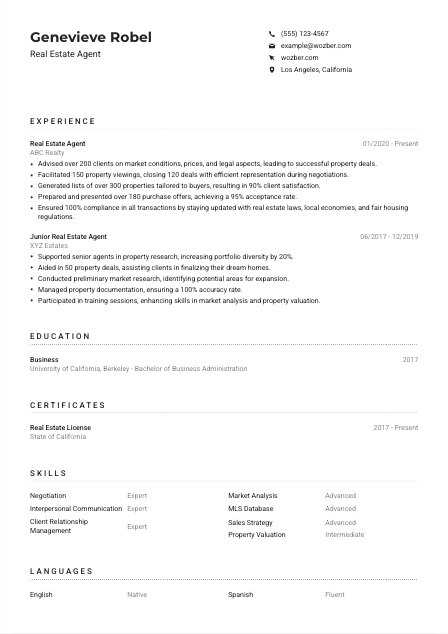
Place "Real Estate Agent" directly under your name if that matches your license and recent work. This keeps your resume aligned with the role immediately, especially when employers are sorting applicants across related titles such as Realtor, sales agent, leasing agent, or junior agent. Precision matters when the posting is clearly hiring for client-facing sales and negotiation work.
Include one phone number and a professional email address you check regularly. Real estate hiring can move as fast as a showing request or offer response, so slow follow-up caused by outdated contact details is an avoidable mistake. If you include a website or profile link, make sure it shows relevant listings, market activity, testimonials, or professional background that matches the resume.
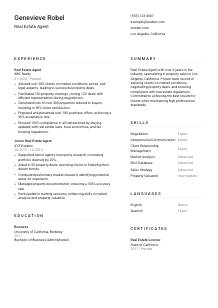
If a job requires you to be based in a specific market, include your city and state. In the example, listing Los Angeles, California works because the employer explicitly wants someone located there. Keep this practical rather than decorative. It tells the reader you can work the local territory, understand neighborhood pricing, and attend viewings, client meetings, and negotiations without relocation questions getting in the way.
A website, LinkedIn profile, or agent page can strengthen your application when it reflects real sales activity, property specialties, or market presence. For a real estate role, that might include transaction history, neighborhoods served, certifications, or client-facing content. Leave it off if it is outdated or inconsistent with your resume.
This section should confirm the essentials in seconds: your professional identity, your availability, and your connection to the target market. When those details are clean and aligned, the rest of the resume can focus on your results in the field.




For real estate agents, experience is where hiring teams look for signs of production, market judgment, and transaction control. They want to see what kinds of clients you advised, how you handled listings or buyer searches, how often your negotiations converted, and whether you worked with the legal and compliance discipline the role demands.
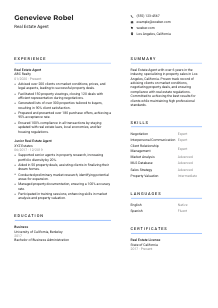
Start by identifying the work the employer actually needs covered. In this case, that includes advising clients on market conditions and legal requirements, facilitating property viewings, matching buyers to suitable properties, preparing offers, and staying current on fair housing and local regulations. Use those themes to decide which parts of your background belong in the top half of the section. The example resume does this well by leading with client advising, viewings, offers, and compliance rather than generic sales activity.
List your most recent real estate position first, then work backward. Keep each entry easy to scan with employer name, job title, and dates. If you moved from a junior agent role into a full Real Estate Agent position, show that progression clearly. In this profession, advancement often reflects stronger client ownership, larger transaction volume, deeper market knowledge, or greater responsibility during negotiations.
Numbers carry real weight here because the job is measured through activity and outcomes. Include metrics that naturally belong to real estate work, such as number of clients advised, property viewings conducted, deals closed, offers submitted, acceptance rates, portfolio size, satisfaction scores, or compliance accuracy. The sample bullets are effective because they connect volume with outcome, such as 150 viewings leading to 120 deals, or 180 offers with a 95% acceptance rate.
Focus your bullets on the parts of your work that mirror the target role. Advising buyers and sellers, pricing properties, preparing offers, coordinating showings, negotiating terms, researching neighborhoods, using MLS data, and keeping documentation compliant all belong here. A vague bullet like "helped clients with real estate needs" says very little. A specific bullet about matching buyers to properties within budget and closing within target timelines says far more.
Real estate changes with inventory, rates, local demand, and regulation, so employers value agents who keep adjusting. Mention training, market research, fair housing updates, continuing education, or process improvements when they support your client work. The junior agent example adds value because it mentions market research and training tied to expansion, valuation, and documentation accuracy. That tells the reader the candidate is building judgment, not just logging time.
Your experience section should show that you can manage the real work of the role: advising, showing, negotiating, preparing offers, and closing compliantly. Wozber's free resume builder helps organize that record in an ATS-compliant resume format so your production history and client-facing scope are easy to read.
Education matters in real estate when it strengthens your commercial judgment, communication, and understanding of how property transactions work. Even in sales-driven environments, a relevant degree can support your case by showing business grounding, analytical ability, and familiarity with legal or financial concepts that surface in client advising.
If the posting asks for a bachelor's degree in Business, Real Estate, or a related field, make that easy to find. List the degree, school, and graduation year in a clean format. When your degree directly aligns, as a Business degree does in the example, it immediately checks an important box without forcing the reader to hunt for it.
Use a straightforward structure: degree, field, school, and date. This section does not need dense explanation unless you are early in your career or your coursework is especially relevant. Hiring teams reviewing real estate resumes are usually scanning for qualification match and overall professionalism, not long academic descriptions.
A relevant degree can reinforce parts of the role that go beyond selling. Business, finance, economics, real estate, or related studies support the pricing, negotiation, client advising, and market analysis expected from an agent. If your degree is adjacent rather than exact, keep the presentation factual and let your experience connect the dots.
Most experienced agents do not need a long list of classes. Still, if you have coursework in property law, real estate finance, valuation, contract law, urban economics, or market analysis, it can be worth mentioning when the posting leans heavily on advising clients or understanding legal requirements. Use this selectively so the section stays focused.
Continuing education matters in a licensed field. If you have completed professional development related to fair housing, local regulations, ethics, negotiation, or market analysis, you can mention it here or in certifications, depending on how formal it is. This helps show that your knowledge is current, which is especially important when laws and local practices shift.
This section does not need to be long, but it should support the kind of work the role requires. A relevant degree adds context for your client advice, market analysis, and transaction judgment, especially when paired with strong sales experience.
In real estate, certifications are not just nice additions. Your license is core to the job, and any related credentials should strengthen confidence in your legal eligibility, market knowledge, or client service capabilities.
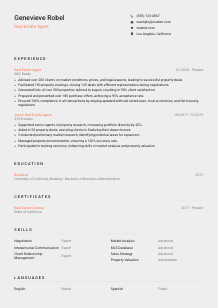
If the role requires an active license in the state of practice, list it first and make the issuing body clear. For the example, "Real Estate License" issued by the State of California directly matches the posting's requirement. This is one of the first things a brokerage or hiring manager will look for because it determines whether you can step into transactions without delay.
After the required license, include certifications that strengthen your profile as a practicing agent. Useful additions might include negotiation training, fair housing, ethics, contract handling, luxury property specialization, buyer representation, or commercial real estate coursework, depending on your market and specialty. Skip unrelated certificates that do not support client representation or deal execution.
Use dates or validity ranges when they help confirm that a credential is current. A license listed as "2017 - Present" signals continuity and active professional standing. In licensed sales roles, those details matter because expired or unclear credentials create immediate questions.
Real estate regulations, disclosures, and fair housing expectations change, and good agents keep up. If you renew credentials regularly or add training that reflects current market practice, include it. That tells employers you are staying sharp on the rules and workflows that affect live transactions.
Your license should answer the first practical question: can you legally represent clients in this market? Once that is clear, the rest of the section can show how seriously you take professional standards and ongoing development.
The skills section works best when it reads like the operating toolkit of a productive real estate agent. Employers expect a mix of sales ability, market judgment, client communication, and transaction discipline, not a long list of generic strengths.
Start with the capabilities the employer names or clearly implies. In this posting, negotiation, understanding market price trends, interpersonal communication, written English, and knowledge of legal requirements all belong near the top. Mirroring that language improves ATS optimization and makes the resume feel grounded in the actual role rather than a generic sales profile.
Choose skills that connect to the way agents actually work. Relevant examples include Negotiation, Market Analysis, Client Relationship Management, Property Valuation, MLS Database, Sales Strategy, Contract Preparation, and Fair Housing Compliance. The sample skill list is useful because it stays close to day-to-day agency work instead of drifting into broad business language.
Group or order skills so the most relevant ones are easy to spot first. A hiring manager should be able to scan this section and immediately understand your strengths in client handling, pricing insight, and deal execution. Wozber can help structure the section in an ATS-friendly resume format so those keywords are readable for both screening software and human reviewers.
Every skill here should connect to a real part of the work, whether that is analyzing price trends, building buyer lists, handling offers, or communicating clearly with clients. If a skill would not help you win, manage, or close a transaction, it probably does not need the space.
Language ability can matter in real estate because trust, clarity, and negotiation all depend on communication. In markets with diverse buyer and seller populations, additional language skills can expand the clients you can serve and the neighborhoods where you can work effectively.
If the posting specifies strong written English, make that clear in your language section or elsewhere on the resume. Listing English as Native or Fluent is a simple way to confirm you can handle emails, offers, disclosures, and client communication professionally. That is especially relevant in a role where written accuracy affects contracts and transaction flow.
Extra languages are most valuable when they connect to the communities you serve. In a market like Los Angeles, Spanish can be a real asset for client communication and relationship building, which is why it adds value in the example resume. Use additional languages to show service range, not just personal interest.
Choose levels you can support in real client situations. If you claim fluency, you should be able to discuss listings, explain next steps, and manage negotiations at that level. Accurate ratings protect your credibility and help employers place you in the right client-facing work.
If you work in neighborhoods or client segments where another language regularly comes up, listing it can differentiate you. This is most useful when it reflects actual transaction support, community relationships, or outreach potential, not when it is added as a weak extra detail.
Ongoing language study can be worth noting when it is close to working proficiency or relevant to your client base. Keep it brief and realistic. Employers care less about casual study and more about whether you can use the language in showings, follow-up, and day-to-day communication.
Language skills are most convincing when they support real client service. List the ones you can use professionally, and let them reinforce your ability to build trust across a broader section of the market.
The summary sets the lens for everything that follows. For a real estate agent, it should quickly establish experience level, market focus, transaction strengths, and the kind of client work you handle well, without slipping into vague sales language.
Before drafting the summary, identify the two or three things the employer most needs to see early. Here, those include licensed real estate sales experience, negotiation ability, market knowledge, and confidence with legal and compliance aspects of deals. That gives you a clear filter for what belongs in the opening lines.
Start with your title, years of experience, and relevant market or specialty. The example uses "Real Estate Agent with over 6 years in the industry" and adds a Los Angeles focus, which works because the job is tied to that market. A concise opening like this immediately tells the reader whether your background is in the right lane.
After the opener, highlight the capabilities that move transactions forward. That may include advising clients on market conditions, negotiating terms, preparing offers, matching buyers to inventory, or maintaining compliance with state and fair housing rules. Keep the points specific enough that they sound rooted in actual practice.
Aim for three to five lines. That is enough space to establish your experience, your core strengths, and the value you bring to a brokerage or agency team. Wozber's free resume builder can help tighten phrasing and keep the section ATS-compliant while preserving the language that matters in real estate hiring.
A good summary tells the reader, early and plainly, what kind of agent you are, what market work you know, and how you operate with clients and transactions. When the rest of the resume supports that message, your candidacy is much easier to picture in a live pipeline.
A real estate resume should make three things easy to see: you can advise clients with confidence, you can move deals from viewing to offer to close, and you understand the legal and market realities that shape every transaction. When those points are clear across your experience, skills, license, and summary, you present yourself as someone who can contribute quickly.
Use Wozber to tighten your wording, align your resume with the job description, and present everything in an ATS-friendly resume template that keeps your qualifications easy to scan. The finished resume should leave no doubt about your ability to represent clients, negotiate effectively, and work compliantly in the market you are targeting.